
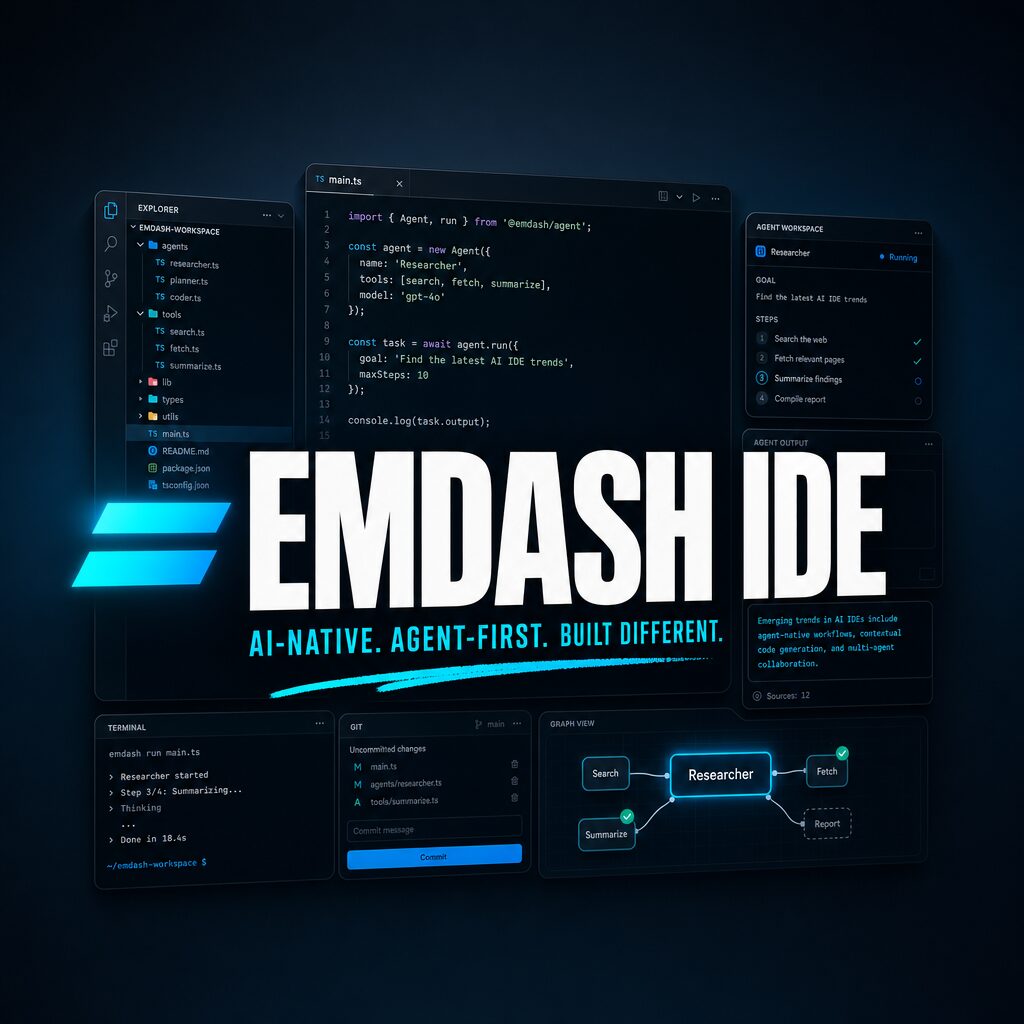


— One app. Every coding agent. Open-source.
372 upvotes · #3 Product of the Day — View on Product Hunt
Emdash launched on Product Hunt on May 20, 2026, ranking #3 with 372 votes. The app — described by its makers as an Agentic Development Environment, or ADE — lets developers run multiple coding agents simultaneously inside a single desktop interface. For engineering teams already juggling Claude Code, Codex, and Gemini in separate terminals, the timing feels deliberate.
Topics: Productivity, Open Source, Developer Tools, GitHub
Built by General Action, a Y Combinator W26 company founded in San Francisco by Arne Strickmann and Raban von Spiegel, emdash is entirely open-source under the Apache 2.0 license. It costs nothing to use, nothing to license, and runs on macOS, Windows, and Linux. The GitHub repository has crossed 2,400 stars and 60,000 downloads since its first release.
What Emdash Actually Does
The core problem emdash addresses is straightforward: AI coding agents have become capable enough that developers want to run several at once, but the tooling to manage that parallelism has not kept pace. Opening three terminal windows and manually tracking which agent modified which file is not a workflow — it is a liability.
Emdash solves this through git worktrees. When a developer assigns a task to an agent, emdash creates a separate worktree — a full copy of the working tree that shares the same .git directory but occupies its own directory on disk. Two agents can modify the same file in the same repository simultaneously without conflicting with each other’s in-progress changes. The isolation is structural, not just organizational.
Beyond worktree management, the app handles the full lifecycle of an agent-driven feature. A developer can pull a ticket directly from Linear, GitHub Issues, Jira, or Asana, assign it to an agent, monitor the session in real time, review the resulting diff, run CI checks, and merge the pull request — all without leaving emdash.


Key Features Worth Noting
- 27 supported CLI agents, including Claude Code, OpenAI Codex, Gemini, Amp, and OpenCode — auto-detected from your local machine with no manual configuration
- Best-of-N comparison: assign the same task to Claude Code and Codex simultaneously, then review both diffs side by side and ship whichever result is stronger
- Remote SSH support: keep emdash as a local control plane while agents, repositories, and long-running jobs execute on a remote server
- Conflict detection: when two open PRs touch the same files, emdash surfaces the collision via mergeability and CI signals before it becomes a problem
- MCP integration: connect external tools through the Model Context Protocol without additional glue code
- Local-first privacy: app data, sessions, and credentials are stored in local SQLite; emdash itself does not transmit code or chat history to any external server
How Emdash Compares to the Alternatives
The most relevant competitors are not niche tools. Cursor 3.0, released in April 2026, introduced an Agents Window for parallel multi-agent execution and supports up to eight simultaneous agents via Background Agents running in cloud-hosted virtual machines. Windsurf 2.0, also released in April 2026, added an Agent Command Center and parallel sessions built on git worktrees — the same mechanism emdash uses. Both are commercial products with subscription tiers starting at $20 per month.
The distinction emdash draws is provider neutrality. Cursor and Windsurf are opinionated IDEs that also happen to support agents. Emdash makes no assumptions about which editor a developer prefers, which agent provider they trust, or which model performs best on their codebase. It is a coordination layer, not a replacement for the tools developers already use. That positioning matters for teams with mixed stacks — a developer running VS Code who wants to orchestrate Claude Code and Codex simultaneously has no native option inside either IDE. Emdash fills that gap.
For teams that rely on AI tools across multiple workflows, the absence of vendor lock-in carries real operational weight. Swapping one agent provider for another requires no reconfiguration inside emdash — the app auto-detects what is installed and treats each CLI uniformly.
Pricing and the Open-Source Model
Emdash is free. The Apache 2.0 license includes an explicit patent grant, which is material for enterprise engineering teams where IP review is part of software procurement. There is no paid tier, no usage cap, and no cloud subscription. The full source code is available for audit at github.com/generalaction/emdash.
The business model is not yet defined. General Action is a seed-stage YC company, and monetization has not been announced. For individual developers and small teams, that is irrelevant — the software works today and costs nothing. For enterprise teams evaluating long-term dependencies, it is a reasonable question to track.
This dynamic is familiar in developer tooling. The open-source approach accelerates adoption and community contribution; the challenge is sustaining development once the founding team needs to convert usage into revenue. How General Action navigates that transition will determine whether emdash becomes infrastructure or a cautionary case study. The early traction — 60,000 downloads, 2,400 GitHub stars within weeks of the YC batch — suggests the demand is real.
Who Should Use Emdash
The clearest use case is an individual developer or a small engineering team that is already running AI agents heavily and wants to parallelize without switching IDEs or committing to a single provider’s ecosystem. If a developer’s current workflow involves opening three separate terminals and mentally tracking which Claude Code session is working on which branch, emdash directly replaces that friction.
Teams already invested in marketing automation software or product-led growth workflows — where engineering velocity has a direct revenue impact — are a natural fit. The Best-of-N feature alone, which lets a team run two agents on a critical feature and compare outputs before merging, is a meaningful quality control mechanism that costs nothing to implement.
Emdash is less compelling for teams that have already standardized on Cursor or Windsurf and find those tools sufficient. If parallel agent support is already baked into a team’s existing IDE subscription, the value of adding a separate orchestration layer is marginal. The same applies to teams whose work is dominated by a single agent provider — the multi-provider flexibility is the core differentiator, and it only matters if you are actually using multiple providers.
Verdict
Emdash is a well-executed solution to a problem that is genuinely new. Running multiple AI coding agents in parallel without infrastructure overhead or IDE lock-in is a workflow that did not exist two years ago and has no clean solution in most existing tools today. The git worktree architecture is technically sound, the provider support list is comprehensive, and the price is zero.
The open-source model and YC backing give it credibility that a typical early-stage developer tool lacks. Whether it can hold its position as Cursor, Windsurf, and others deepen their own parallel-agent capabilities is the more interesting question — but for developers who want a neutral orchestration layer that works today, emdash is the most effective free option on the market. Teams that track CRM software and developer tooling as part of their technology stack evaluation should add it to their shortlist now, before the commercial alternatives catch up.
Check out Emdash on Product Hunt or visit the official Emdash website to learn more.