


Google Ads pricing is one of the most misunderstood topics in digital marketing. Ask ten business owners what it costs to run paid search campaigns, and the answers will range from “a few hundred dollars” to “you need tens of thousands just to get started.” Both answers are technically true — and both are dangerously incomplete. The actual cost of Google Ads depends on your industry, your geography, your competitors, and critically, how well your campaigns are constructed. This guide cuts through the confusion with real numbers, honest assessments of what each budget tier actually delivers, and a frank conversation about when Google Ads makes sense and when it does not.
Quick Answer: Google Ads Pricing at a Glance
For readers who need numbers fast, here is the honest summary of Google Ads pricing in 2024:
- Minimum daily spend: There is technically no platform minimum, but less than $10 per day produces too few clicks to optimize meaningfully.
- Typical small business monthly budget: $1,000 to $10,000 per month, with $1,000 to $2,500 being the most common entry point for serious campaigns.
- Average cost per click (CPC) across all industries: $2.69 on the Search Network; $0.63 on the Display Network.
- Average cost per lead (CPL): $70.11 across industries, though this swings dramatically from $15 in some retail segments to $250+ in legal and financial services.
- Management fees (if using an agency): Typically 10–20% of ad spend, or a flat monthly retainer of $500 to $2,000.
- The $20/day question: $20 per day ($600/month) is enough to generate meaningful test data in moderate-competition markets. It is not enough to compete in high-CPC industries like insurance, legal, or B2B software.
The sections below unpack each of these figures in detail, explain why they vary, and show precisely what a given budget level can realistically accomplish.
Google Ads Pricing Model: How You Are Actually Charged
Understanding the Google Ads pricing model is prerequisite knowledge before any budget conversation. Google does not charge a flat rate for advertising. It operates an auction system that runs billions of times per day, and the price a business pays is the outcome of that auction — not a published menu price.
The Auction Mechanism
Every time a user types a search query, Google runs a real-time auction among all advertisers bidding on relevant keywords. The winner of that auction is not necessarily the highest bidder. Google calculates an Ad Rank for each competing advertiser, which is determined by:
- Maximum bid: The most an advertiser is willing to pay per click.
- Quality Score: A 1–10 rating based on expected click-through rate, ad relevance, and landing page experience.
- Expected impact of ad extensions: Whether sitelinks, callouts, and other extensions are likely to improve performance.
- Auction-time contextual signals: Device, location, time of day, and the searcher’s prior behavior.
The actual cost-per-click paid is not the maximum bid — it is slightly more than what the next-ranked advertiser would pay to hold their position. This is why two advertisers with identical maximum bids can pay meaningfully different CPCs: Quality Score is the differentiator.
Pricing Models Available
Google Ads supports several billing models depending on campaign type and objective:
- Cost-per-click (CPC): The default model for Search campaigns. Advertisers pay only when someone clicks. Best for direct response and lead generation.
- Cost-per-thousand-impressions (CPM): Available for Display and YouTube campaigns. Charges per 1,000 ad views. Better for brand awareness than lead generation.
- Cost-per-view (CPV): Used for video ads. Charges when a viewer watches at least 30 seconds of an ad or interacts with it.
- Cost-per-acquisition (CPA) / Target CPA: A Smart Bidding strategy where Google’s algorithm adjusts bids automatically to hit a target cost per conversion. Requires sufficient conversion data (typically 30–50 conversions per month) to function effectively.
- Target ROAS (Return on Ad Spend): Automated bidding focused on revenue rather than individual conversions. Most appropriate for e-commerce with clear revenue tracking.

Average Google Ads Costs by Industry
Industry benchmarks are the most useful starting point for budget planning. The table below reflects aggregated data from multiple industry studies and represents typical ranges for competitive US markets. Actual CPCs will vary by keyword specificity, geographic market, and campaign quality.
| Industry | Avg CPC (Search) | Avg CPL | Recommended Monthly Budget |
|---|---|---|---|
| Legal Services | $6.75 – $9.21 | $73 – $250+ | $3,000 – $10,000+ |
| Financial Services / Insurance | $3.44 – $8.50 | $51 – $160 | $2,500 – $8,000 |
| Home Services (HVAC, Plumbing) | $6.40 – $12.00 | $65 – $150 | $2,000 – $6,000 |
| Healthcare & Medical | $2.62 – $4.50 | $78 – $130 | $1,500 – $5,000 |
| B2B Software / SaaS | $3.80 – $6.40 | $55 – $180 | $2,000 – $7,000 |
| E-Commerce / Retail | $0.66 – $1.80 | $15 – $45 | $500 – $3,000 |
| Real Estate | $2.37 – $4.00 | $45 – $116 | $1,500 – $4,000 |
| Education & Training | $2.40 – $4.20 | $55 – $90 | $1,000 – $3,500 |
Note: CPL figures assume a well-optimized landing page with a 3–8% conversion rate on clicks. Poor landing page performance can double or triple effective CPL without any change to CPC.
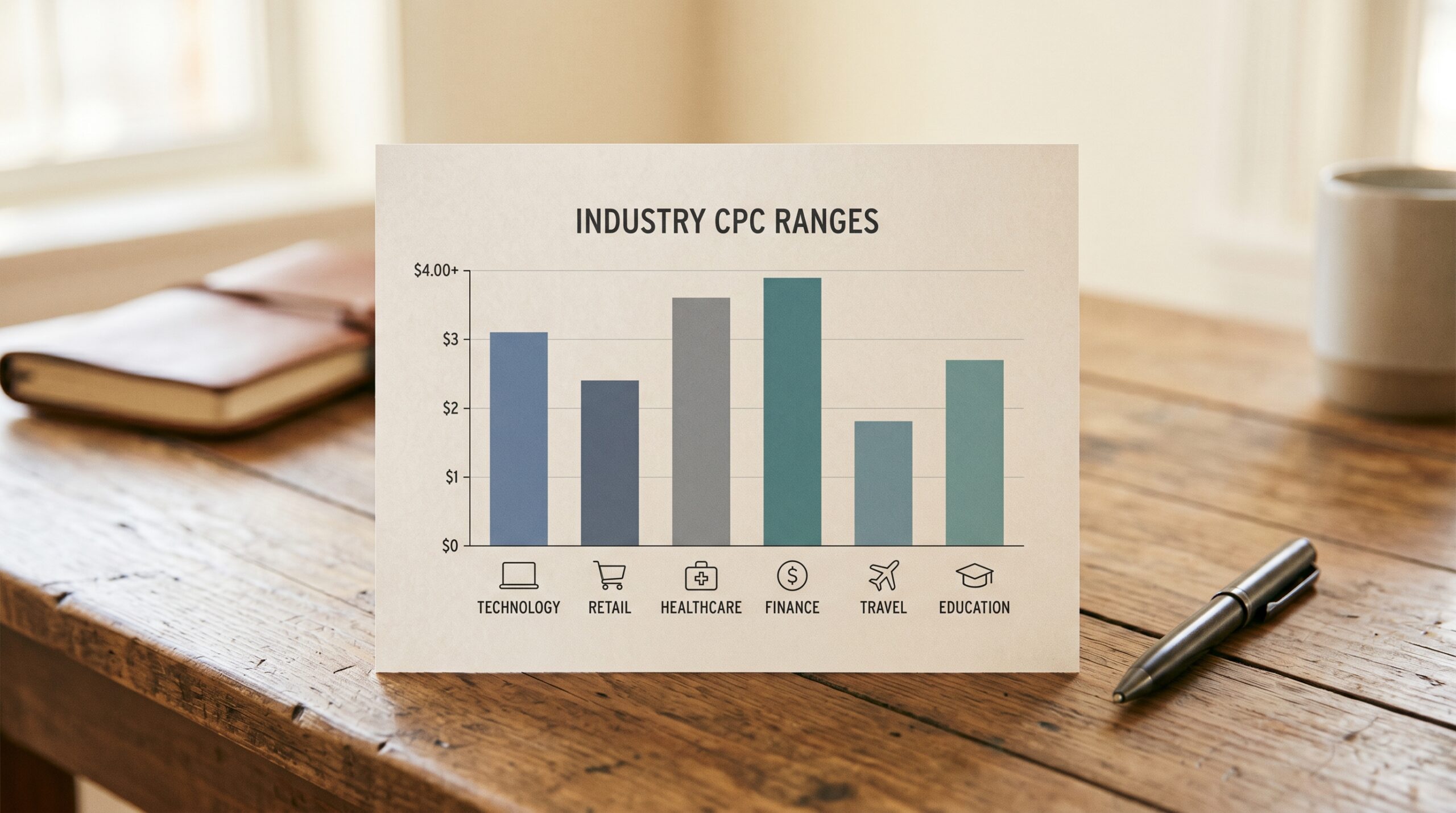
Two observations deserve emphasis. First, high-CPC industries are not necessarily bad investments — a $9 CPC is justifiable if a converted client generates $5,000 in revenue. The math that matters is cost per acquired customer, not cost per click. Second, the numbers in the table represent averages. Early-stage advertisers in any industry will typically pay above-average CPCs until their Quality Scores improve, meaning the effective cost in the first 60–90 days of a new campaign often runs 20–40% higher than these benchmarks.
What Determines Your Google Ads Cost
Beyond industry category, several campaign-level factors exert significant influence over what a business actually pays. Understanding these variables is essential because they represent levers that advertisers can control.
Quality Score
Quality Score is the single most powerful cost lever available to advertisers. A Quality Score of 8 or higher can reduce CPC by 30–50% compared to a score of 4 or lower, for the same keyword and bid level. Quality Score is built from three sub-components:
- Expected click-through rate: How likely is this ad to be clicked given its position? Google compares the ad’s historical CTR to baseline expectations for that keyword and position.
- Ad relevance: How closely does the ad copy match the intent of the search query? Ads that use the keyword naturally, address the searcher’s likely intent, and include a clear value proposition score higher.
- Landing page experience: Is the page the user lands on relevant, fast-loading, and mobile-friendly? Does it deliver on what the ad promised? A poor landing page experience is one of the most common reasons Quality Scores stagnate.
Keyword Match Types and Competition
Broad match keywords reach the widest audience but often attract low-intent searches, which drives down CTR and inflates CPL. Phrase match and exact match keywords restrict reach but typically deliver higher relevance and lower effective CPL. In highly competitive markets, even exact match CPCs can be high simply because many advertisers are bidding on the same specific terms.
Geographic Targeting
CPCs in major metro areas — New York, Los Angeles, San Francisco — can run 2–3 times higher than the same keywords in smaller markets. A home services business advertising in a mid-sized regional city will pay materially less per click than an identical business in a tier-one market.
Ad Scheduling and Device Targeting
Bids can be adjusted by time of day, day of week, and device type. Many advertisers overpay by running full budgets during hours when their audience converts poorly. Analyzing conversion data by segment and applying bid adjustments accordingly is a straightforward way to improve cost efficiency without changing the overall budget.
Competitor Behavior
CPCs fluctuate based on how aggressively competitors are bidding. New entrants into a market, seasonal demand spikes, and major promotional periods can all push CPCs upward. Advertisers have limited control over this variable, which is one argument for maintaining a diversified traffic strategy rather than relying exclusively on paid search.
Realistic Monthly Budgets for Small Businesses
The following budget tiers represent what a competently managed Google Ads campaign can realistically deliver for a typical small business. These projections assume a moderate-competition market, a functional landing page with basic conversion rate optimization, and standard campaign management practices.
$500 per Month: Testing and Learning
At $500 per month (roughly $16 per day), a small business can expect:
- Approximately 150–400 clicks per month, depending on industry CPC.
- 4–20 leads per month if landing page conversion rates fall in the 3–8% range.
- Enough data to identify which keywords are generating clicks, but insufficient volume to make statistically significant optimization decisions quickly.
- Essentially no viability in high-CPC industries (legal, insurance, home services in major metros) where $16/day buys 1–2 clicks.
Best for: E-commerce with low CPCs, very localized service businesses in smaller markets, or businesses testing Google Ads for the first time before committing larger budgets.
$1,000 to $2,500 per Month: Functional Entry Point
This is the budget range most frequently cited by Google and agencies as the realistic minimum for a campaign that can actually optimize and produce consistent results.
- At $1,500/month (~$50/day), a business in a mid-CPC industry can expect 300–750 clicks and 10–45 leads per month.
- Enough conversion volume to begin testing ad copy variations, landing page elements, and bid strategies.
- Viable for most service businesses in non-top-tier markets.
- Still limited in high-CPC verticals, where $50/day may generate only 5–8 clicks in the most competitive keyword clusters.
Best for: Local service businesses, professional services firms in regional markets, and B2B companies with a patient sales cycle that can justify a higher CPL given high customer lifetime value.
$3,000 to $5,000 per Month: Competitive Participation
At this level, most small businesses can run genuinely competitive campaigns across their core keyword set:
- 600–1,500+ clicks per month in moderate-CPC industries.
- Sufficient volume to run meaningful A/B tests on landing pages and ad copy simultaneously.
- Ability to use automated bidding strategies like Target CPA, which require 30+ conversions per month to function effectively.
- Coverage across multiple campaign types: Search, Display remarketing, and potentially a small YouTube presence.
Best for: Established small businesses with proven customer acquisition economics, home services companies in competitive metros, and professional practices (dental, legal, medical) where a single new client justifies significant ad spend.
$5,000 to $10,000 per Month: Dominant Local Presence
Above $5,000 per month, a small business moves from “participating” to “leading” in most local and regional markets:
- Ability to achieve consistent top-3 ad positions on primary keywords.
- Budget for diversified campaign types, including Performance Max, Discovery, and Demand Gen.
- Enough data to leverage Google’s AI bidding aggressively with confidence.
- Meaningful remarketing audiences built from ongoing traffic volume.
Best for: Multi-location businesses, high-ticket service providers, and companies in markets where Google Ads has proven to be a profitable acquisition channel and the goal is to maximize volume.
How to Lower Your Google Ads Costs

Cost reduction in Google Ads is not about spending less — it is about generating more value per dollar spent. The following strategies are ranked roughly by impact-to-effort ratio.
Build a Comprehensive Negative Keyword List
Negative keywords prevent ads from showing on irrelevant queries. A business offering premium accounting software, for example, should exclude terms like “free,” “cheap,” “DIY,” and “template” to avoid attracting users who will never convert. Regular search term report audits — reviewing the actual queries that triggered ads — should be a weekly practice, particularly during the first 90 days of a campaign. A well-maintained negative keyword list can reduce wasted spend by 15–30% in most campaigns.
Optimize Landing Pages for Quality Score
Because landing page experience directly affects Quality Score, improvements to the landing page reduce CPC without requiring any change to bids. Key improvements include:
- Ensuring the landing page content matches the ad’s value proposition precisely — if the ad promises a free quote, the page should lead with a free quote form.
- Improving page load speed, particularly on mobile. Google’s PageSpeed Insights tool provides specific recommendations. Pages loading in under 2 seconds convert significantly better than slower pages.
- Adding trust signals: customer testimonials, industry certifications, and clear contact information all improve both Quality Score and conversion rates.
- Simplifying form fields. Reducing a lead capture form from 8 fields to 3–4 fields typically increases conversion rate by 20–40%.
A purpose-built landing page builder designed for conversion — rather than a generic website page — makes this optimization process substantially more efficient.
Use Tighter Keyword Match Types
Transitioning from broad match to phrase or exact match on high-spend keywords typically reduces click volume but increases lead quality. The math often works out favorably: fewer, higher-intent clicks at similar CPCs produces better CPL.
Segment Campaigns by Intent Stage
Mixing high-intent transactional keywords (“emergency plumber near me”) with informational keywords (“how to fix a leaky pipe”) in the same campaign muddies performance data and inflates CPL. Separating campaigns by intent stage allows different bid strategies, landing pages, and ad copy for each audience — and makes it far easier to cut underperforming segments without collateral damage to the whole account.
Leverage Ad Scheduling
Most businesses see significantly higher conversion rates during specific hours and days. Running ads 24/7 without bid adjustments means paying competitive CPCs for clicks that rarely convert. Analyzing conversion data by time segment and reducing bids (or pausing campaigns entirely) during low-conversion periods can improve effective CPL by 10–25%.
Implement Smart Bidding Once Data Exists
Google’s automated bidding strategies — Target CPA, Target ROAS, Maximize Conversions — outperform manual bidding once sufficient conversion data exists. The threshold is approximately 30–50 conversions per month per campaign. Below that threshold, manual or enhanced CPC bidding is generally more predictable.
When Google Ads Does Not Make Sense
Intellectual honesty requires acknowledging the scenarios where Google Ads is not the right investment for a small business.
The unit economics do not work. If the average CPC in a niche is $15 and the landing page converts at 2%, the effective CPL is $750. If the average customer value is $300, the campaign is structurally unprofitable regardless of optimization efforts. No amount of keyword refinement fixes fundamentally broken unit economics.
The search volume is too low. Some hyper-niche B2B products, highly localized services in small markets, or genuinely novel offerings may have insufficient search volume to sustain a search campaign. If fewer than 1,000 people per month are searching for the core keyword set, Google Ads will generate too few impressions to build meaningful learning or consistent pipeline.
The sales cycle requires relationship-building. Google Ads is a bottom-of-funnel channel: it captures demand that already exists. For complex B2B sales with long evaluation cycles, paid search generates leads that then require months of nurturing. In these cases, content marketing, LinkedIn advertising, and marketing automation software to manage that nurturing process are often better primary investments.
The team cannot handle the leads. A campaign that generates 50 leads per month is worthless if those leads are not followed up within 5 minutes. Studies consistently show that lead response speed is the single largest predictor of conversion rate — businesses that respond within 5 minutes are 100x more likely to qualify a lead than those that respond within 30 minutes. If the operational infrastructure to handle inbound leads rapidly is not in place, Google Ads spend is largely wasted.
Alternatives worth evaluating when Google Ads is not the right fit include SEO-driven content marketing (slower but durable), marketing funnel development for longer-cycle nurturing, online review management to drive organic conversion, and social media advertising on platforms where the target audience is more naturally discoverable.
How ASM Maximizes Your Google Ads ROI
The conversation about Google Ads pricing almost always focuses on the cost side of the equation. The more consequential variable for most small businesses is what happens after the click — the operational infrastructure that determines whether a paid lead becomes a paying customer.
Consider two businesses running identical Google Ads campaigns with identical budgets and identical CPCs. Business A has no CRM, responds to leads by checking email periodically, and has no automated follow-up sequence. Business B uses Automated Sales Machine to capture every lead into a structured CRM pipeline, triggers an immediate automated text and email sequence, and routes high-priority leads to a sales rep for same-day follow-up. Both businesses paid the same amount for those clicks. Business B will convert a dramatically higher percentage of them into customers.
This is where the ROI of Google Ads is actually won or lost — not in the bid adjustments, but in the post-click infrastructure.
Automated Sales Machine integrates directly with the post-click experience across several dimensions:
- Lead capture without leakage: Every form submission, phone call tracked via call tracking, and chat conversation routes immediately into ASM’s CRM software, creating a complete lead record with source attribution. No lead falls through the cracks because someone forgot to check a form notification email.
- Immediate automated response: ASM triggers multi-channel follow-up sequences — SMS, email, and voicemail drop — the moment a lead submits a form. Responding within the first five minutes increases qualification rates dramatically, and with ASM, that speed is structural rather than dependent on a sales rep being available at the exact right moment.
- Pipeline visibility: Google Ads conversion tracking tells advertisers how many form fills occurred. ASM’s pipeline reporting shows how many of those form fills became qualified opportunities, proposals, and closed customers — enabling genuine ROI calculation, not just cost-per-lead analysis.
- Nurture sequences for longer cycles: Not every Google Ads lead is ready to buy today. ASM’s funnel builder enables automated nurture sequences that keep the business top of mind over weeks and months, converting leads that would otherwise go cold.
- Reputation amplification: Closed customers can be automatically enrolled in a review request sequence, building the social proof that improves organic conversion rates — compounding the value of every paid acquisition dollar.
The businesses that generate the strongest returns from Google Ads are not necessarily the ones with the largest budgets or the most sophisticated bidding strategies. They are the ones with the operational systems to close the leads those ads generate. Explore how ASM’s full feature set integrates with paid acquisition strategies, or request a demo to see the complete lead-to-close workflow in action.
Frequently Asked Questions About Google Ads Pricing
How much does a Google ad cost?
Google ads do not have a fixed price — costs are determined by auction. The average cost per click across all industries on the Search Network is approximately $2.69, but this ranges from under $1 in low-competition retail niches to $9 or more in legal services, financial services, and competitive home services verticals. The average cost per lead across industries is $70.11. Most small businesses allocate $1,000 to $10,000 per month to Google Ads, with typically the right range for a first campaign for campaigns designed to generate consistent leads rather than simply testing the platform.
Is $1 a day good for Google Ads?
In practical terms, no. While Google technically allows daily budgets below $1, a $1 per day budget will produce so few impressions and clicks that no meaningful optimization is possible. If the average CPC for a target keyword is $5, a $1 daily budget might generate one click every five days — roughly 6 clicks per month, which is statistically meaningless. For Google Ads to function as a real acquisition channel, the minimum viable daily budget in most markets is $20 to $50 per day ($600 to $1,500 per month). Below that threshold, the primary value is curiosity rather than lead generation.
Is $20 a day good for Google Ads?
$20 per day ($600 per month) is enough to generate useful test data and a modest number of leads in moderate-competition markets with CPCs in the $1 to $4 range. At a $3 average CPC, $20 per day buys approximately 200 clicks per month — which, at a 5% conversion rate, yields about 10 leads. That is a functional starting point. However, $20 per day is not sufficient in high-CPC industries. A $20 daily budget competing for legal or home services keywords in a major metro area may generate only 2–3 clicks per day, producing too little data to optimize and too few leads to build any sales momentum. The answer depends heavily on the specific industry and market.
Is $10 a day enough for Google Ads?
$10 per day ($300 per month) is possible in certain scenarios — specifically, very localized campaigns in small geographic markets with low-competition keywords and CPCs under $1.50. For most US businesses in competitive niches, $10 per day is insufficient to generate consistent leads. It may produce a handful of clicks per day in low-CPC environments, enough to validate that a keyword converts at all, but not enough to run any meaningful optimization. It should be viewed as an exploratory phase — useful for confirming demand before scaling, but not a sustainable acquisition strategy on its own.
Google Ads pricing is, ultimately, a function of what the market charges for attention and what a business is able to do with that attention once it is captured. The businesses that thrive on paid search are not those with unlimited budgets — they are those who have built the infrastructure to convert expensive clicks into lasting customer relationships. Understanding the true cost of Google Ads means understanding both sides of that equation.
For small businesses looking to build that infrastructure, schedule a demo with Automated Sales Machine to see how CRM, automation, and pipeline management work together to make every advertising dollar work harder.