
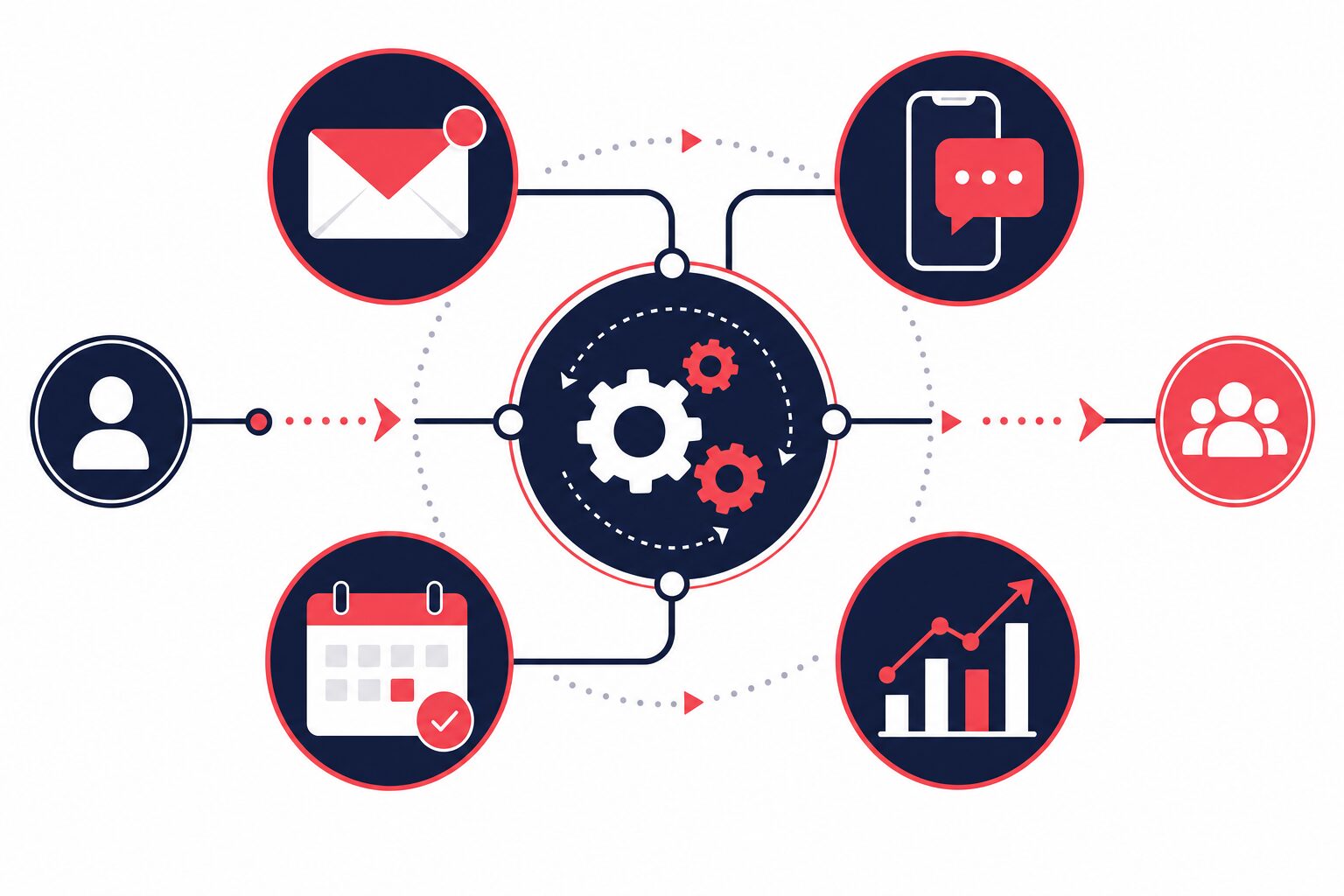

Automated marketing campaigns are the growth engine behind every small business that converts leads on autopilot, follows up instantly, and scales revenue without scaling headcount. When email sequences, SMS triggers, and behavioral workflows fire based on real prospect actions, close rates climb and cost-per-acquisition drops. Businesses that deploy marketing automation report an average 14.5% increase in sales productivity and a 12.2% decrease in marketing overhead — results that compound every month the system runs.
This guide breaks down exactly how automated marketing campaigns work, why they deliver measurable ROI across every industry, and how to build campaign sequences that convert leads into revenue on a repeatable basis. Whether you run a dental practice, a home service company, a coaching business, or an agency, the principles are the same: automate the follow-up, personalize the message, and let the system work every lead — every time.
What Are Automated Marketing Campaigns
Automated marketing campaigns are pre-built sequences of messages, triggers, and actions that execute automatically when a prospect takes a specific action or when a defined condition is met. No manual input required. No leads slipping through gaps. Every touchpoint fires on schedule regardless of time zone, staffing level, or business hours.
The Four Building Blocks of Every Automated Campaign
Every effective automated marketing campaign shares four core components that work together inside a rules-based engine:
- Trigger — the initiating event. A form submission, a missed call, an abandoned inquiry, a completed purchase, or a no-show appointment. The trigger starts the sequence.
- Sequence — the ordered set of actions the system executes after the trigger fires. This includes messages, wait steps, conditional branches, and internal notifications.
- Channel — where the message lands. Email, SMS, voicemail drop, social DM, or voice AI. The best campaigns coordinate across multiple channels simultaneously.
- Conversion Goal — the measurable outcome that defines success. A booked appointment, a completed payment, a replied message, or a submitted review.
When these four elements interact inside a properly configured automation platform, the result is a system that works every lead, every time, without exception — and tracks every interaction along the way.
How Automated Marketing Campaigns Work Across Channels
Modern marketing automation operates across email, SMS, voice, and social simultaneously. A prospect submits a demo request at 11 PM — the platform sends an instant confirmation email, queues a personalized text for 9 AM, and flags the sales rep with full context. No one on the team did anything manually.
AI-powered platforms extend this further. Triggers now respond to behavioral signals including email opens, link clicks, payment status, call outcomes, and review requests after service appointments. The more behavioral data the system collects, the more precisely each campaign sequence targets the prospect’s current intent — delivering the right message at the right moment on the right channel.
The ROI Case for Automated Marketing Campaigns
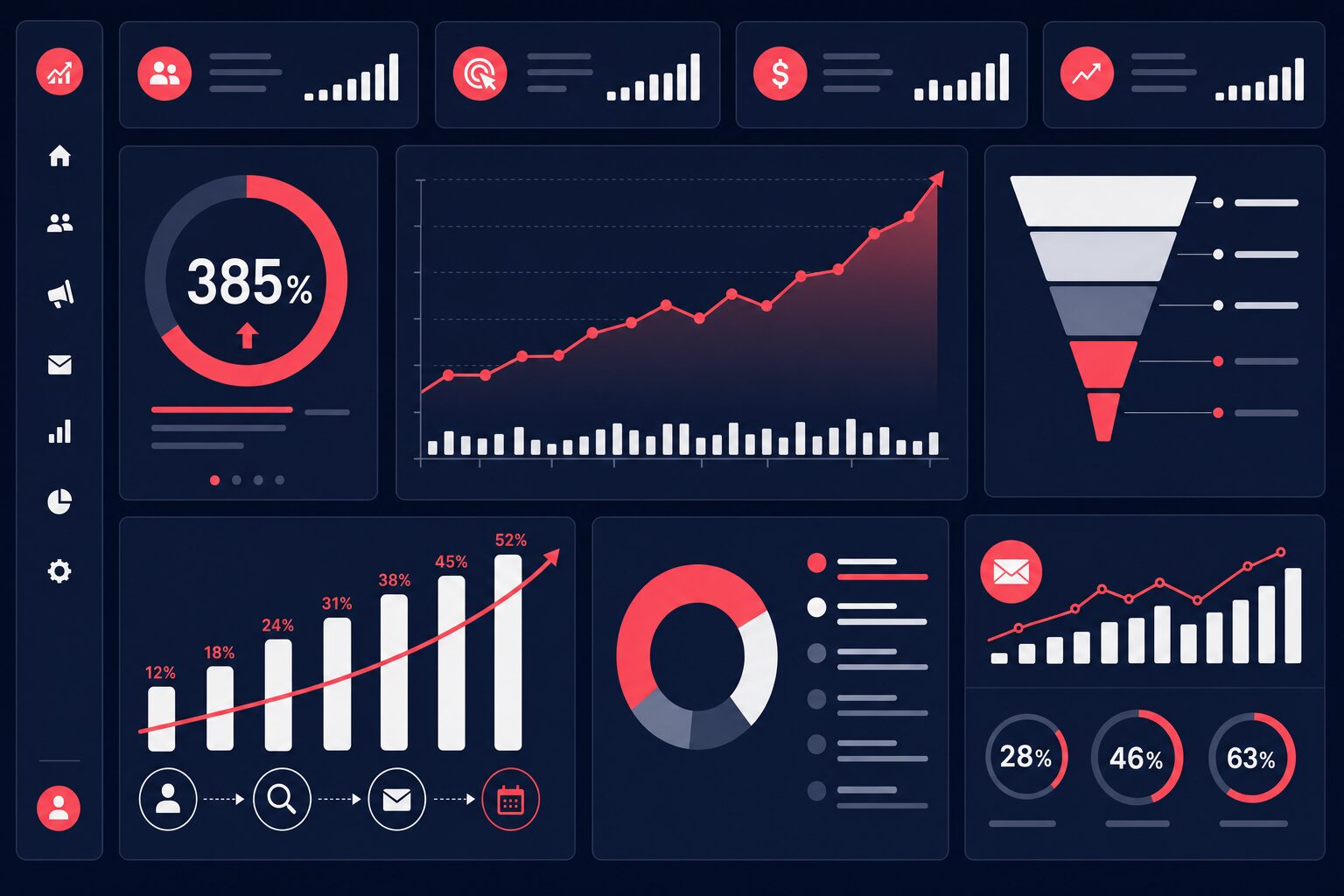
Marketing automation generates documented, measurable returns across thousands of businesses in every vertical — dental offices, real estate agencies, fitness studios, med spas, and home service contractors. The performance data from major research institutions consistently points in one direction: automation pays for itself fast.
Revenue Growth That Compounds Monthly
For every dollar spent on marketing automation, companies see an average return of $5.44 in the first three years, according to research compiled by Forrester Research. Top-quartile programs achieve $8.71 per dollar, driven by tighter CRM integration, multi-touch attribution, and AI-assisted audience segmentation.
The revenue impact is immediate. Companies that implement automated marketing campaigns typically see 10% or greater revenue increases within six to nine months, alongside 25% to 30% reductions in operational costs. According to Salesforce’s State of Marketing report, 76% of companies generate positive ROI within their first year of deploying marketing automation — these are not projections, they are outcomes from businesses already running these campaigns at scale.
The numbers hold across business sizes. Small businesses using marketing automation experience a 25% increase in marketing ROI, while the typical company across all segments attributes a 34% average revenue boost directly to automation. These gains are not theoretical — they show up in pipeline reports within the first quarter.
Cost Savings That Scale With Volume
Beyond revenue lift, these campaigns drive direct cost reductions that compound as your business grows. Manual follow-up requires staff hours, and staff hours are expensive. A business owner spending three hours per day on lead nurturing spends 15 hours per week on work that a well-configured automation stack executes in seconds.
Marketing automation decreases marketing overhead costs by 12.2% on average. That cost efficiency compounds as volume increases: more contacts entering the system, same fixed automation cost. The per-lead cost drops with every new contact that enters an existing campaign sequence.
Email automation demonstrates this compounding effect most clearly. Automated emails represent just 2% of total email volume sent — but they generate $36 in return for every $1 invested, making email the highest-ROI channel for most organizations running these campaign sequences. The smallest slice of effort produces the largest share of revenue.
Lead Generation and Conversion Gains
Implementing marketing automation helps companies generate 80% more leads and achieve 77% higher conversion rates compared to businesses relying on manual outreach. The gap is significant: 63% of companies outgrowing their competitors use marketing automation as a core growth lever.
The response-time window matters as much as the channel. When these trigger-based campaigns reach a prospect within five minutes of initial inquiry, the probability of converting that contact into a booked appointment increases dramatically. Every minute of delay shrinks that conversion window. Automation eliminates the delay entirely.
5 Types of Automated Marketing Campaigns That Drive Revenue
Not all campaign types serve the same function. The highest-performing businesses layer multiple campaign types across multiple channels to address every stage of the prospect journey — from first touch to repeat purchase.
1. Email Drip Sequences
Email drip campaigns send a pre-written series of messages over a defined timeline, with each email building on the previous one and moving the prospect toward a conversion action. A five-email drip that converts a cold inquiry into a booked demo generates compounding ROI with zero additional labor after the initial setup.
Effective email drip sequences within these campaign sequences share three characteristics: one clear call-to-action per email, a genuine value exchange in every message, and progressively tightening urgency as the sequence closes. Most small businesses under-utilize drip campaigns because they lack a platform that makes building them straightforward. That friction disappears inside a unified automation stack where email, CRM, and booking all live in one system.
2. SMS and Missed-Call Text-Back Campaigns
SMS is the highest-engagement channel in any automated marketing campaign stack. Text message open rates exceed 98%, compared to 20% to 30% for email — a gap that makes SMS the highest-ROI channel per message sent for businesses targeting local buyers and service clients.
Missed-call text-back is among the most impactful single-trigger automated marketing campaigns for service businesses. When a prospect calls and no one answers, the platform fires an instant SMS introducing the business and inviting a reply. Dental offices, fitness studios, HVAC contractors, and med spas routinely recover 20% to 40% of previously lost calls through this single automation trigger alone.
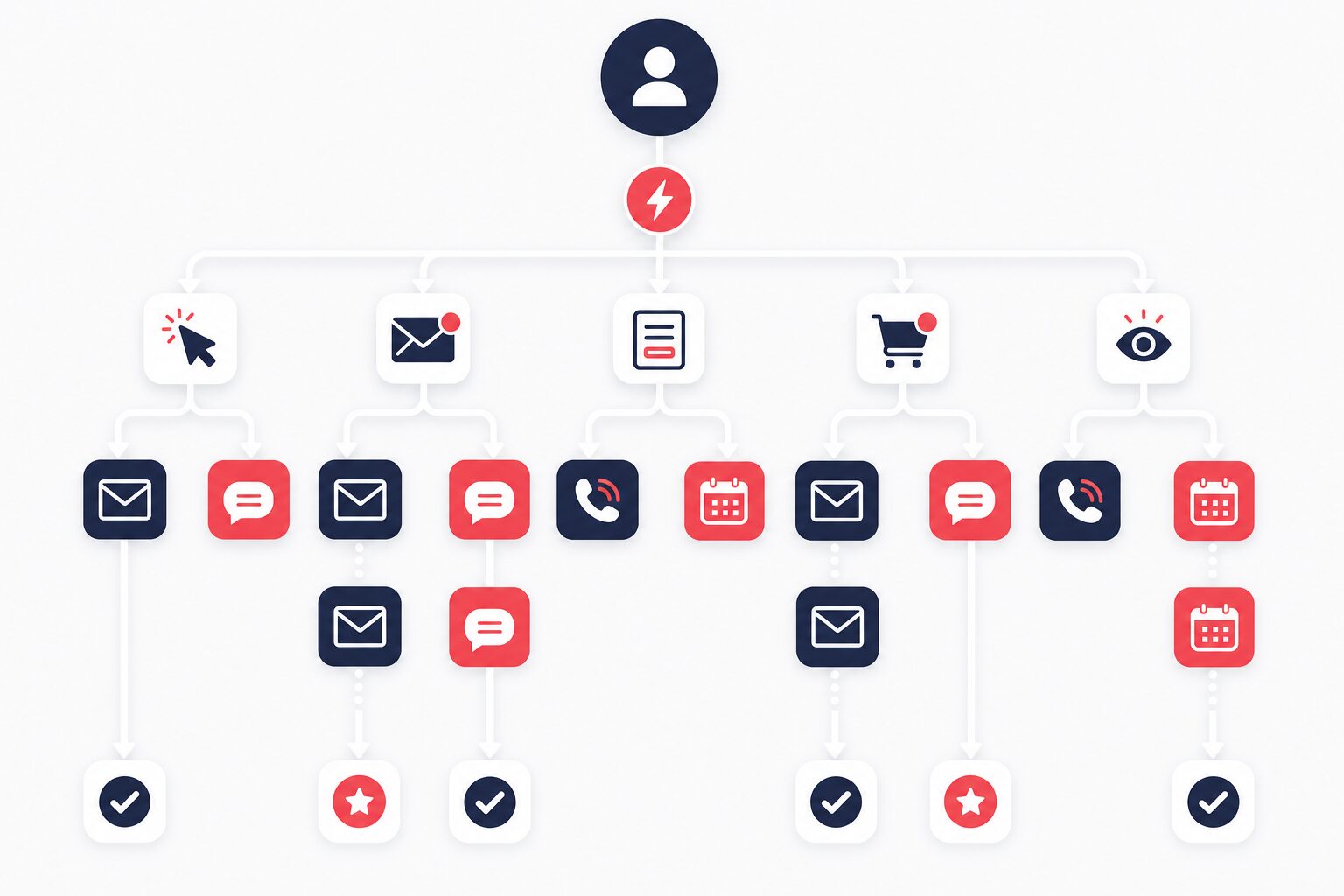
3. Behavioral Trigger Campaigns
Trigger-based automated marketing campaigns respond to individual prospect actions in real time rather than firing on a fixed schedule. An abandoned quote form fires a follow-up email within minutes. A pricing page visit fires a personalized text from the sales rep. A five-star review triggers an automated thank-you with a referral request.
This behavioral responsiveness transforms generic broadcast outreach into intent-matched conversations delivered at scale. Each touchpoint is relevant to what the prospect just did — and the entire system runs without adding headcount. Behavioral trigger campaigns consistently outperform schedule-based sequences because they match timing and message to the prospect’s current state of readiness.
4. Appointment Booking and Reminder Sequences
Appointment-based campaign sequences cover the full booking lifecycle: pre-booking nurture, booking confirmation, reminders at 48 hours, 24 hours, and two hours before the appointment, followed by post-appointment follow-up for reviews or rebooking.
Confirmation and reminder sequences reduce no-show rates by 30% to 50% in service businesses — directly translating into recovered revenue each week with zero manual effort. For a business running 20 appointments per week, eliminating even three to five no-shows adds significant monthly revenue at zero additional acquisition cost. These reminder sequences pay for the entire automation platform within the first month for most service operators.
5. Reactivation and Win-Back Campaigns
Past customers and cold leads are the highest-converting audiences for targeted win-back campaign sequences. A reactivation sequence fires when a contact has been inactive for a defined period: a personalized check-in, a limited-time offer, and a direct booking link. These campaigns convert at a fraction of cold-acquisition cost because the prospect already knows the brand.
Win-back sequences excel for service businesses with recurring purchase cycles — gyms, med spas, HVAC contractors, dental practices — where a customer’s silence signals churn risk. Campaign sequences targeting these lapsed contacts consistently deliver the lowest cost-per-reactivation of any campaign type in the stack.
How to Build Automated Marketing Campaigns That Convert
Building automated marketing campaigns that reliably convert requires three foundational steps before the first workflow goes live. Skipping any one of them guarantees underperformance.
Step 1 — Map the Customer Journey Before Building
Effective automated marketing campaigns begin with a precise customer journey map. Document every touchpoint from first contact to closed deal: how prospects find the business, what action they take first, where they stall, what objections surface, and what finally pushes them to buy.
Most small businesses discover two or three critical drop-off points during this mapping exercise — moments where leads disappear without any follow-up. Those gaps are exactly where a targeted automated marketing campaign delivers the greatest immediate ROI. Fixing even one drop-off point with a well-designed trigger sequence often produces a measurable revenue lift within the first 30 days.
Step 2 — Segment Your Audience for Maximum Relevance
Audience segmentation separates high-converting automated marketing campaigns from generic broadcasts. Segment by lead source, by service category, by funnel stage, and by past purchase behavior. Each segment receives a tailored sequence — not a one-size-fits-all message blast.
According to McKinsey research on personalization, campaigns tailored to audience segments drive revenue lift of 10% to 15% above generic broadcast messaging. That margin compounds across every active sequence in your pipeline. Personalization does not require manual effort — it requires proper conditional logic, dynamic fields, and a platform that lets you build segmented automated marketing campaigns without code.
Step 3 — Define Trigger Logic for Every Scenario
Trigger logic is the operational core of every automated marketing campaign. Map every trigger your platform supports: form submissions, missed calls, email opens, payment completions, review requests, and inactivity flags. For each trigger, define the desired response — message content, timing delay, channel, and next step in the sequence.
Test every trigger before going live. A broken trigger is a lead falling through a gap that no one sees until the revenue impact shows up in the pipeline report weeks later. Consolidate your automated marketing campaigns on one platform and eliminate the integration failures that plague fragmented stacks where triggers break at handoff points between disconnected tools.
Common Mistakes That Kill Campaign ROI
Even well-designed campaign sequences fail when they fall into predictable, preventable traps. These three mistakes cost businesses measurable revenue every week they go uncorrected.
Treating Every Lead the Same
The most common failure in marketing automation is sending identical messages to every contact regardless of source, intent, or funnel stage. A generic five-email drip delivered to every lead is not a targeted campaign — it is a broadcast. Conversion rates on generic sequences are consistently 40% to 60% lower than segmented, personalized alternatives.
Personalization does not require manual work. It requires proper audience segmentation, conditional logic in the workflow builder, and dynamic fields that pull in the contact’s name, service category, and inquiry type automatically. These capabilities exist in every modern automation platform — they only produce results when the setup is done correctly from the start.
Ignoring Campaign Analytics
Campaign sequences generate performance data at every touchpoint — open rates, reply rates, click-through rates, and conversion rates by sequence step. Businesses that ignore this data run the same underperforming sequences for months without identifying where the drop-off occurs.
High-performing operators review analytics weekly, identify the weakest step in each active campaign sequence, rewrite underperforming messages, and test the improved version against a baseline. The optimization cycle is continuous — not a one-time configuration task.
Setting and Forgetting Without Quarterly Reviews
Automated marketing campaigns are not a permanent set-and-forget system. Audience behavior, competitor offers, and seasonal demand shift constantly. A sequence that performed at 35% open rates in January may underperform by April because the offer language became stale or the audience segment evolved.
Quarterly reviews of every active campaign sequence keep the system performing at peak ROI. Replace underperforming triggers, refresh offer language, adjust timing delays, and add new sequence steps based on the previous quarter’s conversion data. The businesses that treat their campaign sequences as living systems — not static configurations — are the ones that sustain compounding returns.
Frequently Asked Questions
What is the difference between automated marketing campaigns and email marketing?
Email marketing is one channel within automated marketing campaigns. These campaigns encompass email, SMS, voice, behavioral triggers, and appointment sequences across the full customer journey — not a single-channel broadcast to a static list. The distinction is multichannel orchestration versus single-channel delivery.
How long does it take to set up automated marketing campaigns?
A basic automated marketing campaign — trigger, three-email drip, and SMS follow-up — can go live in under two hours on a unified platform. Multi-channel builds with AI components and full audience segmentation take one to two weeks of setup and testing. The compounding return on time invested begins the moment the first trigger fires.
What is a realistic ROI timeline for automated marketing campaigns?
Most businesses report positive ROI within 12 months of deployment. Research shows ROI ranges of 192% to 446% with payback periods under six months for well-configured automated marketing campaigns. Small businesses typically see impact first in recovered missed calls and reduced no-show rates — both measurable within the first 30 days.
Can automated marketing campaigns replace a sales team?
Automated marketing campaigns handle top-of-funnel qualification, follow-up, appointment booking, and reactivation — tasks that consume 60% to 80% of a sales rep’s day. The team focuses on closing high-value deals. Automation supports the team by eliminating repetitive tasks; it does not replace the human judgment required to close complex sales.
Start Running Automated Marketing Campaigns That Close More Business
Automated marketing campaigns are not reserved for enterprise companies with dedicated marketing departments and six-figure software budgets. They are the operating infrastructure every small business, agency, and service operator needs to compete at scale — and the technology is accessible today at a fraction of what it cost three years ago.
Automated Sales Machine delivers that infrastructure in one platform: CRM, AI booking, voice automation, SMS, email, reputation management, and social — all running from a single login. Every tool that powers automated marketing campaigns is included, and every campaign runs without the integration failures that break fragmented stacks. No more paying for 15 disconnected tools that do not talk to each other.
Stop losing leads to slow follow-up, missed calls, and disconnected tools. Every day without properly configured automated marketing campaigns is a day of recoverable revenue sitting on the table. Book a free demo and start running automated marketing campaigns that convert more leads with Automated Sales Machine.