


If you’re serious about comparison page SEO, you need to read this.
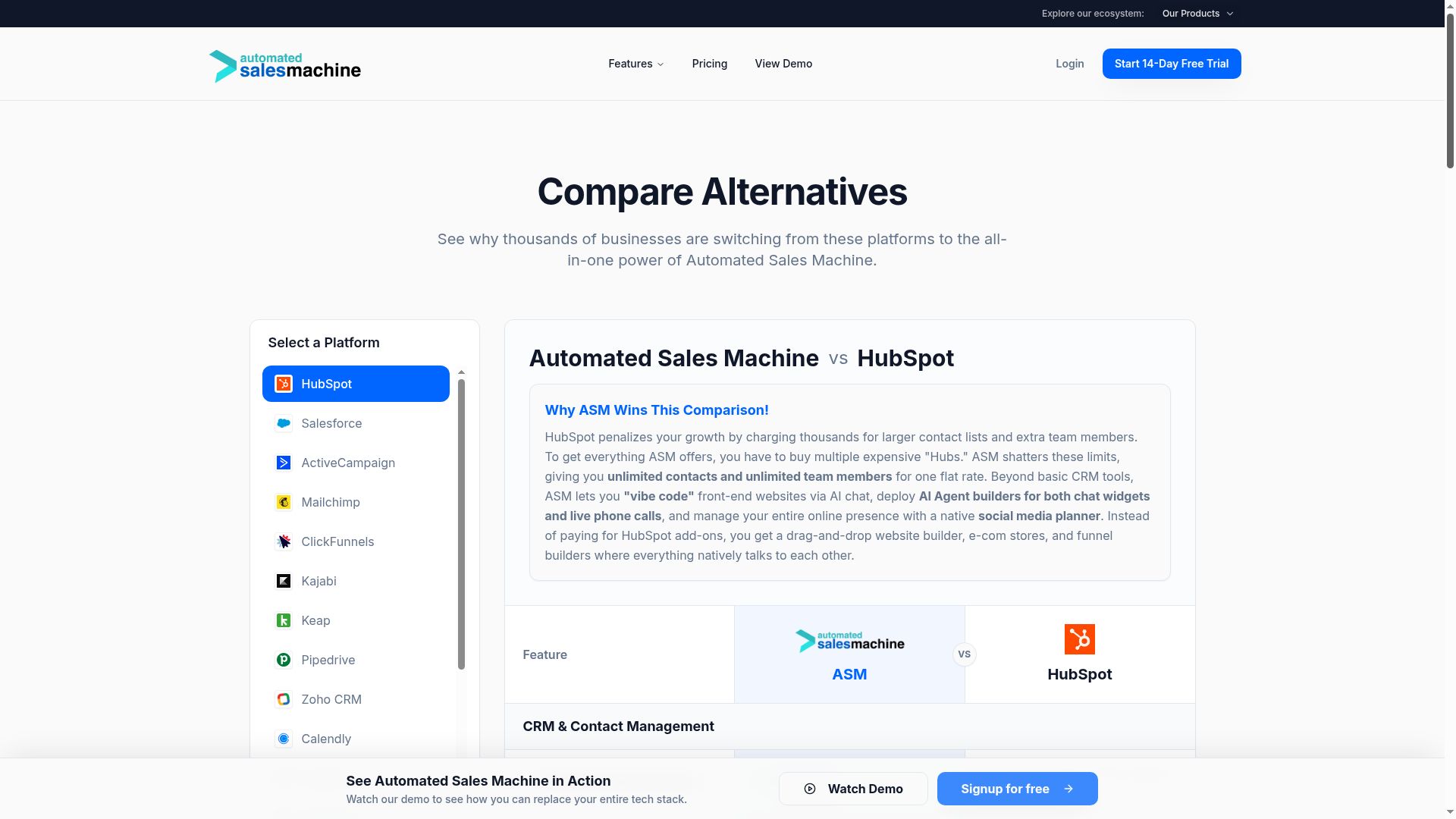
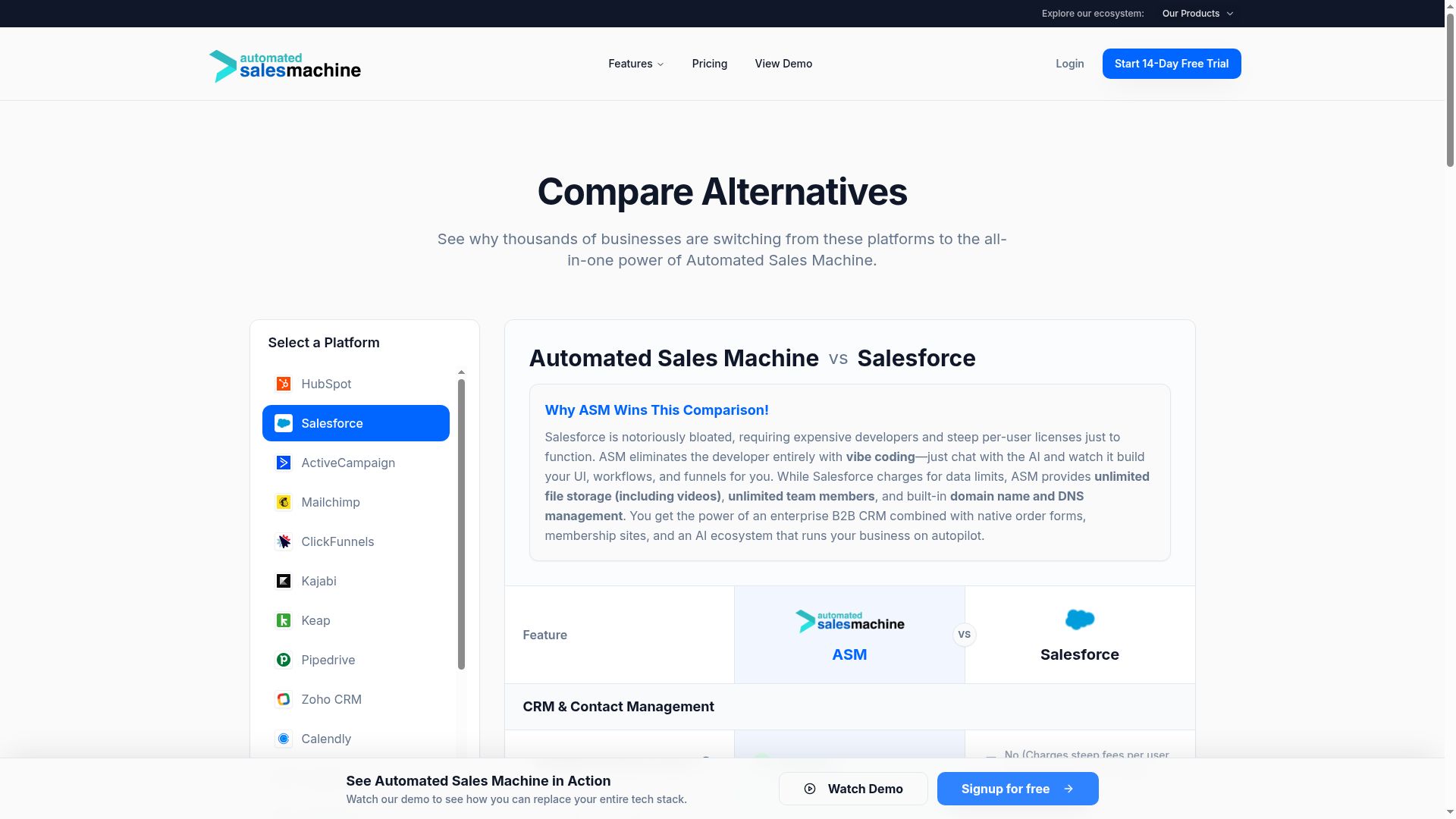
I want to tell you something a little embarrassing. For months, Automated Sales Machine had 20 comparison pages sitting on the website — pages like “ASM vs HubSpot,” “ASM vs Salesforce,” “ASM vs Mailchimp,” and 17 more — and collectively, those pages were generating almost zero organic traffic.
Not a slow trickle. Essentially nothing.
And here’s the part that stings: comparison page SEO should be the easiest win in any content strategy. People who search “HubSpot alternative” or “best Salesforce alternative” aren’t at the awareness stage. They already know the competing platform. They’re frustrated with it — the price, the complexity, the missing features — and they’re actively looking for something better. Their credit card is basically out.
I was leaving all of that traffic, and all of those conversions, completely on the table. Not because I didn’t have comparison pages. I did. But because I built them wrong.
Here’s the full breakdown: what was wrong with every single one of those pages, the framework I used to diagnose the problem, how AI rewrote all 20 of them in a single session, and what any business can take from this.
The Comparison Page SEO Problem Nobody Talks About
Most businesses approach comparison page SEO the same broken way. You make a feature table, write a one-paragraph intro, add a “Start Free Trial” button, and call it done. The page looks professional. The table is accurate. The logic is sound.
And Google completely ignores it. That’s the core comparison page SEO failure mode — and it’s almost universal.
Here’s why: Google can’t rank a table. It ranks content. A comparison table is data — valuable for human readers, but not the kind of substantive, topically authoritative content that earns a ranking for competitive keywords.
When someone searches “HubSpot alternative,” they’re asking a question. They want help making a decision. Google wants to surface the page that most comprehensively helps them make it — the page that explains why HubSpot is frustrating, what they’re specifically missing, who should switch, and what the alternative actually gets right. A table tells them which features exist. It doesn’t answer any of those questions.
My pages had a headline, a paragraph, a table, and a button. That’s not a resource. That’s a placeholder.
What Comparison Page SEO Actually Requires to Rank
Before I get into what I changed, let me share the checklist I used. This is the framework I apply to every piece of content in our pipeline — and comparison pages are no exception. (If you’re not familiar with Rank Math, it’s the SEO scoring plugin that measures on-page optimization against the signals Google’s algorithm actually evaluates.) I’m not going to give away the full recipe, but here are the signal categories and enough specifics to give you a real picture.
The Keyword Fundamentals
The focus keyword needs to appear in three specific places with very specific constraints. The H1 is the most critical — but it’s not enough to just have the keyword in the headline. It needs to appear within the first half of the H1. “The Best HubSpot Alternative for Small Businesses That Are Tired of Paying More to Grow” passes. “Why Small Businesses Are Switching From HubSpot — The Best Alternative” fails (keyword appears too late).
The same focus keyword needs to appear in the first 100 words of body text — not buried in paragraph three. And it needs to be in the meta title and meta description, written for click-through rate, not keyword stuffing. A meta description that leads with a specific pain point the searcher just typed is not the same as one that just says “See why ASM is the best alternative.”
The Content Depth Requirements
This is where most comparison pages fall apart — and where the biggest SEO gains live. A properly optimized comparison page needs:
- A Table of Contents with anchor links to each major section
- Minimum 2,000–2,500 words of actual copy surrounding the comparison table
- Multiple H2 and H3 headings creating proper content hierarchy — not just one introductory paragraph
- Platform-specific pain point sections that go beyond generic “this tool is expensive” copy to address the actual pricing model, feature gaps, and user frustrations that drive someone to search for an alternative
- A clear “who should switch” section that qualifies the reader honestly
- An FAQ section targeting long-tail query variations — “is there a cheaper alternative to HubSpot,” “what does HubSpot not include,” “how much do I save switching” — all searcher intents within the same buyer journey
The Trust Signals
Internal links to other relevant pages on your site. Outbound links to credible external sources. Image alt text containing the focus keyword. A URL slug that already contains the focus keyword. That last one I happened to have right — /compare/hubspot-alternative is a perfect URL. Everything else was wrong.
When I ran all 20 of my comparison pages through this checklist, every single one failed at least 8 criteria. Most failed more.
Why My Comparison Page SEO Was Failing Every Criterion
The root cause was simple: I’d prioritized the table over everything else. My comparison page SEO was invisible because I’d given Google nothing to rank beyond the data itself.
The feature comparison tables on those pages are genuinely good — accurate, comprehensive, updated. That’s the core value of a comparison page, and I had it right. But I’d treated the surrounding content as an afterthought. A few lines of context, then the table, then a CTA.
The H1s were brand-naming — “Automated Sales Machine vs HubSpot” — not keyword-optimized. Nobody is searching that phrase. The meta descriptions were generic. There were no H2 or H3 sections creating topical depth. There were no FAQs. There was nothing for Google to evaluate beyond the table itself.
And across 20 pages, I had 20 versions of the same problem. Each targeting a different competitor — Salesforce, Mailchimp, ClickFunnels, Kajabi, Pipedrive, Zoho, Calendly, Typeform, Hootsuite, Zendesk, Intercom, WordPress, Wix, Shopify, Podium, Birdeye, Klaviyo, Keap, ActiveCampaign — and each one thin in exactly the same way.
How AI Fixed My Comparison Page SEO Problem in One Session
Here’s where this gets practical. I didn’t rewrite 20 pages by hand. I used an AI agent — the same AI infrastructure that runs our content pipeline — to audit each comparison page, understand the competitive landscape for that specific platform, and generate a complete implementation prompt for every single one.
For each of the 20 pages, the AI:
Identified the correct focus keyword based on actual search intent — not brand naming. “Salesforce alternative” instead of “ASM vs Salesforce.” Simple in principle, but none of the original pages were targeting these properly.
Rewrote the meta title and meta description with the focus keyword leading, a specific benefit proposition in place of generic copy, and click-through optimization rather than keyword insertion.
Rewrote the H1 to contain the focus keyword in the first half of the headline, include a power word, and address the specific pain point that drives someone to search for that competitor’s alternative.
Rewrote the intro to hit the focus keyword within the first 100 words, address the specific reason someone would be searching for that particular alternative, and frame the problem accurately.
Added a full Table of Contents with proper anchor links, multiple H2/H3 content sections before and after the existing table, and an FAQ section targeting long-tail queries for each competitor.
Rewrote the closing CTA with a platform-specific value argument rather than a generic “Start Free Trial” prompt.
And critically — the comparison tables were left completely untouched. The tables are good. The data is accurate. I didn’t need to rewrite the data. I needed to surround it with the content depth that makes Google want to rank the page.
Each page got its own unique treatment — not a template copy-pasted 20 times. Every competitor has a different pricing model, a different set of feature gaps, and a different reason someone would be searching for an alternative. That specificity is the difference between comparison page SEO that ranks and comparison page SEO that doesn’t.
The Competitive Intelligence That Made the Difference
What impressed me most about this comparison page SEO overhaul wasn’t just the structure — it was the accuracy of the competitive intelligence woven into each page.
For the HubSpot page, the copy correctly identified the contact-tier penalty (your bill scales as your list grows), the per-seat tax on the Sales Hub ($460/mo for five reps on Professional), and the four-Hub fragmentation that makes a complete HubSpot stack cost $1,500–$5,000+/mo — all documented on HubSpot’s own pricing page.
For Salesforce, it correctly framed the implementation wall — $5,000–$25,000+ for a basic setup through a Salesforce partner — and the fact that marketing automation requires Pardot (starts at $1,250/mo) as a completely separate product.
For Podium and Birdeye, it surfaced the $299–$599/mo single-purpose pricing for reputation management tools that still leave you maintaining a separate CRM, email platform, and SMS stack on top.
For Klaviyo, it nailed the contact-tier escalation — $700/mo at 50,000 email contacts for a platform that’s Shopify-centric and doesn’t manage your full customer lifecycle.
Every platform got accurate, specific treatment. That specificity matters for two reasons: it’s more persuasive for readers who are actually frustrated with those platforms, and it signals to Google that this is a topically authoritative resource, not thin filler content.
Comparison Page SEO: Your Highest-Intent Traffic Source (And Why Most Businesses Ignore It)
Someone who lands on a “HubSpot alternative” page is not at the awareness stage. They already know HubSpot. They’re already paying for it, or they’ve evaluated it and decided it’s too expensive or too limited. They’re in decision mode. They want to be convinced.
A thin comparison page — a table and a CTA — doesn’t convince anyone. It presents data. Data doesn’t close deals. A well-written page that specifically addresses why someone is frustrated with their current platform, what they’re precisely missing, and why the alternative fits their situation — that closes deals.
The combination of properly optimized comparison pages (to earn the organic traffic) and genuinely persuasive content (to convert that traffic) is one of the highest-leverage plays in SaaS and service business marketing. The buyer intent is the highest it gets in organic search — keyword intent research consistently places “alternative” and “competitor” queries at the bottom of the funnel. Most competitors are running the same thin-table approach I was running — which means a properly optimized page can move from nothing to a first-page position faster than almost any other content type.
Most businesses build the table and stop there. The companies that win the comparison page game treat these pages as the full-funnel, high-intent conversion assets they actually are.
Can Any Business Improve Their Comparison Page SEO?
Yes — and you don’t need to be running a SaaS company or managing 20 competitor pages for this comparison page SEO framework to apply.
Any business that has competitors has comparison page SEO opportunities. Service businesses can create “us vs them” pages for direct competitors. Agencies can compare their approach to DIY alternatives. Local businesses can compare local vs. national chains. The methodology is the same regardless of industry.
Here’s the repeatable process:
Step 1: Audit Your Existing Comparison Page SEO
Run each page through an SEO scoring tool like Rank Math. Identify every criterion it fails. Be honest — if your page is 200 words and a table, it’s failing almost everything. That’s your gap list.
Step 2: Define the Correct Focus Keyword for Each Comparison Page
Use the search-intent-based alternative keyword, not your brand-vs-brand naming format. “[Competitor] alternative” has search volume. “[Your brand] vs [competitor]” has almost none unless you’re already famous. Target the keyword your buyer is actually typing.
Step 3: Build the Competitive Intelligence Brief
This is the hard part. Generic “this tool is expensive” copy doesn’t work. You need accurate, specific information about the competing platform’s actual pricing model, real feature gaps, and the genuine frustrations their users experience. Research it properly or work with someone who knows these platforms. Vague competitor copy is easy to spot — and it doesn’t rank.
Step 4: Structure the Page — Comparison Page SEO Needs Real Content Depth
Table of Contents, multiple H2/H3 sections, an FAQ section with long-tail keyword coverage, 2,000+ words surrounding your comparison table. The table stays — you’re building around it, not replacing it.
Step 5: Add the Technical Signals That Comparison Page SEO Requires
Internal links to your pricing and features pages. Outbound links to credible sources validating your competitive claims. Image alt text containing your focus keyword on every image. These are table stakes for competitive comparison page SEO.
Need This Done for Your Business? Contact InnoVision Marketing Group
If your comparison pages, alternative pages, or any conversion-critical content is sitting on your site generating close to zero organic traffic — this is a solvable problem. And it’s one we know how to solve.
Getting comparison page SEO right is one of the highest-ROI investments a software or service business can make in organic search. At InnoVision Marketing Group, we do exactly this at scale for businesses across industries. We audit your existing content, identify keyword and content gaps, and rewrite your pages with the framework I’ve described here — optimized for search, built to convert.
We also design and manage full AI-powered content pipelines — the same infrastructure that rewrote 20 ASM comparison pages in one session. Applied to your blog, your landing pages, your alternative pages, and your ongoing content calendar, this means SEO-optimized content produced consistently, with automatic publishing and social syndication built in.
If you’re ready to stop leaving high-intent organic traffic to your competitors — and finally get your comparison page SEO working for you, reach out to InnoVision Marketing Group. We’ll audit your current content situation. (Not yet an ASM customer? Compare plans and pricing here.) and show you exactly what the opportunity looks like for your business.
Comparison Page SEO: Frequently Asked Questions
What is comparison page SEO?
Comparison page SEO is the practice of optimizing “vs” or “alternative” pages to rank in organic search for high-intent queries like “HubSpot alternative” or “best Salesforce competitor.” These pages target buyers who are actively comparing tools and close to a purchase decision — making them among the highest-converting organic landing pages for software and service businesses.
How long should a comparison page be for SEO?
For competitive comparison page SEO, aim for a minimum of 2,000–2,500 words of content surrounding the comparison table. Pages under 500 words are unlikely to rank competitively for high-volume alternative keywords because Google can’t evaluate their topical authority from thin copy alone.
What focus keyword should I use for a comparison page?
Use the search-intent-based alternative keyword, not your brand-vs-brand naming format. “HubSpot alternative” has significant search volume. “Automated Sales Machine vs HubSpot” has almost none unless you’re already well-known. Target the keyword your buyer is actually typing — not the one that’s convenient for your brand naming convention.
Does Rank Math score matter for comparison pages?
Yes. Rank Math’s SEO analysis is a reliable proxy for the on-page signals Google evaluates. A score of 70+ is the minimum viable threshold for competitive rankings; 90–100 indicates the page is properly optimized across all major on-page factors. Pages scoring below 50 are unlikely to rank for competitive alternative keywords regardless of how good the comparison table is.
Can AI really write comparison page content that ranks?
Yes — with proper briefing and human oversight. AI-generated content that’s accurately briefed on competitive pricing, feature gaps, and buyer pain points can produce on-page content that is both SEO-optimized and genuinely persuasive. The key is accurate competitive intelligence in the brief — the AI shouldn’t be guessing at competitor pricing or inventing features. Brief it properly and the output is strong. Brief it generically and the output is generic.
How many comparison pages should a SaaS company have?
As many as you have meaningful competitors — and “meaningful” means platforms your target buyers are actively considering or currently paying for. ASM has 20 comparison pages covering the 20 tools most commonly in the consideration set of our potential customers. Each page targets a different “[competitor] alternative” keyword. Together, they form a comparison page SEO moat that covers the full competitive landscape from organic search.