
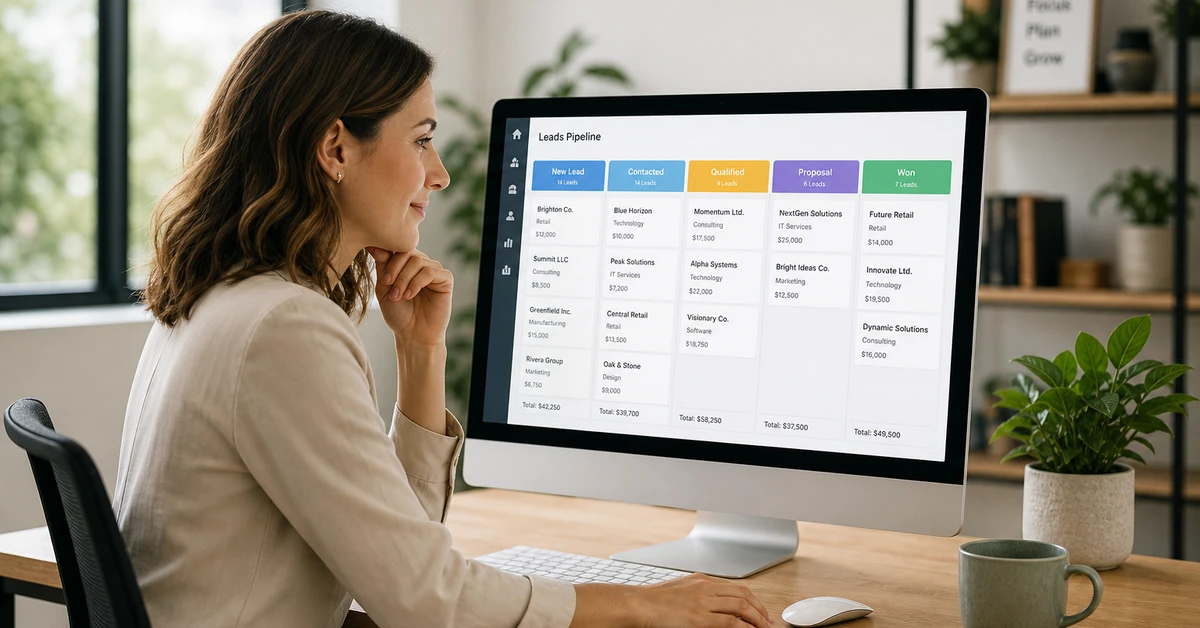

Sales leads are individuals, businesses, or contact records that represent potential customers who have shown some level of interest in your product or service — or who match the profile of someone who would benefit from it. Understanding what are sales leads is the critical first step in building a revenue-generating pipeline. Every sale starts with a lead: capture the right ones, qualify them systematically, and you have a predictable path to growth.
Ready to automate your entire lead pipeline? Book a free demo with Automated Sales Machine and see how top-performing small businesses convert more leads in less time.
Every business lives and dies by its pipeline. Whether you’re running a dental practice in Denver, a real estate brokerage in Dallas, or a home services company in Houston, the question is always the same: where is the next customer coming from?
The answer starts with a clear understanding of sales leads — and more importantly, how to generate, qualify, and convert them at scale. Most small business owners have some notion of sales leads, but without a structured system, leads slip through the cracks, follow-ups stall, and revenue suffers.
This guide cuts through the noise. You’ll walk away with a clear definition of sales leads, a practical taxonomy of every lead type, a proven qualification framework, a conversion playbook, and a look at the platform that automates the entire process. Let’s build your lead engine.
What Are Sales Leads? The Core Definition
At its core, a sales lead is any person or organization that has demonstrated potential interest in purchasing your product or service — or who fits the profile of a buyer who would benefit from it.
But that definition deserves unpacking. When sales professionals ask what are sales leads, they’re typically navigating three concepts that get conflated constantly:
- Lead: A broad contact — someone who submitted a form, clicked an ad, or appeared in a database. You know minimal detail about their intent or fit yet.
- Prospect: A lead you’ve qualified to some degree. They match your ideal customer profile (ICP), and there’s a plausible path to purchase.
- Opportunity: A prospect who’s actively in a sales conversation, has a defined need, and has a realistic probability of closing.
Understanding what are sales leads in this layered sense changes how you allocate time and resources. Not every lead deserves the same level of attention — and treating all contacts as hot prospects is one of the most costly pipeline mistakes a small business can make.
Think of it this way: a lead is a bet. A prospect is a calculated bet. An opportunity is where you go all in. The discipline of moving leads through this progression — systematically, at scale — is what separates businesses that grow from businesses that grind.

Types of Sales Leads: From Cold Contacts to Ready-to-Buy Prospects
One of the most useful frameworks for understanding what are sales leads is the temperature model. Not all leads arrive with the same level of intent, and your outreach strategy should reflect that reality precisely.
Cold Leads
Cold leads have had zero prior contact with your brand. They may appear on a purchased list, surface in a LinkedIn search, or be identified through competitive research. They haven’t raised their hand — yet. Cold leads require more nurturing and higher outreach volume, but they represent the broadest possible market opportunity. The key with cold leads is relevance: reach them with a message that acknowledges their specific situation, not a generic pitch.
Warm Leads
Warm leads have engaged with your brand in some meaningful way. They’ve visited your pricing page, downloaded a lead magnet, attended a webinar, or engaged with your social content. They’re showing early signals of intent. Warm leads are the sweet spot of most small business pipelines — they’re receptive to outreach because you have context on them, and they have context on you.
Hot Leads
Hot leads are actively evaluating your product or service. They’ve requested a demo, submitted a “contact sales” form, or engaged across multiple channels in a compressed window. These are what are sales leads at their most actionable — they demand same-day response and top-priority attention from your sales team. Every hour you delay costs you conversion probability.
Marketing-Qualified Leads (MQLs)
An MQL is a lead that marketing has determined meets the threshold for sales follow-up, typically based on behavioral scoring — page visits, content downloads, email click sequences. MQLs are formally handed off from marketing to sales for direct outreach and qualification.
Sales-Qualified Leads (SQLs)
An SQL is a lead the sales team has personally vetted and confirmed as a genuine opportunity. MQLs become SQLs through discovery calls, needs assessments, or hitting defined lead scoring thresholds. The MQL-to-SQL conversion rate is one of the most important pipeline health metrics you can track.
Inbound vs. Outbound Sales Leads
- Inbound leads come to you through SEO, content marketing, referrals, social media, and paid advertising. They’ve already discovered you — your job is to capture and convert.
- Outbound leads come from proactive prospecting: cold email, cold calling, LinkedIn outreach. You’re initiating the relationship.
Most high-performing pipelines run both channels simultaneously. According to HubSpot Research, 61% of marketers rank lead generation as their top marketing challenge — which is precisely why diversifying your lead acquisition channels is non-negotiable for sustainable revenue growth.
Where Do Sales Leads Come From?
Knowing exactly where to source quality sales leads is equally critical. Here are the primary acquisition channels, ranked by scalability and cost-efficiency for small and mid-sized businesses:
1. SEO and Content Marketing
Your website is your most scalable silent salesperson. Articles, guides, and landing pages optimized for buyer-intent keywords generate inbound sales leads 24/7 without incremental cost per contact. This guide is a direct example — a business owner searching “what are sales leads” is at the awareness stage of the buying journey. Capturing them with useful content starts the relationship on your terms and costs nothing to deliver at scale.
2. Paid Advertising
Google Ads, Meta Ads, and LinkedIn Ads allow precise targeting by job title, industry, geography, company size, and behavioral signals. Paid channels generate volume fast, but require immediate follow-up automation — leads go cold within hours if your response process isn’t structured and fast.
3. Social Media Prospecting
LinkedIn, Instagram DMs, and niche Facebook Groups have become high-yield channels for service businesses. A focused outbound prospecting campaign on LinkedIn — targeting the right title + industry + geography — can generate 10–20 qualified sales leads per week at near-zero cost per contact, for the right offer with the right message.
4. Referral Programs
Word-of-mouth drives 20–50% of all purchasing decisions, per McKinsey & Company research on purchasing behavior. A formal referral program — even a simple incentive structure — converts your existing customer base into your most effective lead generation channel. Referred leads close at higher rates, arrive with built-in trust, and churn far less frequently than any other lead source.
5. Cold Email and Cold Calling
Still the backbone of outbound sales across B2B industries. Modern cold outreach is built on precision targeting and genuine personalization. Spray-and-pray is dead — but a well-researched cold email that opens with a specific observation about the prospect’s situation and clearly articulates a relevant value proposition still generates consistent pipeline for businesses that execute it well.
6. CRM and Marketing Automation
The most scalable approach to managing what are sales leads is building automated capture and nurture infrastructure. According to Salesforce’s State of Sales report, sales reps spend only 28% of their week actually selling — the rest goes to administrative tasks, manual data entry, and disorganized follow-up. Automating lead capture and sequenced nurture reclaims that time and redirects it toward closing.

How to Qualify a Sales Lead Using the BANT Framework
Not every lead deserves equal attention from your sales team. Qualification is the discipline of determining which of your leads have genuine buying potential — and which are browsing without intent, curiosity without urgency, or fit without budget.
The most widely adopted qualification framework is BANT, developed by IBM and still highly effective across industries today:
B — Budget
Does the prospect have the financial capacity to purchase? Qualifying what are sales leads on budget doesn’t mean demanding payment information upfront — it means gauging whether your price point is realistic for their situation. A lead that loves your product but can’t afford it is not an opportunity; it’s a distraction.
A — Authority
Who actually makes the buying decision? Many contacts are influencers, not decision-makers. Qualifying what are sales leads means identifying — and reaching — the person with genuine purchase authority, or mapping the full decision-making unit and building your strategy accordingly. Selling to the wrong person burns time and kills deals at the last moment.
N — Need
Does the prospect have a real pain point your solution directly addresses? More importantly, is that pain point active and urgent — or theoretical and distant? Need without urgency converts slowly. Need with urgency converts fast. Assess both the existence of the problem and the intensity of the motivation to solve it now.
T — Timeline
When is the prospect looking to make a decision? A well-qualified lead with a 30-day window behaves completely differently than a lead with a 12-month horizon. Timeline informs priority, follow-up cadence, and how much sales energy to invest in each opportunity relative to your pipeline capacity.
A lead that scores well across all four BANT dimensions is a strong SQL — move it to your pipeline and initiate a discovery call immediately.
Lead Scoring: The Modern Evolution of BANT
Modern CRM platforms extend BANT with automated lead scoring — a numerical system that assigns points based on:
- Demographic fit (job title, company size, industry vertical)
- Behavioral signals (pages visited, emails opened, pricing page views, forms submitted)
- Engagement recency (how recently they’ve interacted with your brand)
Lead scoring removes subjectivity from the qualification process. Instead of relying on a sales rep’s gut instinct, leads become objectively ranked by conversion probability — and your team always works the highest-priority opportunities first, regardless of when they entered the pipeline.
According to Gartner’s B2B buying journey research, 79% of marketing leads never convert to sales — primarily because of inadequate qualification processes and poor follow-up execution. A structured lead scoring model directly addresses both failure points and dramatically reduces that conversion gap.
For small businesses managing their pipeline independently, Automated Sales Machine applies behavioral lead scoring automatically as contacts move through your funnel — so you always know which leads to call first, without manual analysis.
How to Convert Sales Leads into Paying Customers
Qualification gives you a prioritized list. Conversion is where revenue actually happens. Here’s the proven sequence for turning what are sales leads into closed business:
1. Respond Within the First Hour
Speed-to-lead is the single strongest predictor of conversion rate. Harvard Business Review research has demonstrated that companies responding to leads within an hour are 7 times more likely to qualify those contacts than companies that wait 60 minutes or longer. For hot leads, your response time is the most controllable variable in your conversion rate. Automate it.
2. Personalize the First Touchpoint
Generic outreach gets deleted. Reference something specific in your first message — the form the prospect submitted, the article they read before converting, the service category they browsed. A single sentence of genuine personalization increases reply rates significantly and signals that your sales process is relevance-first, not volume-first.
3. Build a Multi-Touch Follow-Up Sequence
Most deals require 6–12 touchpoints before a prospect commits. A structured follow-up sequence combining email, SMS, phone calls, and voicemail drops keeps leads warm across multiple channels without requiring manual tracking of every individual contact. Automation handles the sequencing; your team handles the conversations that result.
4. Deploy Social Proof at the Right Moment
Case studies, client testimonials, and measurable results are conversion accelerants — but timing matters. A lead in the discovery phase needs a relevant case study that mirrors their situation. A lead evaluating pricing needs a ROI frame or a direct peer reference. Match the proof point to the decision stage.
5. Create Real Urgency Without Pressure Tactics
Artificial urgency (“this offer expires in 24 hours!”) destroys trust and reduces conversion quality. Legitimate urgency — a limited onboarding window, a seasonal pricing lock, a genuine capacity constraint — moves leads forward naturally by making the cost of delay tangible. Know the difference and use only the former.
6. Automate the Nurture; Preserve the Relationship
Technology should manage the sequencing, timing, and multi-channel coordination of your follow-up cadence. What can’t be automated is the genuine understanding of a prospect’s unique situation and the tailored recommendation that addresses it directly. Use automation to show up consistently; use human judgment to show up relevantly.
Common Mistakes That Destroy Sales Lead Conversion
Even well-sourced, well-qualified what are sales leads die in the pipeline. Here are the six most common failure points — and how to eliminate them:
- No structured follow-up system: Leads go cold fast. Without a defined cadence, most businesses follow up once or twice and abandon the opportunity. Research consistently shows most deals close after the sixth touchpoint or later. One-and-done outreach leaves the majority of revenue on the table.
- Treating all leads identically: A cold contact from a purchased list and a warm referral from an existing client require completely different messaging, timing, and tone. Blasting one message to both converts neither and wastes both channels.
- Pitching before discovering: Jumping straight to the demo or proposal before understanding the prospect’s specific situation is the fastest path to a lost deal. Discovery first — always. Understand the problem before presenting the solution.
- No lead scoring: Without a scoring system, your team spends equal time on weak and strong leads. Score leads objectively and direct effort where conversion probability is highest.
- CRM data chaos: Leads scattered across spreadsheets, email inboxes, and sticky notes create blind spots that kill deals silently. Every contact, every interaction, and every next action belongs in one unified system with complete visibility for the whole team.
- No MQL-to-SQL handoff protocol: Marketing generates the lead; sales never receives it, or receives it days later. Documented handoff processes — with defined SLAs for response time — ensure qualified leads move through the pipeline, not into a black hole.
How Automated Sales Machine Transforms Your Lead Pipeline
Knowing what are sales leads is essential. Managing them at volume — without a full sales team — is where most small businesses struggle. Automated Sales Machine solves this with a unified CRM and marketing automation platform purpose-built for SMBs and service businesses that are serious about scaling revenue.
Centralized Lead Capture
Every lead — from landing pages, social ads, chat widgets, referral forms, and missed call automations — flows into a single contact record in real time. No data silos. No leads slipping between channels. Every lead source feeds one unified system with complete history from the first touchpoint.
Automated Multi-Channel Follow-Up
Build your follow-up workflows once, and the platform executes them automatically across email, SMS, voicemail drops, and direct messaging — at the right intervals, across the right channels, with message variations that feel human, not automated. Speed-to-lead becomes a feature, not a staffing challenge.
Built-In Lead Scoring
Assign behavioral point values to specific actions and watch your pipeline rank itself. The highest-converting leads surface automatically at the top of your queue — so your team always works the most valuable opportunities, not the most recent ones.
Visual Pipeline Management
A drag-and-drop visual pipeline gives you a real-time view of where every lead stands — from initial capture to closed revenue. Stage bottlenecks become obvious. Priority actions become unmissable. Your entire pipeline becomes legible at a glance.
AI-Powered Appointment Booking
Automated Sales Machine books calls directly from follow-up sequences — no manual scheduling, no back-and-forth email threads. Leads move from captured to booked in a single automated flow, keeping the pipeline moving without human intervention at every step.
For service businesses running disconnected stacks of HubSpot, Calendly, Mailchimp, and a separate CRM, Automated Sales Machine consolidates everything — and builds the infrastructure that ensures no leads ever go unworked again. The platform replaces multiple tools at a fraction of the combined cost, with tighter integration across every stage of the lead lifecycle.
Frequently Asked Questions About Sales Leads
What are sales leads in simple terms?
A sales lead is any person or company that has the potential to become a customer. That includes people who’ve expressed interest in your product or service, signed up for your mailing list, clicked on an ad, or simply match the demographic and behavioral profile of your ideal buyer.
What are sales leads vs. prospects?
A lead is broad — anyone in your funnel with some level of potential. A prospect is a lead you’ve qualified: they match your ideal customer profile, have an active need, and there’s a plausible path to conversion. Prospects get direct sales attention; unqualified leads enter nurture sequences until they’re ready.
How do I generate what are sales leads for free?
The most effective free lead generation strategies include SEO-driven content marketing (like this guide), social media engagement in communities where your audience already spends time, formal referral programs with your existing customers, and strategic partnerships with complementary businesses that serve the same target audience.
What are sales leads in B2B versus B2C?
In B2B, what are sales leads typically involves organizational contacts — often multiple stakeholders across different departments with different roles in the buying decision. Cycles are longer and require more sustained nurturing. In B2C, leads are individual consumers; conversion can happen in a single session with the right offer, urgency, and a frictionless checkout path.
What is the difference between inbound and outbound sales leads?
Inbound leads come to you through content, SEO, referrals, or advertising — they’ve already discovered your brand and taken some initiating action. Outbound leads are sourced through your proactive prospecting — cold email, calling, LinkedIn outreach — where you initiate the first contact. High-performing pipelines run both simultaneously and use automation to ensure neither channel goes underworked.
Stop Losing Sales Leads — Start Converting More with Automated Sales Machine
Understanding what are sales leads is the foundation. Building the infrastructure to capture, qualify, nurture, and convert them consistently — without adding headcount — is the competitive advantage that separates growing businesses from struggling ones.
Most small businesses leave significant revenue on the table not because they lack leads, but because they lack the follow-up infrastructure to work them fast enough, persistently enough, and intelligently enough. Hot what are sales leads go cold. Referrals go unworked. Paid ad spend generates contacts that never convert because the pipeline process downstream is broken.
Automated Sales Machine closes that gap. From the moment a lead enters your funnel, the platform manages every touchpoint — automated sequences, behavioral lead scoring, visual pipeline tracking, and AI-powered appointment booking — ensuring that no opportunity ever goes unworked again.
Whether you’re generating what are sales leads through organic search, referrals, or paid advertising, the bottleneck is almost always in the conversion infrastructure, not the lead volume. That’s the problem Automated Sales Machine is purpose-built to solve — for small and mid-sized businesses that are ready to stop managing leads manually and start closing them systematically.
Ready to turn what are sales leads into customers on autopilot? Book your free demo with Automated Sales Machine and see how the platform transforms your lead pipeline in 30 days or less.