


Last updated September 14, 2026
Self-improving AI agents represent the shift from manually patched chatbots to autonomous systems that learn from execution feedback. We are moving away from the duct-taped tech stack. Now, businesses can deploy agentic workflows that refine their own logic. This guide outlines best practices for building self-healing systems based on recent breakthroughs in inference scaling and recursive optimization.
Direct Answer: To build a self-improving AI agent, you must create a continuous loop where the system executes a task, evaluates the outcome against a specific success metric (execution feedback), and stores the resulting lesson in a persistent "Learning Store." This is achieved through test-time compute scaling, where the model iterates on its reasoning before responding, and recursive self-improvement of the agent’s prompt scaffold rather than retraining the underlying model.
Key Takeaways
- Persistent Memory: Use a structured Learning Store to ensure agents don’t repeat errors across different sessions.
- Verification Gates: Deploy specialized "verifier" models to check the logic of "generator" models before any action is taken.
- Compute Scaling: Focus on letting models "think" longer at the moment of inference to solve complex reasoning tasks.
- Recursive Scaffolding: Allow agents to update their own prompts and control logic instead of waiting for manual software updates.
- Environmental Feedback: Use multimodal signals (video, audio, and tool results) to provide a richer data set for the agent’s self-optimization.
1. Implement a ‘Learning Store’ to prevent agents from repeating past mistakes across sessions.
Standard chatbots are trapped in a cycle of amnesia. They reset their logic every time a new session begins. To build true self-improving AI agents, you must implement a persistent "Learning Store." This is a structured database or JSON file. The agent reads it at the start of every fresh run. Do not dump raw, noisy logs into this store. Instead, you should capture specific failure reasons identified during diagnostic feedback loops. For example, if a lead qualification agent fails to recognize specific industry jargon, the diagnostic loop notes this gap and updates the store.
This allows the system to update its internal reasoning. It ensures that complex edge cases are only encountered once. We treat every error as a permanent data point for improvement. This is how you move away from the fragile nature of traditional software. This persistent memory ensures the agent’s reasoning evolves. It turns past failures into a robust library of successful strategies for future interactions.
2. Activate a governed ‘Self-Improvement Flywheel’ to outpace static software updates.
A self-improvement flywheel functions by automating the cycle of error detection, root-cause diagnosis, and logic simulation to refine agent performance without manual coding.

The era of waiting for quarterly software updates to fix broken workflows is over. By activating a governed "Self-Improvement Flywheel," you allow your systems to move away from "frozen weights." They move toward active evolution. This strategy involves the agent automating its own cycle of detecting performance failures and diagnosing root causes. Before any change goes live, use simulations to test multiple logic improvements simultaneously against your existing scaffold. At ASM, our AI Operating System integrates these workflows directly into your CRM. Your lead qualification logic improves without you ever writing a single line of code.
This matters. Salesforce notes that the inference cost of leading GPT-class models fell more than 280 times in roughly 18 months. Frequent, automated refinement cycles are now affordable. A duct-taped tech stack is a liability because every update risks breaking an integration. Our unified system allows these improvements to propagate safely across your entire sales funnel.
"The transition from static to agentic workflows represents a fundamental shift in how businesses handle recursive logic and long-term memory in AI deployments."
3. Use ‘Test-Time Compute Scaling’ to improve reasoning without retraining the base model.
You don’t always need a bigger model to get better results. Sometimes you just need to let the model think longer. Test-time compute scaling allocates more inference-time tokens. It uses repeated sampling and search techniques to find superior answers. By employing an architecture search framework like Archon, you can optimize these inference-time techniques. This solves complex problems that a single-pass response would miss. According to researchers at Stanford CS329A, balancing model parameter scaling with test-time compute is a viable way to achieve a performance boost.
This approach allows self-improving AI agents to "deliberate" over difficult queries. They search through multiple potential responses before delivering the most accurate one. For businesses, this means you can maintain high-level reasoning for lead generation and customer support. You avoid the massive overhead of fine-tuning or retraining custom models. It turns your agent into a deep thinker rather than a fast talker. This is essential for maintaining brand integrity in high-stakes sales conversations. This shift toward agentic workflows allows for more nuanced handling of prospect objections. The model explores multiple reasoning paths before replying.
4. Deploy automated verifiers to bridge the generation-verification gap.
Automated verifiers are specialized secondary models that evaluate the output of a primary generator model to catch hallucinations and logical inconsistencies before deployment.

A major hurdle for autonomous agents is the risk of confident hallucinations. To solve this, you should deploy automated verifiers. Their sole job is to check the logic of stronger generator models. This is particularly effective for math, coding, and structured data tasks. Implementing a step-by-step verification method, similar to the "Math-Shepherd" style, allows the system to reinforce its logic. It does not require constant human annotations. As highlighted by Stanford researchers, using these outcome-based reward signals helps filter out hallucinations before they ever reach your production environment.
If you are managing a high-volume unified inbox, these verifiers act as a quality control gate. They ensure that the responses sent to your prospects are grounded in fact. Separate the "doing" from the "checking." This creates a self-correcting loop that mimics a high-performing human team. This structural redundancy allows agents to handle complex multi-step workflows. They can book appointments, update CRM pipelines, and maintain near-perfect reliability. These specialized components work together. They ensure the agent remains tethered to reality even as its internal reasoning evolves.
5. Establish a benchmark harness with multi-seed reporting to avoid optimization noise.
When you allow an agent to self-optimize, you run the risk of "drift." The agent thinks it is improving when it is actually just reacting to statistical noise. To prevent this, you must establish a benchmark harness. Use structured fixtures rather than vague prose-based instructions to define a "good" answer. Run your evaluations across multiple seeds. This ensures any recorded improvements are statistically significant. It helps you filter out noise where minor fluctuations look like progress but offer no real-world value.
According to PyMC Labs, a single written skill once moved an AI coding agent’s pass rate from 60% to 93% on specific tasks. Such gains are only trustworthy if they are validated through stable gates. Prioritize validation steps where failures are easily diagnosable through execution traces. For agencies managing reputation management, this rigor ensures that AI-generated review responses remain professional and consistent. Without a rigorous benchmark, recursive improvements may inadvertently degrade performance over time.
6. Ground automated skill optimization in documentation to prevent hallucinations.
Grounding optimization in documentation requires the agent to validate every self-generated logic update against a centralized source of truth to ensure real-world constraints are met.
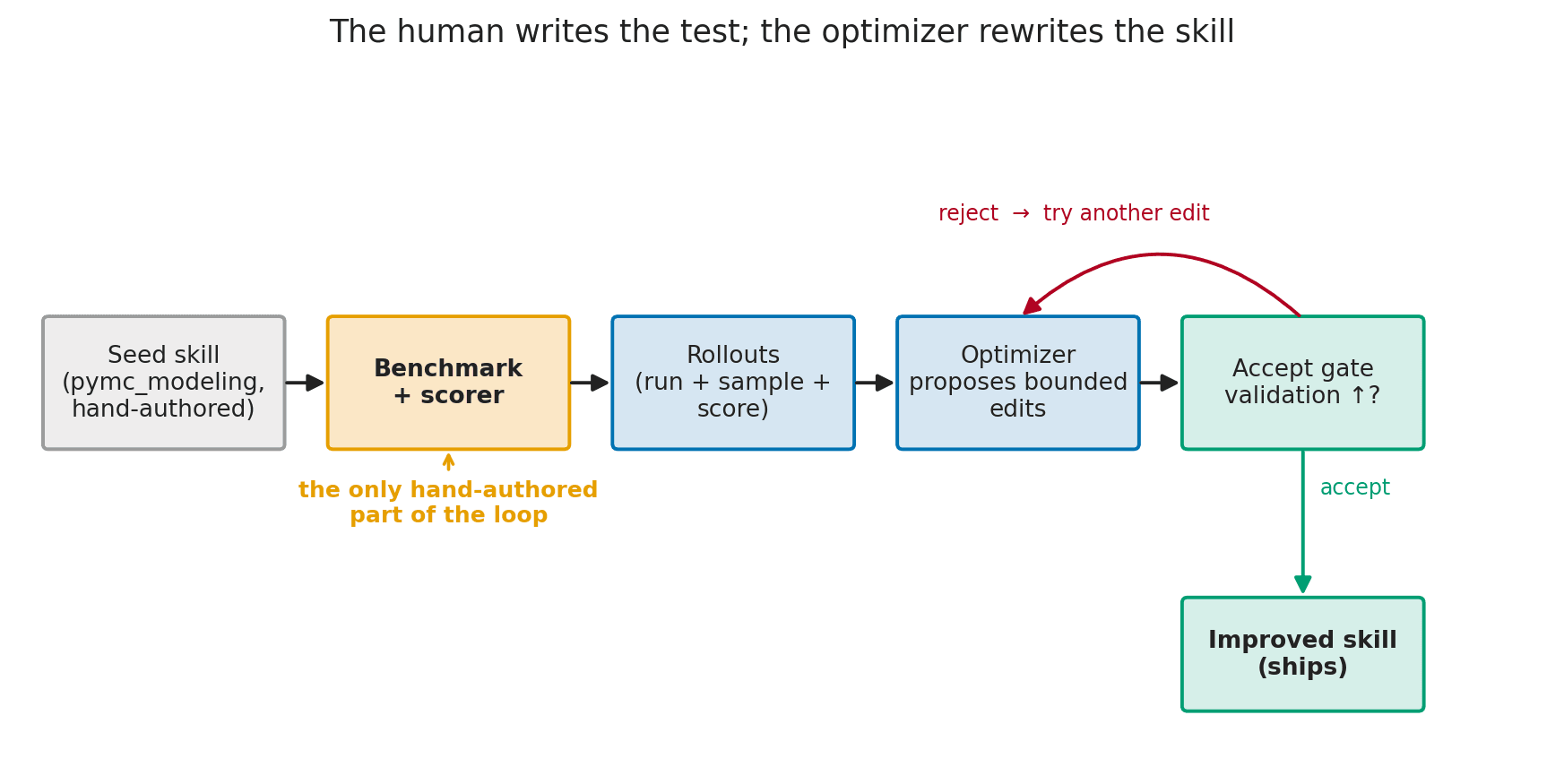
Image source: pymc-labs.com
Self-improvement fails when an agent hallucinates a more efficient way to perform a task that actually violates real-world constraints. To prevent this, you must ground automated skill optimization in a context layer. It acts as a single source of truth. As highlighted by PyMC Labs, using Reinforcement Learning from Execution Feedback (RLEF) allows an agent to verify that its generated code or logic actually runs successfully before it is integrated into the live workflow. This validation gate must be absolute. If an improved skill fails a check, it is rejected. It does not matter if the model insists it is a superior solution.
In a business setting, this might involve an agent checking a brand’s specific service area or pricing rules. It does this before updating its lead qualification script. By ensuring self-updates are tethered to existing documentation, you prevent the agent from drifting into logical errors. This approach moved an AI coding agent from a 60% success rate to 93% on PyMC tasks. Rigorous verification is the engine behind reliable self-correction. Organizations utilize grounded frameworks to ensure that automated content production remains aligned with strict brand guidelines, factual accuracy, and company policy.
7. Switch from manual patches to Recursive Self-Improvement (RSI) for scaffold components.
Manually updating every prompt and workflow in your tech stack is a recipe for burnout. The modern standard is switching to Recursive Self-Improvement (RSI) for scaffold components. This means formalizing self-improvement as an operator. It modifies the agent’s own prompts, memory structures, and control logic. Instead of changing the base foundation model, you apply these updates to the operational scaffold. This keeps the core system safe while allowing the capability layer to evolve. This transition is vital for those moving away from a duct-taped marketing stack.
By treating your capability gains as a structured library, you allow the agent to better navigate complex integration layers. Manual intervention becomes unnecessary. This recursive approach ensures that as your business grows and your data becomes more complex, your AI infrastructure scales. Its intelligence grows to match the new demand. The scaffold acts as the brain’s connective tissue. It allows for rapid iteration while the core model remains stable. This creates a scalable environment. The cost of improvement remains low. The quality of agentic workflows increases exponentially.
8. Orchestrate multimodal interactions to broaden the agent’s environmental feedback.

Image source: mindstudio.ai
To truly improve, an agent needs to see and hear the context of its work. Reading text is not enough. Orchestrating multimodal interactions integrating tool use, code execution, and sensory signals broadens the feedback. Using multimodal signals allows the agent to learn from diverse interactions. It can identify a friction point in a visual landing page builder. As discussed at Stanford CS329A, developers are increasingly building autonomous systems that function as multimodal research assistants.
This is particularly useful for businesses that need their agents to manage digital outreach across different formats. This includes video or social DMs. When an agent can process a video testimonial or a screenshot of a technical error, its ability to self-correct its support logic becomes significantly more powerful. This holistic feedback loop ensures the agent is not just optimizing for keywords. It optimizes for the actual human experience of your customers. By incorporating diverse data streams, the agent builds a comprehensive understanding of the business ecosystem. This leads to more robust self-improvement cycles.
How to Transition from Static Bots to Self-Improving Agents
The transition from rigid chatbots to self-improving AI agents begins with an audit of your current tech stack. Identify where manual data entry or fragmented tools cause friction. These are the points where autonomous agents offer the most immediate relief. Instead of relying on various disconnected apps, centralize your data into a unified AI operating system. This provides the clean context layer necessary for agents to ground their learning. It helps avoid hallucinations during recursive optimization steps.
Start small. Deploy agentic workflows for lead qualification. These agents handle high-volume outreach. They refine their messaging based on which questions lead to booked appointments. You can also expand into autonomous reputation management by implementing agents that send review requests and reply to customer feedback automatically. This builds a self-sustaining loop for local SEO that gets stronger with every customer interaction. As you scale, monitor the cost-benefit of test-time compute scaling versus simple fine-tuning. By moving away from a duct-taped approach, you allow your AI to become a dynamic asset.
Measuring Success and Avoiding Recursive Drift

To keep your self-improving systems on track, you must treat your agent’s logic with the same rigor as software development. Use version control for all prompts and logic scaffolds. This ensures you can roll back any unsuccessful self-improvements immediately. Security protocols are also paramount to prevent jailbreaking during the autonomous update process. You should constantly compare agent-led qualification rates against your historical human benchmarks. Quality must remain high as the agent optimizes for speed.
Monitoring agent health requires specialized tools that can interpret how agents process complex data. Developers utilize diagnostic tools to see how AI reads video and text assets. This ensures the agent’s interpretation aligns with the intended outcome. This prevents recursive drift, where an agent might optimize for a narrow metric like response time while sacrificing accuracy. Finally, adopt a flat-pricing model for your AI tools. ASM offers $150 per month. This ensures that as your agents handle unlimited contacts and users, your software costs do not spiral out of control.
Frequently asked questions
How do self-improving AI agents actually work?
They use a feedback loop where execution results (success or failure) are fed back into the agent’s prompt or logic scaffold. The agent analyzes its own performance against a set of benchmarks and modifies its internal rules of thumb to avoid past errors. This process creates a flywheel effect where the agent becomes more efficient and accurate over time without human intervention.
Can a self-improving agent qualify leads better than a human sales rep?
Agents can handle 24/7 lead qualification across SMS, WhatsApp, and social DMs without fatigue. By learning from every interaction, agents can refine their questioning techniques to identify high-intent prospects more accurately than manual screening. Integrating these agents into a unified inbox allows them to bridge the gap between initial contact and a booked appointment without friction.
What is the difference between an AI agent and a standard chatbot for lead generation?
Standard chatbots follow static, hard-coded decision trees that break when a user deviates from the script. Self-improving AI agents use agentic workflows to reason through complex queries and adapt their behavior based on user intent. Agents can perform actions like updating a CRM pipeline, sending review requests, or scheduling appointments autonomously.
What are the risks of recursive self-improvement in AI?
The primary risk is drift, where the agent optimizes for a specific metric at the expense of accuracy or brand voice. Without proper grounding in a context layer, agents might hallucinate new rules that contradict business policies. Implementing a governed scaffold ensures that improvements are validated by a verifier model before being deployed to the live environment.