
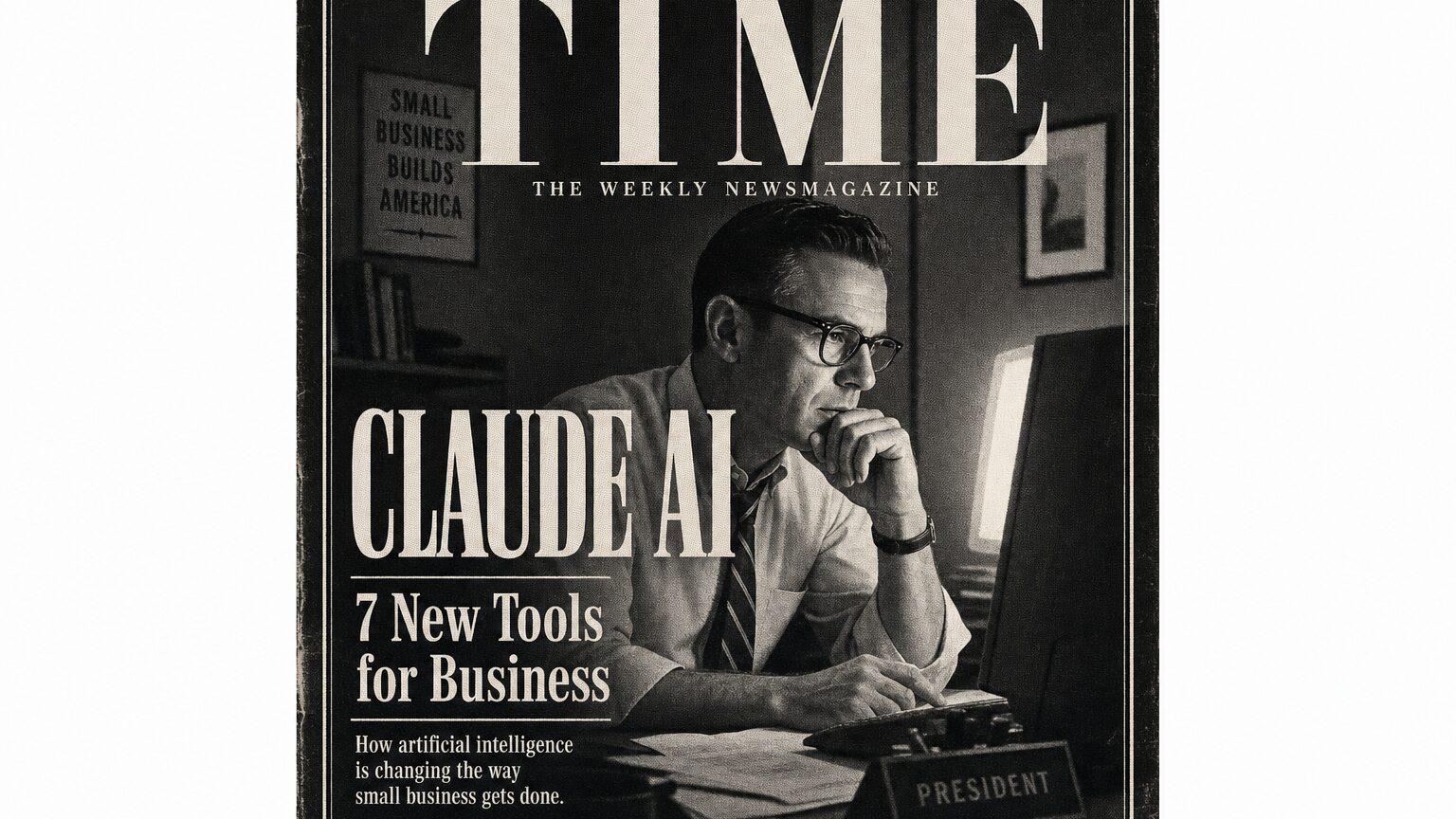

Anthropic launched Claude for Small Business in May 2026, a bundled package of connectors and ready-to-run workflows that drops the company’s AI assistant directly inside the tools small business owners already use every day. The release positions Anthropic, the maker of Claude, as a direct competitor for the small business AI dollar at a moment when 82% of small employers report active investment in AI tools, according to the Small Business and Entrepreneurship Council’s 2026 Tech Use Survey.
The product is designed as a toggle install. Once enabled, Claude is connected to Intuit QuickBooks, PayPal, HubSpot, Canva, Docusign, Google Workspace, and Microsoft 365. From inside those tools, the assistant can plan payroll, close the month, run a sales campaign, chase invoices, and draft customer communications without the owner switching context between six dashboards.
What Small Business Owners Actually Get
The headline value of Claude for Small Business is not the model itself. Owners can already access Claude through the standard consumer or team plans. The new product matters because of the connectors. Each connector turns a one-off chat tool into a workflow engine that reaches into the systems where work actually happens.
A few of the use cases Anthropic highlighted at launch:
- Reconcile a QuickBooks ledger and surface unusual transactions before month-end close.
- Pull HubSpot pipeline data and draft personalized follow-up emails for stalled deals.
- Generate Canva-ready creative assets for a seasonal sales campaign from a single prompt.
- Track open invoices in PayPal and draft a sequence of reminder messages with payment links attached.
- Search across Google Workspace and Microsoft 365 to assemble a briefing for a customer meeting.
For a small operation, the practical effect is that one operator can run sales, finance, and marketing tasks from a single interface rather than juggling separate logins.
Why the Tour Matters More Than the Software
Alongside the product, Anthropic announced a national tour. Starting May 14, 2026 in Chicago, the company is taking Claude for Small Business on the road as a free, half-day live AI fluency training and hands-on workshop for 100 local small business leaders per stop. The tour is co-hosted by Tenex.co, with local partners at each city.
Attendees receive a one-month Claude Max subscription. The format mirrors the offline strategy that Microsoft and Google have run for years: the on-the-ground sessions teach owners how to evaluate AI before they buy, which reduces buyer’s remorse and makes adoption stick.
Anthropic is also funding a separate equity initiative with Workday and the Local Initiatives Support Corporation. The Workday Foundation Solopreneurship Accelerator Program will equip an initial 2026 cohort of 15 aspiring solopreneurs with seed funding, Claude credits, and an AI-first entrepreneurship curriculum developed by LISC.
How the Move Reshapes the Competitive Landscape
The launch lands at a moment when competition for the small business AI subscription is unusually intense. Google used National Small Business Week in early May to push the Gemini Enterprise app and a promotional offer of 95% off Google Workspace for the first three months. OpenAI announced an enterprise-focused Deployment Company on May 11, 2026 with the explicit goal of embedding engineers inside organizations. Microsoft is bundling Copilot deeper into Microsoft 365.
Anthropic’s bet is that small business owners want fewer dashboards, not more. By making Claude work inside QuickBooks and HubSpot rather than asking owners to copy and paste data into a separate AI tab, the company is trying to compress the time-to-value that has stalled adoption for years.
The bar is real. A U.S. Census Bureau survey found that less than a fifth of firms are using AI in any business function, and a March 2026 Anthropic study acknowledged that its models were being used for only a fraction of the work tasks they are already capable of handling. The gap between capability and adoption is where Claude for Small Business is aimed.
Key Takeaways for Small Business Owners
- Pick the integration, not the model. The reason this matters is the connectors. If your business runs on QuickBooks, HubSpot, and Canva, this bundle removes the friction of switching tools. If it runs on tools outside that list, the upgrade is less compelling.
- Treat AI as a workflow change, not a tool purchase. The biggest gains from Claude for Small Business come from redesigning a routine (invoice chasing, lead follow-up, month-end close) around the assistant rather than bolting it onto a broken process.
- Use the tour for free training. The half-day workshops are designed for owners who have never built an AI workflow. Free expert-led training of this depth rarely lands in regional markets, and the one-month Claude Max included with attendance is a low-risk way to test the product.
- Watch the privacy posture. Connecting an AI assistant to financial and customer systems means reviewing data handling policies before turning on the connectors. Owners in regulated industries should confirm the integration meets their compliance requirements.
- Compare against Gemini Enterprise and Microsoft Copilot. The market has three serious contenders for the small business AI subscription. The best fit depends on which productivity suite your team already lives in.
Background
Anthropic was founded in 2021 by former OpenAI researchers and has positioned Claude as the safety-focused alternative to GPT-style assistants. The company has spent the past two years aggressively pursuing the enterprise market through deals with Amazon Web Services, Google Cloud, and major financial services firms.
The Claude for Small Business release marks the first time Anthropic has built a dedicated product for the small business segment. Until now, owners had to use the general consumer or team subscriptions and build their own integrations. By delivering pre-built connectors and offline training, the company is acknowledging that the small business buyer needs a different go-to-market motion than the enterprise buyer.
The broader context: small business AI spending is projected to keep climbing. 93% of small businesses using AI plan to continue investing in it in the next year, and 62% report they will increase AI-related spending in 2026. The product launch is a clear bid for that wallet share.
What Owners Should Do Next
For owners already paying for QuickBooks, HubSpot, or the major productivity suites, the practical next step is to run a controlled trial on a single workflow. Pick one painful process, such as invoice follow-up or month-end reporting, and use Claude for Small Business to handle it for two weeks. Measure the hours saved and error rate before deciding whether to expand.
For owners not on those platforms, the news is less actionable. The connector bundle is the value, and the bundle assumes the integrations match. The tour, however, is open to anyone running a small business and is a low-cost way to evaluate AI fluency before committing to a subscription.
The bigger signal in this launch is the direction of the small business AI market. The era of standalone chat tools is ending. The next round of competition will be won by whoever delivers the most useful workflow inside the tools owners already pay for, with the least amount of new training required.