
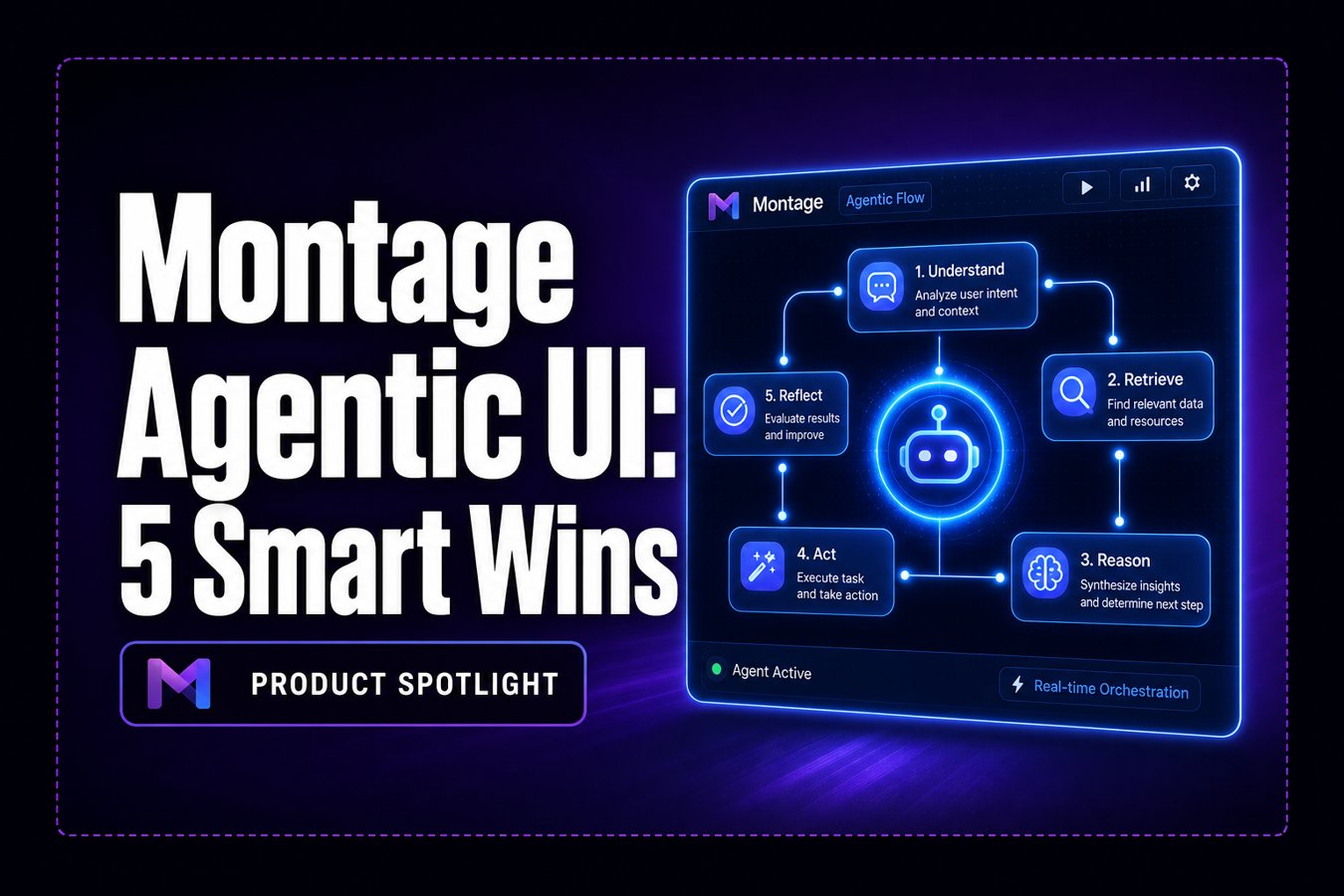


M1 by Montage — Agentic UI that scales on demand
161 upvotes · #5 Product of the Day · Launched May 18, 2026 — View on Product Hunt
M1 by Montage addresses a critical infrastructure gap in agentic AI: the cost and latency explosion of rendering interactive user interfaces. The montage agentic ui platform solves the fundamental problem that most AI agents generate UI descriptions client-side, forcing expensive inference loops and inconsistent output. Montage compiles production-ready components server-side, delivering hosted interactive visuals in a single API call—achieving 10x faster rendering and 50-100x fewer tokens consumed.
Topics: User Experience, Developer Tools, Artificial Intelligence
What M1 by Montage Does
M1 by Montage operates on a simple premise: let agents emit a lightweight intent schema instead of generating verbose UI code. The platform then handles the heavy lifting—compiling that schema into production-grade components, hosting them as live interactive interfaces, and managing persistent state. One API call generates a rich dashboard, form, data visualization, or workflow UI with styling that conforms to the brand’s design system.
The result is dramatic efficiency. Compared to traditional agent-UI loops where each turn re-renders or regenerates interface elements, Montage keeps inference focused on logic rather than presentation. The hosted artifacts persist across sessions, allowing users to return and interact with saved outputs without re-invoking the model. Progressive streaming renders the interface as it builds, eliminating skeleton-screen delays.


Why Montage Agentic UI Matters
Inference costs are the primary operational constraint in scaling AI agents to production. Every token an agent consumes to describe UI layout, styling, or interactivity is a token that could instead drive business logic, reasoning, or tool integration. Small business owners and developers running agent workloads at meaningful scale face a choice: accept high inference bills or accept degraded user experience.
Montage agentic ui inverts that tradeoff. By moving UI compilation and hosting off the model’s execution path, teams recover the token budget they were burning on presentation. The 50-100x token reduction directly translates to operational cost savings, particularly for teams running continuous agent processes or serving multiple concurrent users. The 10x latency improvement matters equally—users see responsive interfaces instead of waiting through multi-second generation cycles.
Model and framework agnosticism is the infrastructure advantage. Teams using any major LLM all integrate with the platform through the same API. Frontend frameworks (React, Vue, or plain JavaScript) are decoupled from the agent’s choice of LLM, eliminating forced architectural dependencies.
Key Features
M1 by Montage ships with several core capabilities designed for production agent infrastructure:
- Server-Side Component Compilation: Intent schemas become production components instantly, no client-side rendering overhead.
- Persistent State Management: Artifacts retain data across sessions, enabling users to reference and build on prior agent outputs.
- Hosted Live UIs: No infrastructure required—Montage manages hosting, scaling, and availability of generated interfaces.
- Progressive Streaming: Interfaces render as they build rather than blocking on full completion, improving perceived responsiveness.
- Design System Theming: The platform adapts styling to match company branding without additional configuration.
- Single API Call Integration: Teams invoke one endpoint to generate, host, and deliver interactive visuals directly to end-users.
Who Will Benefit Most
M1 by Montage targets teams already committed to agentic infrastructure: founders and developers building customer-facing AI products. Early adopters benefit most—those creating AI-powered dashboards, analytical tools, research workspaces, or operations systems where UI generation is happening today but at prohibitive cost.
Small business owners operating on tight unit economics find immediate value. Every 50-100x reduction in token consumption directly improves margins. Developers managing agent deployments across multiple models appreciate the framework-agnostic design; switching LLMs no longer requires rearchitecting UI generation pipelines.
Teams in regulated industries (finance, healthcare, compliance-heavy sectors) benefit from Montage’s hosted infrastructure—no client-side code generation, no injection risks, deterministic output that auditors can validate.
Pricing Model
M1 by Montage operates on a freemium credit system. New users receive free credits to explore the platform, then graduate to paid plans based on volume. Credit consumption correlates directly to API calls and artifact hosting, making cost predictable and tied to actual usage rather than seat-based licensing.
Alternatives in Agent Tooling
Teams might consider alternative approaches: building custom UI rendering pipelines (high engineering cost, ongoing maintenance burden), using generic component libraries (still requires token-expensive agent generation), or accepting that UI regeneration is necessary overhead. Few platforms directly tackle this specific problem—the intersection of agent cost optimization and persistent, branded UI delivery.
Pros and Cons
Strengths: Dramatic token reduction (50-100x) and latency improvement (10x) address the primary scaling constraint in agent applications. Model and framework agnosticism eliminate architectural lock-in. Hosted infrastructure removes operational overhead. Persistent state and progressive streaming improve user experience without additional engineering.
Weaknesses: Dependency on a third-party service means inference UI generation becomes external to the agent’s infrastructure. Teams must trust Montage’s availability and uptime. Early-stage platform may have undocumented edge cases or limited customization for highly specialized UI requirements. Pricing at scale remains variable and worth calculating against the team’s actual token consumption.
The Verdict
M1 by Montage solves a real, acute problem: AI agents waste enormous token budgets and inference time on UI generation. For small business owners and developers shipping agent-driven products, montage agentic ui offers a path to lower operational costs and better user experience. The 50-100x token savings alone justify evaluation, particularly for teams already managing inference budgets as a critical constraint. The platform’s model-agnostic design and hosted infrastructure eliminate the engineering overhead of building equivalent functionality in-house. Teams evaluating agent infrastructure should benchmark Montage against their current UI generation costs.
Check out M1 by Montage on Product Hunt or visit the official M1 by Montage website to learn more.