
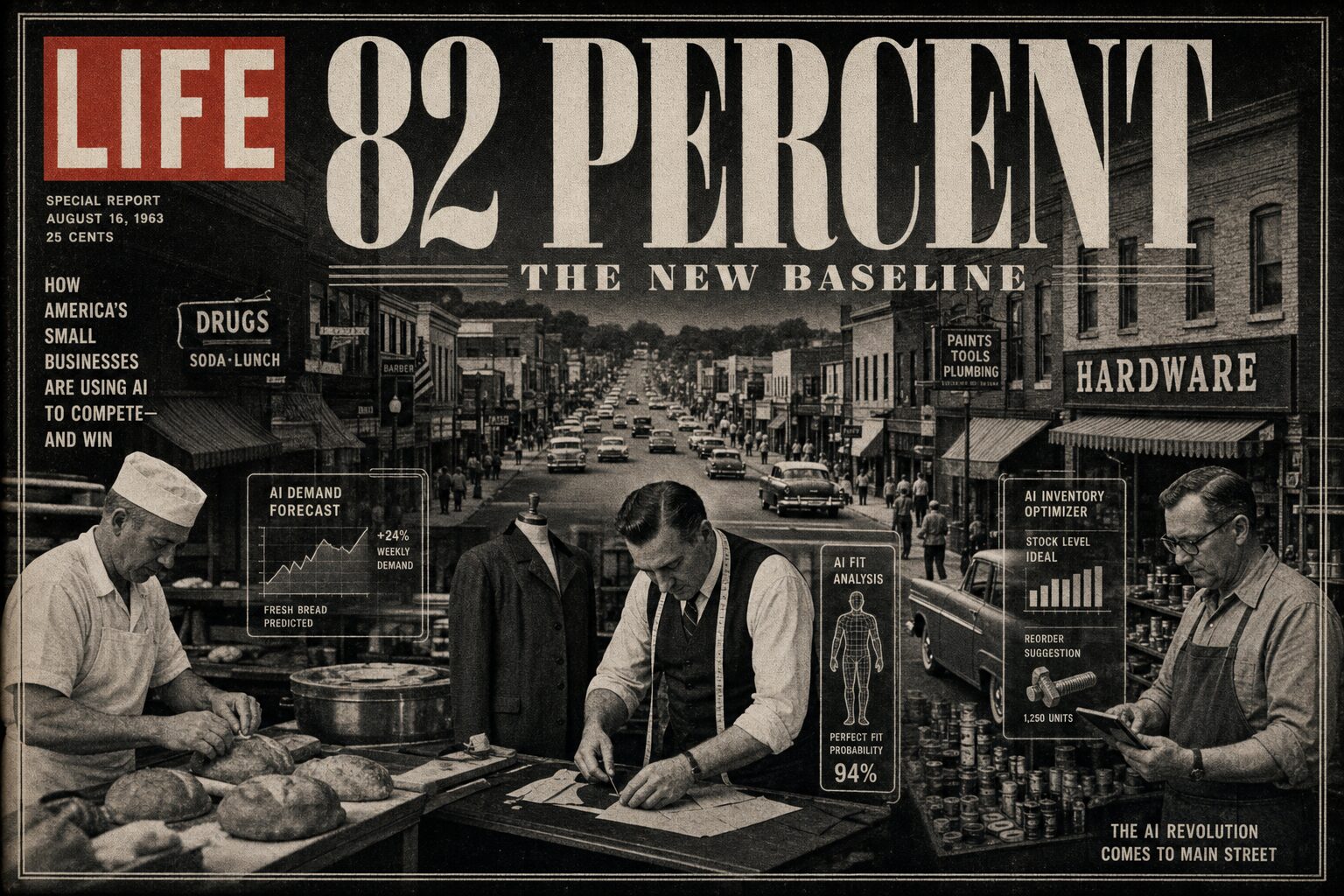

The majority of America’s small businesses have crossed a decisive threshold: artificial intelligence is no longer an experiment — it is an operational standard. A landmark 2026 survey by the Small Business & Entrepreneurship (SBE) Council finds that 82% of small business employers have adopted at least one AI tool, the average company runs five distinct AI tools, and 62% plan to increase AI spending before the year is out. For the roughly one-in-five small businesses still on the sidelines, the competitive gap is widening by the week.
The Numbers That Define a Turning Point
The SBE Council’s Small Business Technology Use Survey, conducted in February 2026 among 517 small business employers with 2 to 99 employees, delivers the clearest picture yet of how deeply AI has embedded itself in day-to-day operations.
Key findings at a glance:
- 82% of small business employers have invested in at least one AI tool
- The typical small business now runs five AI tools simultaneously
- 93% of AI-using businesses plan to continue investing over the next 12 months
- 62% will actively increase their AI-related spending in 2026
- 81% of small business owners say AI is important to their competitiveness and growth
- 77% express optimism about AI’s broader impact on business and the economy
- Only 9% of small business owners describe themselves as pessimistic about AI’s trajectory
Those figures collectively paint a picture of mainstream adoption with confident forward momentum — not cautious experimentation.
Where Small Businesses Are Putting AI to Work
Small businesses are not deploying AI in one place and calling it done. According to the SBE Council’s research, the most successful operators are building what researchers describe as “AI ecosystems” — deliberate stacks of complementary tools aligned to specific pain points and revenue goals.
Marketing and Content Creation
Marketing ranks as the single most common use case for AI among small businesses surveyed. Content creation — including social media copy, email campaigns, product descriptions, and ad creative — sits at the center of this category. AI tools allow lean teams to produce at a volume and consistency that was previously possible only for businesses with dedicated marketing departments.
Workflow and Administrative Automation
Administrative automation is one of the fastest-growing AI applications in the small business sector. Scheduling, document processing, customer follow-up sequences, invoicing reminders, and internal communications are all being handed off to AI-driven systems. The time savings are not marginal: the survey finds that business owners personally save a median of five hours per week, while employee time savings average 11.5 hours per week across the organization.
Combined, that is 16.5 hours of recovered capacity every week — time redirected from administrative friction toward revenue-generating work.
Customer Engagement and Sales Support
Customer engagement and management tools rank among the top three AI use cases, particularly for businesses selling online or across multiple channels. AI is being applied to personalize customer communications, identify purchasing trends, respond to inquiries faster, and surface upsell opportunities that manual workflows routinely miss.
Financial Operations
Financial AI tools are among the most impactful for long-term sustainability, according to SBE Council researchers. Small businesses are using AI to shift finance from a transactional function — tracking what happened — to a strategic one: modeling scenarios, improving margins, and supporting faster, better-informed decisions.
The ROI Case Is Already Closed
Skepticism about AI’s business value is fading rapidly among small business owners who have put the tools to work. Two-thirds — 66% of AI-adopting businesses — report measurable revenue increases linked directly to AI use. Within that group, 22% report revenue gains exceeding 10%.
The SBE Council estimates that the aggregate time savings across the small business sector — based on the survey’s median figures — translate to $243.6 billion in annual value when calculated at representative labor costs. That is not a projection; it reflects what businesses say they are already saving.
AI assistants such as ChatGPT, Claude, and Gemini are frequently cited as entry points for adoption — described by researchers as functioning like a flexible, low-cost “AI employee” capable of spanning multiple business functions from a single interface.
Key Takeaways for Small Business Owners
- Majority adoption means the bar has moved. With 82% of small business employers using AI, it is no longer a differentiator — it is baseline infrastructure. Businesses still evaluating whether to start are already behind the efficiency curve their competitors are running on.
- Five tools is the new normal. Single-tool adoption is a starting point, not a strategy. The survey’s data shows that high-performing small businesses build layered AI stacks aligned to marketing, operations, customer management, and finance — not just one category.
- Time savings compound quickly. Recovering 16.5 hours per week across owner and staff time is the equivalent of adding nearly half a full-time employee’s productive capacity — without the overhead. Businesses not capturing this gain are operating at a structural disadvantage.
- Revenue impact is real and measurable. Two-thirds of AI-using small businesses report higher revenue. Waiting for more proof means watching competitors capture customers, conversions, and margin while standing still.
- The investment window is now. With 62% of current AI users planning to spend more in 2026 and only 9% pessimistic about AI’s outlook, the competitive distance between adopters and non-adopters will continue to grow throughout the year. Starting with even one or two tools in marketing or automation creates compounding returns.
Barriers Worth Acknowledging — and Overcoming
The SBE Council’s survey also captures the friction that holds some businesses back. The leading barriers to adoption are limited knowledge or training (23%) and concerns about data privacy. Both are real challenges, but neither is insurmountable — and both are shrinking as AI tools become more intuitive, better documented, and more transparent about how data is handled.
For small business owners who feel underprepared, the practical starting point is narrow: identify the single most time-consuming task in the business and find one AI tool built to address it. Content drafting, appointment scheduling, and customer inquiry response are all areas where AI delivers immediate, measurable relief with minimal setup.
The Competitive Landscape Has Already Shifted
The SBE Council’s April 2026 analysis frames the current moment clearly: small businesses are not waiting for AI to mature. They are using it today, expanding their use tomorrow, and building operational models that assume AI as a core layer — not an add-on.
For business owners who have been waiting for the right moment to adopt, that moment has passed. The right move now is the fastest path to catching up. Platforms designed to unify AI-driven marketing, automation, and customer management — the kind of integrated infrastructure that tools like an Automated Sales Machine are built around — represent one path to compressing that gap quickly.
The data is unambiguous: small businesses using AI are saving more time, generating more revenue, and entering 2026 with stronger momentum than those that are not. The survey’s 82% figure is not a ceiling — it is the floor of the new competitive standard.