


Nugget AI — Turn customer interviews into your product roadmap
143 upvotes · #9 Product of the Day — View on Product Hunt
Nugget AI addresses a persistent friction point for product teams: converting customer interview data into actionable evidence. The platform automates the extraction of pain points, feature requests, and market themes from recorded or uploaded calls, then synthesizes findings into draft product requirement documents (PRDs) grounded in real customer quotes. For product teams and founders evaluating AI tools for business, Nugget AI offers a focused solution that eliminates manual transcription and synthesis work while positioning itself at half the cost of established alternatives like Dovetail.
Topics: SaaS, Artificial Intelligence
How Nugget AI Works: The Customer Interview Pipeline
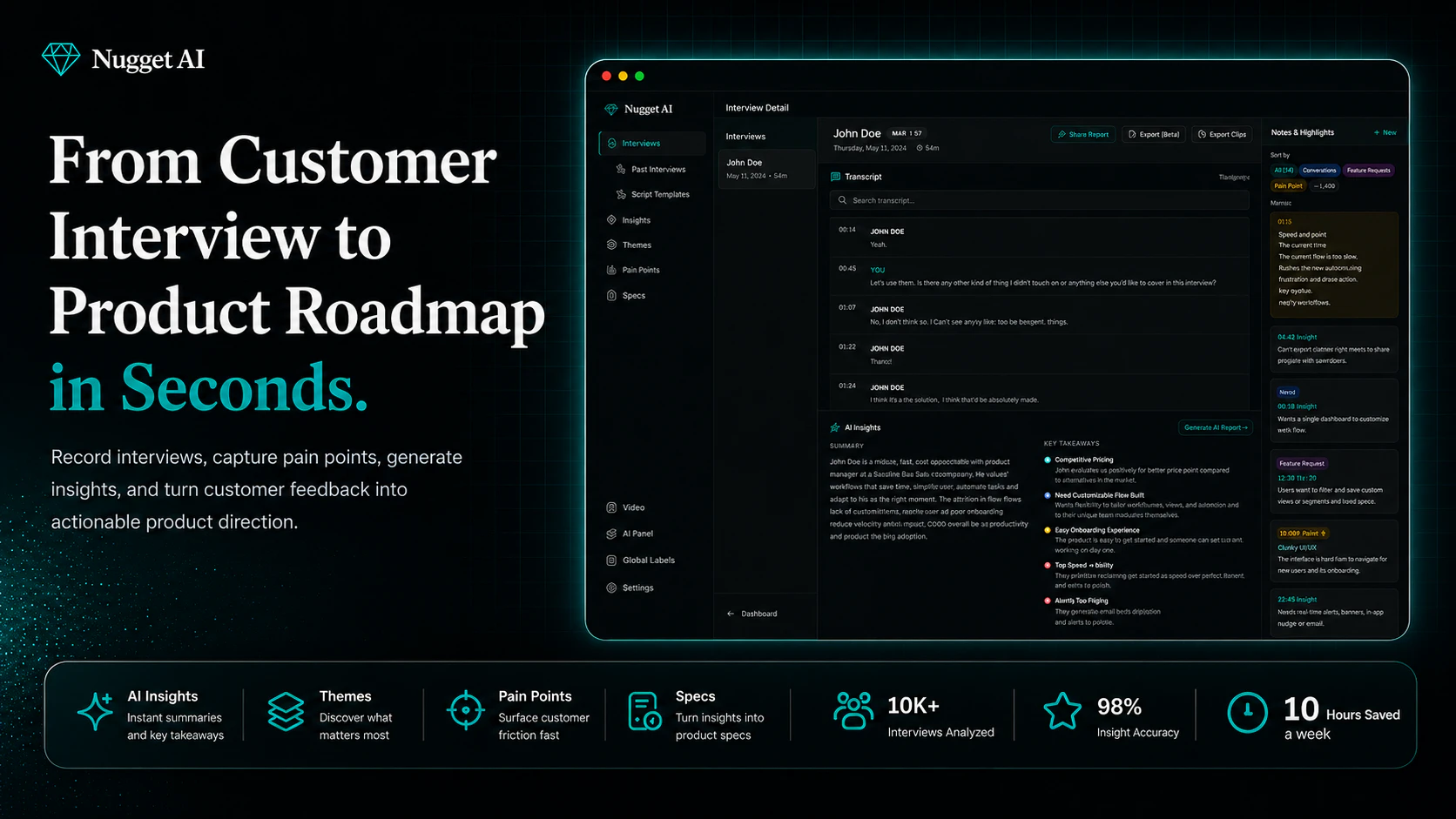
Nugget AI operates on a straightforward four-step workflow. First, users record calls directly or upload existing interview recordings and transcripts. The platform accepts audio and video formats, making it practical for teams that already conduct customer research. Second, the AI layer extracts structured insights—pain points, feature requests, and user context—without requiring manual annotation. Third, a synthesis engine identifies recurring themes across all interviews, surfacing patterns that might be buried in dozens of individual conversations. Fourth, the system generates draft PRDs populated with direct customer quotes, creating a dev-ready artifact that product teams can refine and hand off to engineering.
This pipeline replaces a manual workflow that typically consumes 10-15 hours per research round: listening to calls, transcribing, reading transcripts, highlighting key moments, synthesizing themes, and writing requirements from scratch. By automating the heavy lifting, Nugget AI compresses that cycle significantly, though teams will still want to validate findings and add strategic context.
Key Features: MCP Server and AI Agent Integration
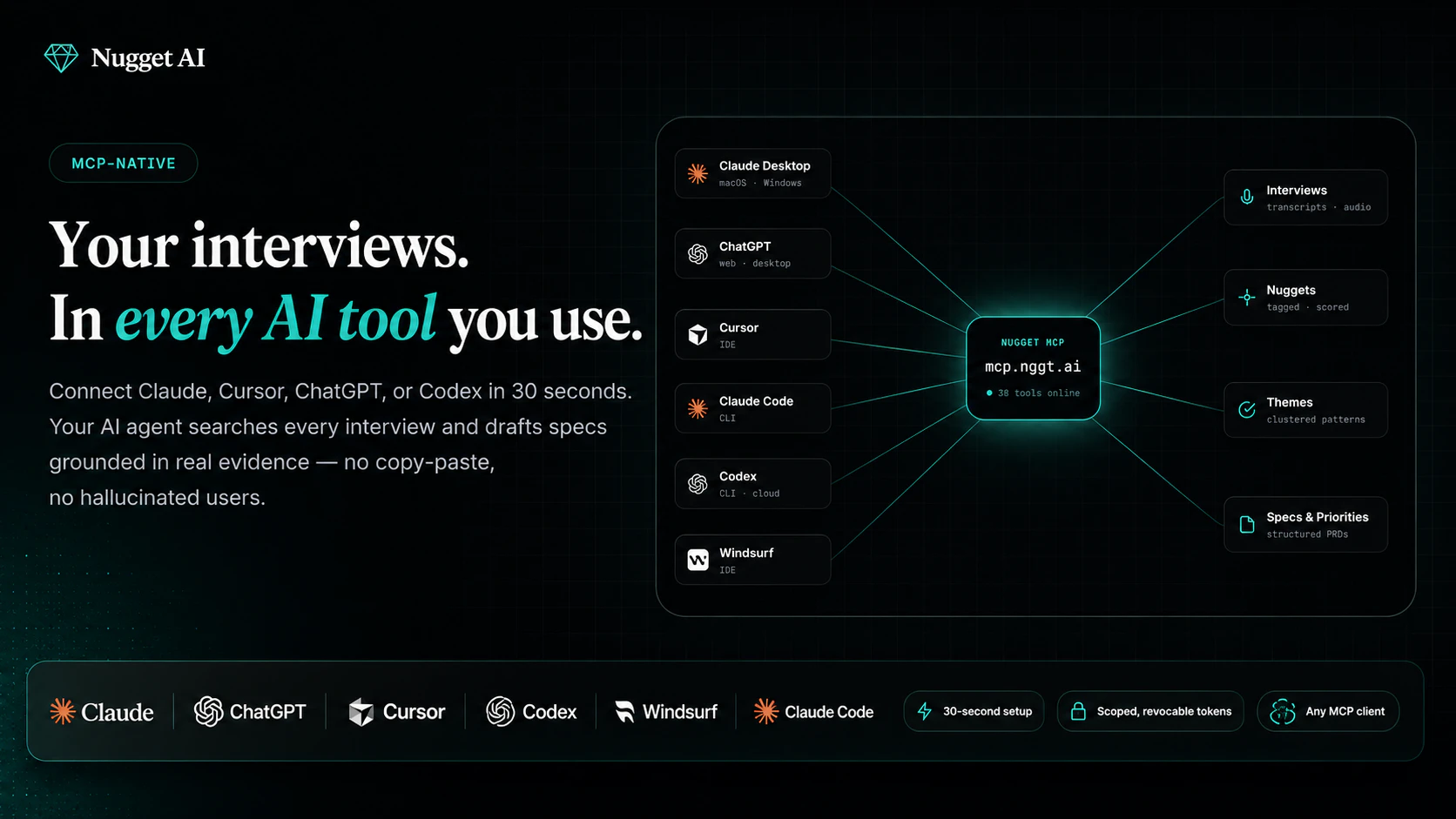
Nugget AI’s headline feature for 2026 is its Model Context Protocol (MCP) server, which fundamentally changes how product teams interact with customer data. Rather than exporting insights manually and copy-pasting into specification tools, teams can now connect Claude, ChatGPT, Cursor, or other AI agents directly to the Nugget AI knowledge base. An AI agent running in your IDE or editor can search every interview on the fly, ground feature specifications in real customer evidence, and draft requirements without context-switching.
This integration matters because it removes the information asymmetry that often exists between customer research and development. Engineers typically see PRDs but not the underlying interview data; with MCP access, agents (and teams) can trace requirements back to the source conversation. This creates accountability and reduces the “we built what was requested, but users didn’t want it” failure mode.
Beyond the MCP server, core features include:
- PRD Generation: Auto-generated product requirement documents with customer quotes embedded as evidence, reducing writing time and increasing credibility with engineering teams.
- Linear and GitHub Integration: Direct handoff to development tools, transforming PRDs into tickets without manual data entry.
- Theme Synthesis: AI groups similar pain points and requests across interviews, helping product teams distinguish signal from noise.
- Interview Repository: Searchable archive of all calls and transcripts, accessible to the broader team rather than siloed with the researcher.
Use Cases: Product Teams and Founder-Led Research
Nugget AI is designed for two primary audiences. Product teams at scaling SaaS companies use it to formalize customer feedback into product strategy, particularly when research volume exceeds one researcher’s capacity to manually synthesize. The tool allows teams to conduct more interviews without proportionally increasing synthesis time, making customer-driven development sustainable at higher research cadence.
Founders leading early-stage product decisions benefit differently. For bootstrapped or seed-stage companies, customer interviews are often the only market signal available; Nugget AI lets founders dedicate more time to talking to users and less time transcribing. The MCP server feature is particularly valuable here—a founder can ask Claude or ChatGPT to draft a feature spec grounded in customer interviews without learning yet another tool or hiring a product manager.
Teams managing complex feature requests across multiple customer segments—common in B2B SaaS—use Nugget AI to distinguish signal (requests from multiple high-value customers, representing a real market gap) from noise (one-off requests from low-intent users). The theme synthesis does this work automatically.
Pricing and Comparison to Alternatives
Nugget AI’s pricing positions it at half the cost of Dovetail, the market leader for qualitative research platforms. This price advantage is significant for small and mid-market teams that would otherwise find enterprise research tools prohibitive. Below is a feature and positioning comparison:
| Feature / Capability | Nugget AI | Dovetail | Productboard | Maze |
|---|---|---|---|---|
| Call Recording & Transcription | Yes | Yes | Limited | Yes |
| AI-Powered Theme Synthesis | Yes | Yes | Yes | Limited |
| Auto-Generated PRDs | Yes | Partial | Yes (via integrations) | No |
| MCP Server / AI Agent Integration | Yes (New) | No | No | No |
| Linear / GitHub Direct Handoff | Yes | Limited | Yes | Limited |
| Relative Pricing | 1x (Base) | 2x | 1.5x | 1.2x |
Nugget AI’s MCP server is the strongest differentiator. Dovetail and Productboard excel at heavyweight qualitative analysis and cross-team collaboration, but neither offers native AI agent integration. For teams already embedded in AI-first workflows—using Claude or ChatGPT for drafting, Cursor for coding, or custom agents for automation—Nugget AI’s MCP layer is a material advantage.
Alternative Platforms and Where Nugget AI Fits
Dovetail remains the best-in-class for enterprise teams running large-scale, multi-team research programs with complex collaboration needs. Its tagging, filtering, and report-building tools are more granular than the platform’s. However, Dovetail’s pricing and feature complexity make it overkill for many product teams.
Productboard is stronger at roadmap management and capturing feature requests from multiple sources (support tickets, user interviews, sales calls). It’s less specialized in interview analysis than the platform.
Maze focuses on unmoderated research (surveys, user tests) and is better for behavioral data than qualitative feedback synthesis.
UserTesting offers managed research and panel recruitment; it’s a different product category aimed at teams without research capacity.
the tool occupies a narrow but important niche: teams that conduct their own interviews and need to convert those conversations into product specs quickly. The MCP integration pushes this further, enabling AI-native workflows that neither Dovetail nor Productboard support.
Limitations and Considerations
the system is not a CRM tool and should not be considered a replacement for broader CRM for small business systems. It has no built-in customer tracking, pipeline management, or deal tracking. For teams that blend customer research with sales operations, a dual-tool approach (it + CRM) is necessary.
The AI-driven extraction and synthesis are only as good as the input quality. Rambling, poorly structured interviews will produce less actionable insights than tightly focused conversations with clear problem exploration. Teams still need discipline in how they conduct research.
The MCP server feature is new and ecosystem adoption is still building. While Claude, ChatGPT, and Cursor all support MCP, custom workflows and edge cases may require engineering support.
Pros and Cons at a Glance
Pros:
- Eliminates manual transcription and synthesis work, compressing research-to-spec timelines by 60-70%
- MCP server integration is a genuine differentiator, enabling AI agents to ground specs in customer evidence
- Direct handoff to Linear and GitHub reduces handoff friction and data loss
- Priced at half the cost of Dovetail, making it accessible to teams that would otherwise skip formalized research tooling
- Interview repository creates institutional knowledge, preventing research from siloing with individual team members
Cons:
- Limited to interview-centric research workflows; no support for surveys, support tickets, or other feedback channels
- Requires quality input; poor interviews yield poor synthesis
- MCP ecosystem is young; long-term platform stability and feature roadmap are unproven
- No advanced collaboration features like team comments, multi-stage approval, or permission management
Verdict
the platform fills a genuine gap in the product research toolchain, particularly for teams running Automated Sales Machine workflows or managing customer-driven product development. The core value—automating the conversion of interview recordings into structured, dev-ready PRDs—is real and saves time across both product and engineering teams. The MCP server is the forward-looking feature that sets the tool apart; it treats customer research as a data source that AI agents should have direct access to, rather than a static document to be reviewed and forwarded.
For founders and small product teams, the cost advantage relative to Dovetail alone justifies testing the platform. For larger teams, the decision hinges on whether the MCP integration and focused scope are preferable to the broader capabilities of heavier platforms. Either way, the system represents a shift toward AI-native product development, where customer evidence is not buried in Slack or email but instead flows directly into code and specification tools.
Check out it on Product Hunt or visit the official the system website to learn more.