



Prosed — Go from newsletters & podcasts to published manuscript
152 upvotes · #8 Product of the Day — View on Product Hunt
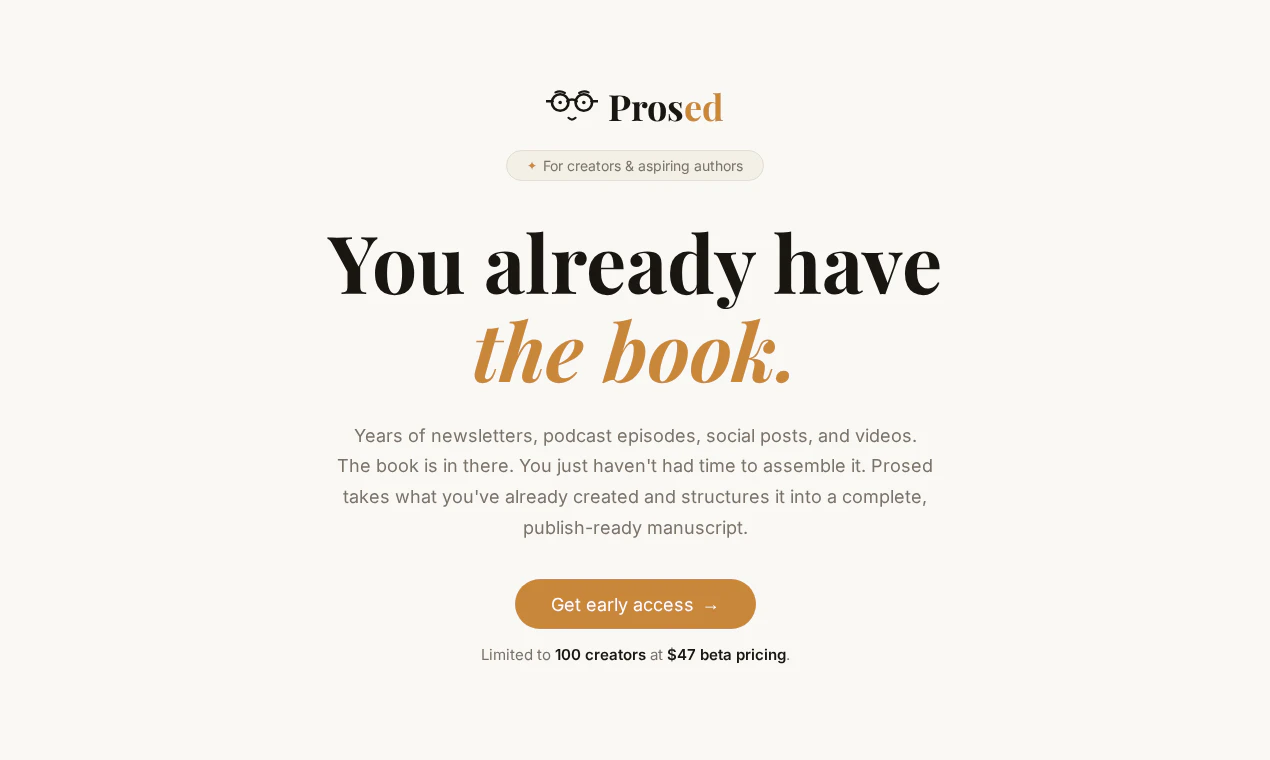
Prosed tackles a problem that plagues modern creators: the gap between the content they’ve produced and the book they haven’t written. Newsletters, podcasts, LinkedIn posts, courses, and blog articles represent hundreds of hours of thinking, research, and audience building — yet converting this scattered material into a cohesive manuscript feels impossible. The Prosed book writing tool automates the messy middle, analyzing voice patterns, organizing content into chapters, and producing a readable manuscript in weeks rather than years.
Topics: Artificial Intelligence, Books
For content creators and entrepreneurs who’ve built an audience through multiple channels, a published book represents both a credential and a business asset. But the traditional path from content to manuscript is grueling: manually compile posts, identify themes, rewrite for consistency, edit ruthlessly, and navigate publishing logistics. Prosed shortens this timeline by applying AI-driven structure and analysis to content that already exists, preserving the creator’s authentic voice while eliminating the editorial grunt work.
The Creator Content Gap
Many successful creators live this paradox. A podcaster with 200 episodes of original thinking. A newsletter writer with five years of subscriber insights. A course creator with modular lessons that could form a book’s backbone. Yet each of these individuals likely assumes that turning that content into a book requires starting from scratch — or hiring a ghostwriter at $15,000 to $50,000.
The barrier isn’t inspiration or audience. It’s architecture. Creators know their ideas work (their metrics prove it), but they lack a fast, affordable way to repackage that content into a format that publishing platforms, bookstores, and book-buying customers expect. Prosed exists to bridge that gap.
How Prosed Works: The Inkwell Pipeline
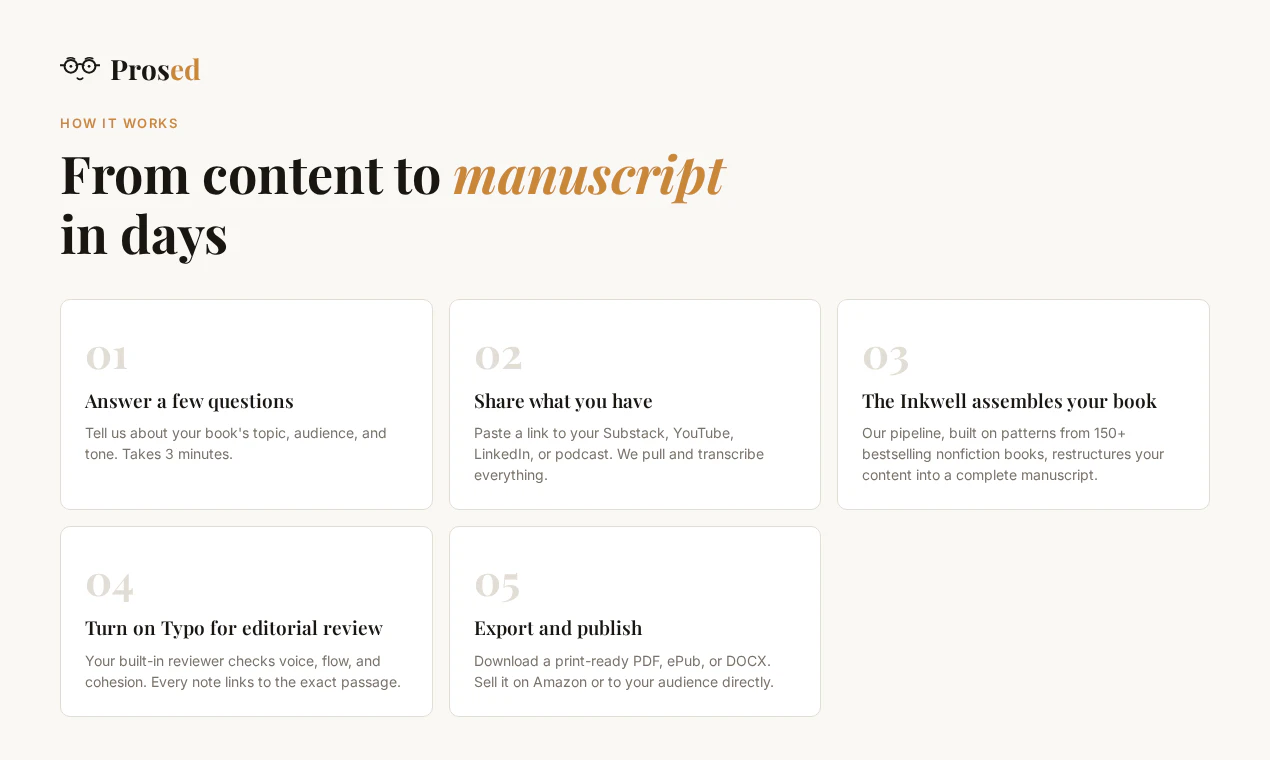
Prosed’s core innovation is its Inkwell pipeline, a multi-stage process that ingests scattered content and outputs a manuscript:
| Pipeline Stage | What It Does |
|---|---|
| Voice Analysis | Scans creator’s content to identify tone, vocabulary, recurring themes, and stylistic patterns |
| Content Organization | Groups related material into logical chapters and sections |
| Manuscript Generation | Synthesizes content into a cohesive narrative while maintaining the creator’s voice |
| Editorial Review | Built-in review layer flags inconsistencies, gaps, and redundancies |
| Export | Delivers print-ready PDF and DOCX formats |
The voice-analysis step distinguishes Prosed from generic AI writing tools. Rather than producing generic output, the system learns the creator’s perspective, vocabulary choices, and unique phrasing. The result reads like the creator’s authentic voice — not an algorithm’s interpretation of what a book should sound like.
Key Features
- Multi-source ingestion: Pull from newsletters (email archives), podcast transcripts, LinkedIn posts, blog articles, and course materials in a single project
- Intelligent structuring: Automatically clusters content by theme and assigns it to chapter positions without manual tagging
- Voice preservation: Uses your actual language patterns to ensure the manuscript sounds authentically like you
- Editorial dashboard: Review, flag, and edit chapters before export; built-in feedback loop improves accuracy
- Print-ready output: Export as PDF (formatted for print) or DOCX (for further customization)
- Metadata handling: Preserves publication dates, source attributions, and citations where relevant
Who Prosed Is For
Prosed targets four primary audiences:
Newsletter writers with a five-year archive and a mailing list. A newsletter is fundamentally a book in serialized form — Prosed recognizes this and offers to collect, theme, and finalize it.
Podcasters sitting on transcripts. Podcast episodes often contain 60–80 minutes of original insight per week. Across a multi-year run, that’s the equivalent of several books’ worth of material; Prosed extracts and condenses it.
Course creators who’ve already organized their thinking into modules. If your course is structured by topic (e.g., modules on strategy, tactics, case studies), Prosed can map that structure into chapters.
LinkedIn-native entrepreneurs and consultants who share insights in posts and threads. This scattered, frequent format is harder to organize manually; Prosed’s clustering algorithms handle it.
For any of these creators, Automated Sales Machine readers will recognize the appeal: a published book amplifies authority in the same way that marketing automation software amplifies reach. It’s a leveraged asset.
Beta Pricing and Positioning
Prosed is currently in beta, priced at $47 for the first 100 founders. This pricing is explicitly temporary — a way to gather feedback from early users before a full release. Current pricing positions the tool as an impulse purchase for creators who already believe a book is valuable; the long-term pricing structure will likely be higher.
For $47, creators get one manuscript project, the full Inkwell pipeline, editorial review, and export. The value proposition is clear: $47 vs. $15,000–$50,000 for a ghostwriter, with the added benefit that the creator retains complete control and creative input.
How Prosed Compares to Alternatives
The competitive landscape includes three relevant tools:
Atticus (atticusbooks.com) is a full book-publishing platform covering writing, formatting, and distribution. It’s more comprehensive but requires the creator to already have a manuscript drafted. Prosed solves the pre-manuscript problem.
Sudowrite (sudowrite.com) is a general creative writing AI trained to enhance prose quality. It can help polish a manuscript but doesn’t solve the structural challenge of turning scattered content into a cohesive narrative.
Jasper (jasper.ai) is a general-purpose copywriting and content AI that can generate books but doesn’t specialize in voice preservation or multi-source content ingestion. A creator would need to supply more structured input and do more manual assembly.
Prosed’s differentiation: it specializes in the creator-content-to-manuscript workflow and prioritizes voice authenticity. It’s narrower in scope but deeper in the problem it solves.
Limitations and Reality Check
Prosed is beta software, and important caveats apply:
First, the AI-generated manuscript is a draft, not a finished product. The Inkwell pipeline produces a readable structure with cohesive narrative flow, but the result will require line editing, fact-checking, and likely some chapter-level rewrites. Creators should expect 20–40 hours of editorial work post-export, depending on content quality and ambition level.
Second, beta software is inherently unstable. Feature updates, workflow changes, and potential bugs are par for the course. Early adopters should treat the $47 investment as a chance to shape the tool’s direction, not as a fully mature product.
Third, content quality matters. If source material is repetitive, poorly organized, or internally contradictory, the manuscript output will reflect that. Prosed can’t turn thin content into deep content; it can only organize and synthesize what’s there.
The Case for Creator-First Publishing
The rise of tools like Prosed signals a shift in how books get written. Traditionally, publishing required a publisher’s gatekeeping and a writer’s isolation. Today’s creators already have an audience and a body of work; they need help assembling it, not permission to publish it.
For entrepreneurs and content strategists — the same audience that uses CRM software for small business to systematize their operations — a published book is a scalable asset. It positions the creator as a thought leader, opens speaking opportunities, and creates a permanent reference that doesn’t disappear like a social post.
Verdict
Prosed is a thoughtful tool for a real problem. It won’t replace a professional editor or a ghostwriter for creators who want a polished final product without effort. But for creators willing to invest 20–40 hours in editorial review to turn their existing content into a manuscript, $47 is a genuinely compelling entry point.
The Inkwell pipeline’s voice-preservation approach sets it apart from generic AI writing tools, and the multi-source ingestion (newsletters, podcasts, blogs, courses) is rare in the publishing tool market. For podcasters with deep archives, newsletter writers with five-year backlogs, and course creators with organized material, Prosed offers a fast, affordable path from content to book.
The main risk: beta instability and the certainty that substantial editorial work remains after export. The main reward: a published manuscript in weeks instead of years, at a price that makes sense for early adopters.
Check out Prosed on Product Hunt or visit the official Prosed website to learn more.