
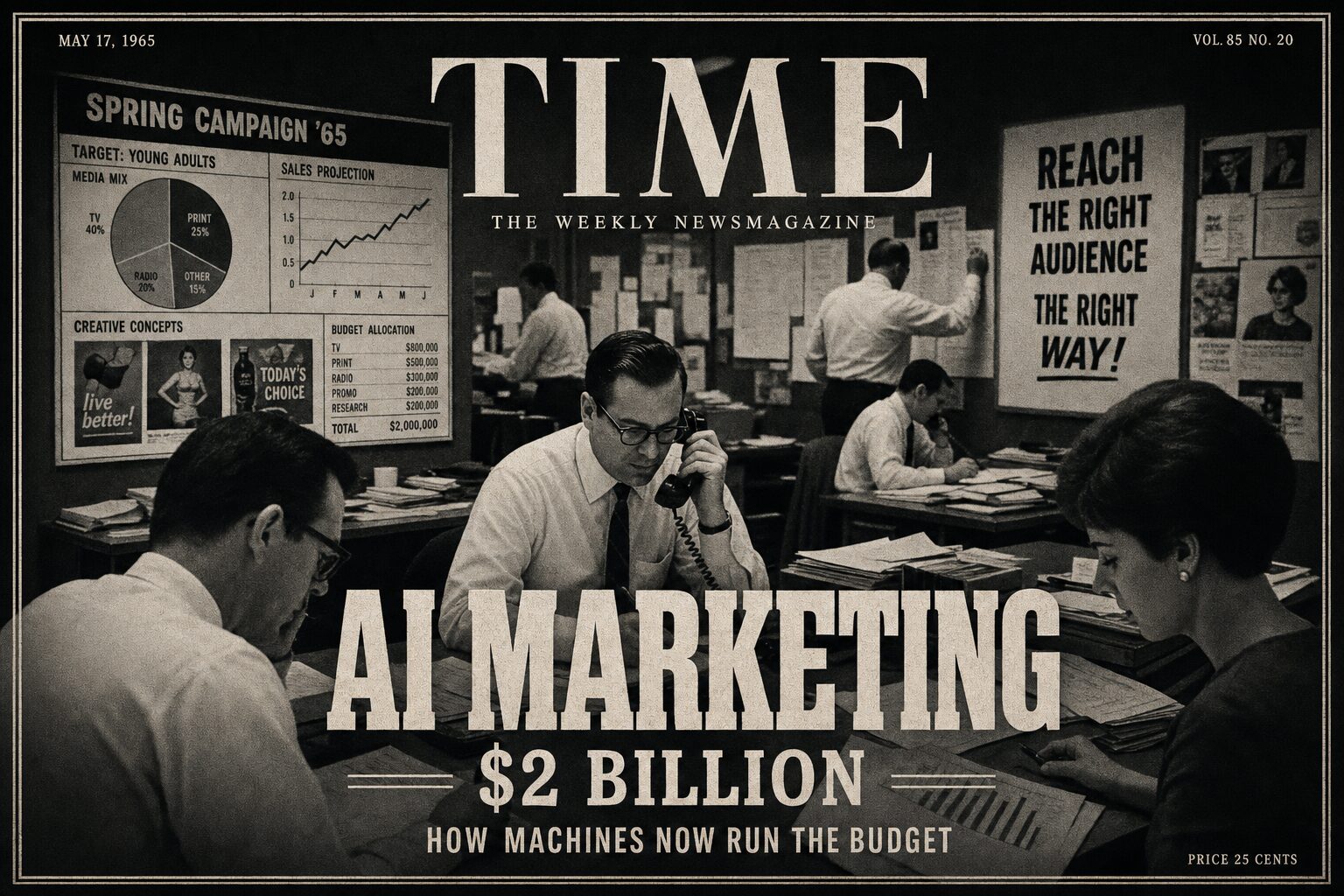

The Hershey Company has deployed an agentic AI marketing system to guide decisions across its $2 billion annual marketing budget — running marketing mix modeling monthly instead of the quarterly or twice-yearly cadence that has defined the industry for decades. The platform, built on tools from Mutinex and Tracer, processes data across Hershey’s entire brand portfolio every 30 days. For small and mid-sized businesses watching from the sidelines, the move signals that AI-driven, always-on marketing automation software is rapidly becoming the competitive baseline — not a luxury reserved for enterprises. The agentic AI marketing model Hershey is deploying may soon become a baseline expectation for competitive brands.
From Quarterly Guessing to Monthly AI Optimization
For much of its history, marketing mix modeling — the statistical method that measures how media spend, pricing, promotions, and distribution interact to drive sales — has been an inherently backward-looking tool. Hershey’s own VP of Media and Marketing Technology, Vinny Rinaldi, captured the problem plainly: “We were getting the full read of 2024 data midway through 2025, while we were planning for 2026.”
Under the old model, Hershey ran marketing mix analyses approximately three times per year, covering roughly five brands. Results arrived months after the underlying data was collected, making course corrections slow and expensive. By the time the analysis confirmed that a media channel was underperforming, budgets had already been locked for the next cycle.
The new system changes that arithmetic. Hershey now runs models across its full brand portfolio every month — 12 times per year versus the prior cadence of three. Each modeling cycle completes in as little as three weeks, compared to the months the traditional process required. The result is a marketing organization that can react to shifting market conditions in near-real time: adjusting where ad dollars flow before a bad quarter compounds into a worse one. For context, the difference between quarterly and monthly decision cycles means Hershey now has four times as many opportunities each year to redirect spending toward what is actually working in the market.
How the Agentic AI System Works
The platform Hershey deployed is built on two core components: Mutinex, which handles the AI-powered marketing mix modeling, and Tracer, which standardizes and cleans the data those models consume.
Tracer functions as what Rinaldi described as a “data washing machine.” Marketing data is notoriously fragmented — social platforms, search engines, streaming services, retail point-of-sale systems, and trade promotion databases all report in different formats on different schedules. Tracer ingests those disparate feeds and normalizes them into a consistent structure before Mutinex’s models ever see a data point. Without that standardization layer, the speed gains that Mutinex offers would be undercut by dirty inputs.
Mutinex itself operates as a multi-agent system, built on Claude and Gemini as underlying models. Rather than running a single monolithic analysis, it deploys specialized AI agents for distinct domains — marketing econometrics, competitive pricing theory, model diagnostics, and anomaly detection. Each agent contributes its domain expertise to a composite picture of how Hershey’s investments are performing.
The term “agentic” here is precise: the system does not merely surface dashboards for humans to interpret. It surfaces insights and recommends specific budget actions — and routes decisions that exceed a defined complexity threshold to human teams for final judgment. That human-in-the-loop architecture is deliberate. The agentic AI handles the high-frequency, lower-stakes optimization work; humans retain authority over material reallocation decisions. This mirrors what a well-designed marketing funnel looks like at the operational level: each stage handled by the right intelligence at the right speed.
The 4-5% Revenue Target — Realistic or Hype?
Hershey has publicly projected a 4% to 5% increase in revenue attributable to media spend once the system reaches full deployment. On a company of Hershey’s scale — annual revenues exceeding $10 billion — that range translates to $400 million to $500 million or more in incremental revenue. Against the $2 billion marketing and trade investment, it represents a meaningful improvement in return on spend.
The projection is ambitious but not implausible. Early signals from the system have already influenced real decisions: organic content for Kit Kat US delivered a view rate 4.5 times higher and 13 times more engagement than paid media, a finding that is now informing investment allocation. When modeling catches those signal anomalies monthly rather than quarterly, the compounding effect on allocation efficiency is real.
The honest caveat for smaller businesses is this: gains of this magnitude require clean data infrastructure as a prerequisite. The Tracer component — the data standardization layer — is not an afterthought. It is what makes the modeling reliable. Businesses that cannot first unify their marketing and sales data into a coherent structure should not expect optimization tools to compensate for fragmented inputs. The sequence matters: clean data first, then automation, then optimization.
What SMBs Can Take From This Agentic AI Marketing Shift
The lesson from Hershey’s deployment is not that every business needs a $2 billion budget and an enterprise AI contract. The underlying principles apply at any scale — and several are actionable for small and mid-sized businesses today.
1. Increase your measurement cadence. If marketing performance is reviewed quarterly, the feedback loop is too slow. Even moving to monthly reporting cycles — without AI — gives a business four more decision points per year to correct underperforming campaigns before waste compounds. The frequency of measurement is as important as the tools doing the measuring.
2. Prioritize attribution before optimization. Hershey’s shift was made possible by Tracer’s data standardization work. For smaller businesses, this means ensuring that the CRM for small business and marketing platforms are connected and tracking attribution consistently before investing in optimization tools. Attribution clarity is the foundation — without it, optimization is guesswork dressed up as data.
3. Automate routine decisions. Hershey’s agentic system offloads high-frequency, lower-complexity decisions to AI — freeing human teams for strategic judgment. Smaller businesses can apply the same logic to email sequences, ad bid adjustments, lead follow-up timing, and campaign pacing using marketing automation tools already available at accessible price points.
4. Shift from reach to relevance. Rinaldi noted that Hershey’s philosophy has moved from maximizing reach to maximizing relevance. For SMBs with limited budgets, this is not optional — it is required. Every dollar spent on a message reaching the wrong audience is a dollar not spent reaching the right one. Tighter segmentation, triggered by behavioral data, delivers the relevance that drives conversion.
Key Takeaways on Agentic AI Marketing
- Hershey now runs AI-powered marketing mix modeling across its full brand portfolio 12 times per year — up from three — using Mutinex and Tracer, targeting a 4-5% lift in media-attributable revenue.
- Agentic AI in this context means the system recommends specific budget actions automatically, escalating complex decisions to human teams — it is not a reporting tool, it is an optimization engine.
- The 4-5% revenue projection is credible but contingent on clean, unified data infrastructure; businesses without that foundation should invest in data standardization before pursuing AI optimization.
- The core principles — faster measurement cadence, attribution clarity, routine automation, and relevance over reach — are applicable to businesses of any size and do not require enterprise-scale budgets to implement.
Always-On Optimization Without Enterprise Complexity
Hershey’s deployment demonstrates where marketing automation is heading: systems that optimize continuously, not just when a human analyst has time to review a dashboard. Automated Sales Machine is built around the same philosophy — giving growing businesses the same always-on optimization discipline without the enterprise infrastructure requirements. Explore ASM’s marketing automation tools to see how continuous optimization works at your scale.