


Service businesses compete on trust. When a homeowner searches for a plumber, a property manager evaluates a cleaning crew, or a small business owner vets an accountant, online reviews shape the decision before a single phone call happens. Reputation management software for service businesses gives you the tools to collect reviews automatically, monitor what customers say across every platform, and respond at scale — turning your online presence into a measurable growth engine.
According to the BrightLocal Local Consumer Review Survey (2026), 97% of consumers read online reviews before choosing a service provider, and a full 41% now report they “always” read reviews — up from just 29% the year prior. The stakes have never been higher, and the businesses that invest in structured reputation management are pulling ahead.
Reputation management software for service businesses automates the process of collecting, monitoring, and responding to customer reviews across Google, Yelp, Facebook, and dozens of other platforms. The right platform increases your review volume, raises your average star rating, and converts more online searchers into paying customers. If your service business relies on local trust to win jobs, explore how automated reputation management tools can accelerate your growth.
What Is Reputation Management Software?
Reputation management software is a centralized platform that helps businesses monitor, collect, and respond to customer reviews and online mentions. For service businesses — where trust and word-of-mouth referrals drive the majority of new customer acquisition — this category of software addresses a critical operational need that manual processes cannot scale.
At its core, reputation management software consolidates data from review platforms such as Google Business Profile, Yelp, Facebook, the Better Business Bureau, and industry-specific directories into a single dashboard. Instead of manually checking each platform every morning, service business owners and their teams can monitor every review, respond promptly, and track trends from one interface.
How Reputation Management Software Works for Service Businesses
The workflow is straightforward. After a job is completed, the software automatically sends a review request to the customer via SMS or email. These requests are timed for maximum response rates — typically within two to four hours of service completion, when the customer experience is still fresh. Customers receive a direct link to leave a review on the platform that matters most to your business, usually Google.
Incoming reviews trigger real-time notifications. Positive reviews can be amplified through social sharing and website widgets. Negative reviews are flagged for immediate response, allowing service teams to address concerns before they escalate publicly. This systematic approach replaces the reactive cycle of discovering bad reviews weeks after they are posted.
Core Functions That Drive Results
Modern reputation management platforms designed for service businesses include these essential capabilities:
- Automated review request campaigns triggered by CRM events, invoicing, or appointment completion
- Multi-platform monitoring with a unified inbox for Google, Yelp, Facebook, BBB, and industry-specific directories
- AI-powered sentiment analysis that categorizes feedback by theme — pricing, timeliness, quality, and communication
- Review response templates with personalization tokens for faster, consistent replies
- Competitive benchmarking against local competitors in your service area
- Reporting dashboards that track review volume, average rating, response rate, and sentiment trends over time

Why Service Businesses Need Reputation Management Software
The data makes the business case for reputation management software unambiguous. Consumer expectations around reviews have escalated sharply, and the revenue impact of strong online reviews is now well-documented by multiple research institutions.
Consumer Expectations Have Reached a Tipping Point
The BrightLocal 2026 survey documented a sharp escalation in consumer scrutiny. In 2025, 55% of consumers required a minimum four-star rating before engaging with a local business. By 2026, that number jumped to 68%. Even more striking, 31% of consumers now demand 4.5 stars or higher — nearly double the 17% threshold from the prior year.
This means service businesses operating below a 4.5-star average are invisible to nearly one-third of potential customers before any marketing spend takes effect. Consumers also use an average of six review platforms when evaluating a service provider, according to the same BrightLocal data. Relying on a single platform is no longer a viable strategy.
Review recency matters as much as volume. Research shows that 73% of consumers only trust reviews written within the last month. A service business with a strong historical review profile but no recent activity looks abandoned — and potential customers move on. Reputation management software for service businesses solves this by ensuring a steady flow of fresh reviews through automated collection.
The Revenue Impact Is Quantifiable
Multiple studies confirm the direct link between online reviews and revenue for service businesses:
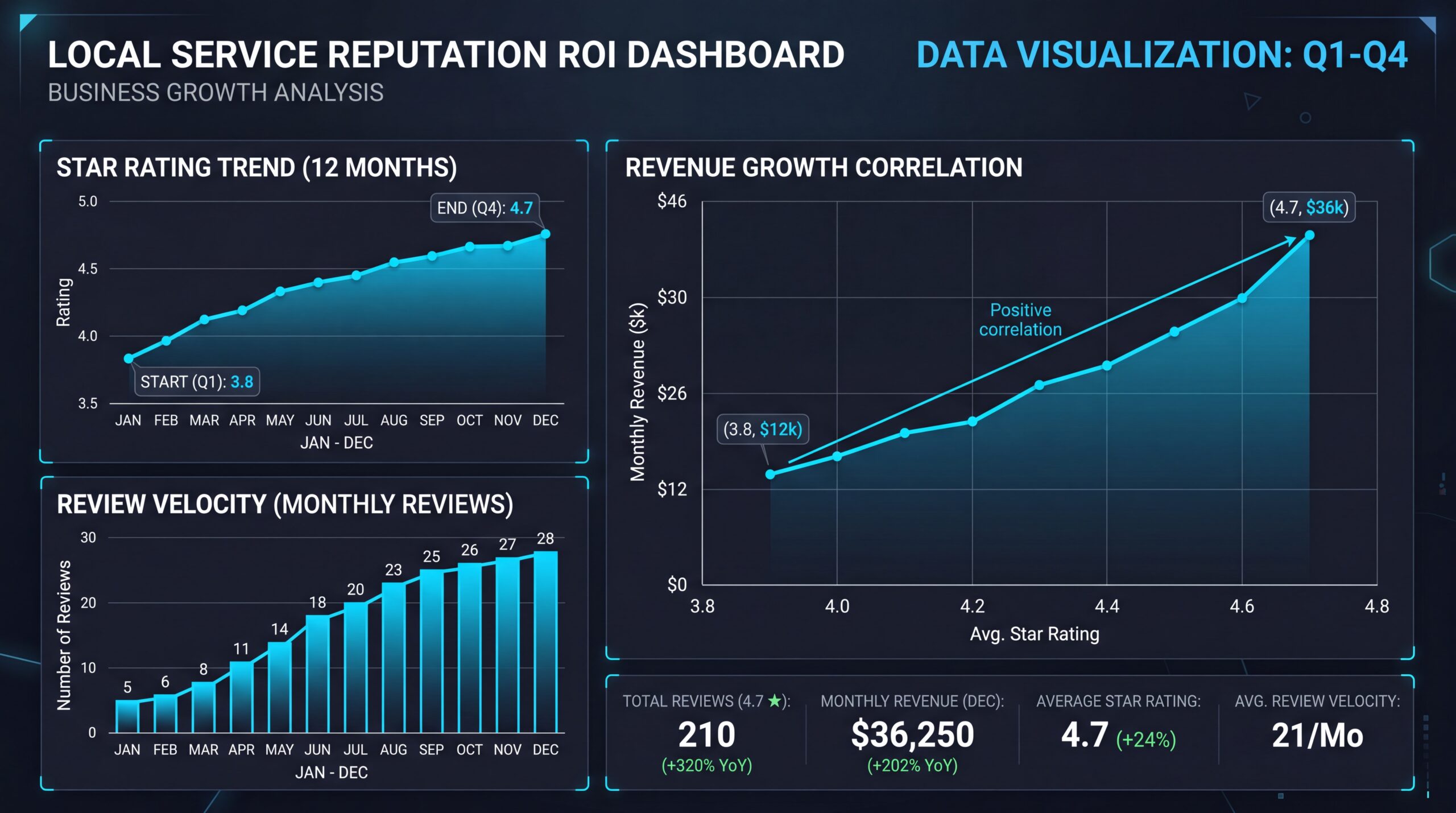
- A one-star increase in average rating correlates with a 5–9% increase in revenue, according to research originally published through Harvard Business School.
- Businesses that respond to at least 25% of their reviews earn 35% more revenue than those that ignore feedback entirely, per data compiled by Chatmeter.
- Displaying customer reviews on a website increases conversion rates by up to 270%, according to research from the Spiegel Research Center at Northwestern University.
- A 2026 peer-reviewed study in the Journal of Small Business Strategy confirmed that online reputation management directly impacts small business performance, with competitive intensity strengthening the positive effect.
Conversely, the cost of inaction is steep. A single negative review can drive away up to 30 potential customers. According to data from ReviewTrackers, 94% of consumers say a negative review has convinced them to avoid a business entirely. For a service company averaging $150 per transaction, that represents $4,500 in lost revenue from a single unaddressed complaint.
Essential Features to Look for in Reputation Management Software
Not all platforms deliver equal value for service businesses. Service companies operate with constraints that differ from e-commerce or enterprise B2B — smaller teams, higher per-transaction value, and deep dependence on local search visibility. The features below separate effective solutions from platforms that create more work than they eliminate.
Automated Review Request Generation
Manual review requests fail at scale. Owners forget, staff deprioritize the task, and customers move on. Effective reputation management software triggers review requests automatically based on completed jobs, paid invoices, or closed service tickets.
Look for platforms that support both SMS and email delivery, allow custom timing delays, and include smart throttling to avoid over-requesting from repeat customers. The strongest systems integrate directly with your CRM, scheduling tool, or invoicing software — platforms like ServiceTitan, Housecall Pro, or Jobber — so that no completed job falls through the cracks.
Multi-Platform Review Monitoring
Google hosts 71% of all online reviews as of 2026, but it is far from the only platform that influences customer decisions. Depending on your industry vertical, Yelp, Facebook, the BBB, Angi, Thumbtack, Houzz, Healthgrades, or Avvo may carry significant weight with your target audience.
A unified monitoring dashboard eliminates the need to log into multiple platforms daily. Alerts should be configurable by platform, star rating, and sentiment — allowing your team to prioritize responses where they have the greatest impact on reputation and revenue.
Sentiment Analysis and AI-Powered Insights
Reading every review individually is not scalable for growing service businesses. AI-powered sentiment analysis categorizes reviews by theme, identifying recurring patterns in customer feedback around pricing, timeliness, communication quality, or workmanship.
These insights help service businesses address systemic issues before they become visible trends. For example, if sentiment analysis reveals a spike in complaints about appointment scheduling delays, that signals an operational problem worth fixing — not a marketing problem to paper over with better responses.
The rise of AI-driven business recommendations makes this capability even more urgent. BrightLocal reports that 31% of consumers now use ChatGPT and similar AI tools for local business recommendations, up from just 6% in 2025. These AI systems analyze your entire review corpus to determine whether to recommend your business. The quality and sentiment of your reviews directly influence whether AI platforms send customers your way.
Review Response Automation
Speed matters. According to BrightLocal’s 2026 data, 19% of consumers now expect a same-day response to their review — up from 6% the previous year. Yet only 5% of businesses respond to any reviews at all, creating a massive opportunity gap for service businesses that do respond consistently.
Review response automation bridges this gap. Look for tools that generate AI-assisted response drafts, allow one-click approval workflows, and support personalization with the reviewer’s name, service type, and specific feedback. Automated responses should sound human, acknowledge the customer’s experience, and — for negative reviews — invite an offline conversation to resolve concerns.
Reporting and Analytics Dashboards
What gets measured gets managed. Your reputation management software should provide clear, actionable reporting on:
- Total review volume by platform and time period
- Average star rating trends over weeks and months
- Response rate and average response time
- Net Promoter Score or sentiment score trajectory
- Competitive positioning against local businesses in your service category
These metrics allow service business owners to set targets, track progress month-over-month, and demonstrate concrete ROI from their reputation management investment.
How to Choose the Right Platform for Your Service Business
Evaluate Your Current Review Landscape
Before selecting a platform, audit your current state. How many reviews do you have on Google? Yelp? Facebook? What is your average star rating on each? How many reviews have you received in the last 90 days? What percentage have you responded to?
This audit reveals your biggest gaps. A business with strong volume but declining ratings has a different need than one with few reviews and no collection process. The right reputation management software for service businesses should address your specific starting point, not force a generic workflow.
Match Features to Business Size and Goals
A solo HVAC technician running three jobs per day needs different functionality than a multi-location cleaning franchise managing 200 technicians across a metro area. Key considerations include:
- Single location vs. multi-location support and reporting
- Number of review requests per month — pricing often scales on volume
- Team collaboration features — can multiple staff members respond to reviews with role-based permissions?
- White-label capabilities for agencies or franchise operators managing multiple brands
Prioritize Integration With Your Existing Tech Stack
The most effective reputation management platforms connect directly with the tools your team already uses daily. Look for native integrations or open API access for CRM platforms like HubSpot, Salesforce, or GoHighLevel; scheduling and dispatch tools such as ServiceTitan, Housecall Pro, or Jobber; invoicing systems including QuickBooks or FreshBooks; and Google Business Profile for direct review management.
Data flow between systems eliminates manual work and ensures review requests trigger reliably after every completed service engagement. When your reputation management system talks to your sales and customer communication pipeline, the entire customer lifecycle operates without gaps.
Getting Started: A Practical Implementation Roadmap
Step 1 — Audit Your Current Online Reputation
Start by claiming and verifying your business profiles on Google Business Profile, Yelp, Facebook, and any industry-specific directories relevant to your trade. Ensure your business name, address, and phone number (NAP) are consistent across every listing. Inconsistent NAP data confuses search engines and erodes consumer trust in your legitimacy.
Review your existing feedback across all platforms. Identify your current average rating, total review count, response rate, and the date of your most recent review. Given that 73% of consumers only trust reviews written within the last month, according to BrightLocal, a stale review profile underperforms regardless of its historical volume or rating.
Step 2 — Set Up Automated Review Collection
Configure your reputation management software to trigger review requests automatically after each completed service. The ideal timing is two to four hours after job completion, when the customer experience is still fresh and satisfaction is highest.
Customize the messaging to reflect your brand voice. Include the customer’s first name, reference the specific service performed, and provide a direct link to your preferred review platform. A/B test SMS versus email delivery to determine which channel delivers higher response rates for your specific customer base. Most service businesses find SMS outperforms email by a factor of two to three.
Step 3 — Establish a Response Protocol
Define clear guidelines for who responds to reviews, how quickly they must respond, and with what tone. A proven framework used by high-performing service businesses:
- Positive reviews (4–5 stars): Thank the customer by name, reference the specific service performed, reinforce the positive experience, and invite them to return or refer others.
- Neutral reviews (3 stars): Thank the customer, acknowledge their specific feedback, and offer to make it right with a direct contact number or email.
- Negative reviews (1–2 stars): Respond within 24 hours. Acknowledge the concern, take ownership without being defensive, and provide a direct phone number for offline resolution. Never argue publicly.
According to data from ReviewTrackers, 56% of consumers changed their opinion about a business based on how it responded to a review — not the review itself. Your response protocol is as important as the reviews themselves.
Step 4 — Monitor, Measure, and Optimize
Set monthly review targets based on your current acquisition rate and desired growth trajectory. Track your average rating, total review volume, response rate, and average response time as core KPIs.
Use sentiment analysis reports from your reputation management software to identify operational improvements. Schedule quarterly competitive audits to compare your review profile against the top three competitors in your service area. If competitors are generating more reviews, increasing their response rates, or earning higher average ratings, adjust your strategy to close the gap.
Common Reputation Management Mistakes Service Businesses Make
Ignoring Negative Reviews
Silence is not a strategy. When a dissatisfied customer leaves a negative review and receives no response, every future prospect who reads that review sees a business that does not care about customer satisfaction. Responding to negative reviews demonstrates accountability and gives potential customers confidence that problems get resolved.
Buying Fake Reviews
Google’s algorithms have grown sophisticated at detecting fabricated reviews, and the consequences include review removal, listing suspension, and permanent trust damage. The Federal Trade Commission finalized rules in 2024 that impose fines of up to $51,744 per fake review. The financial and reputational risk far outweighs any short-term rating boost from purchased reviews.
Treating Review Management as Marketing Instead of Operations
Reviews reflect operational reality. No amount of review solicitation or response polish will fix a business that consistently delivers late, communicates poorly, or overcharges. Reputation management software for service businesses is most effective when paired with genuine operational improvement — the software surfaces the problems customers experience, but the business must commit to solving them at the root cause.
Take Control of Your Service Business Reputation
Your online reputation is not a vanity metric — it is a revenue driver backed by clear data. Service businesses that actively collect reviews, respond promptly, and monitor their online presence across multiple platforms earn more, convert more searchers into customers, and retain more clients than those that leave their reputation to chance.
Reputation management software for service businesses turns this process from an overwhelming manual task into a streamlined, automated system. Whether you run a single-truck operation or a multi-location franchise, the right platform helps you build the trust that wins customers before your competitors do.
Ready to automate your reputation management and grow your service business? Discover how Automated Sales Machine can help you build a review engine that drives measurable results.