


If you’re running a dental practice and still relying on phone calls, sticky notes, and fragmented scheduling software to manage patient relationships, you’re leaving serious revenue on the table. The right CRM for dentists transforms how your practice communicates with patients — automating follow-ups, reducing no-shows, and systematically reactivating patients who’ve gone quiet. This guide breaks down exactly what a dental CRM does, what features to prioritize, and how to implement one without overhauling your entire operation.
The dental industry has lagged behind other service verticals when it comes to patient communication infrastructure. Most practices still depend on their practice management software to handle tasks it was never designed for — proactive outreach, drip sequences, and relationship marketing. A purpose-built patient relationship platform changes that equation entirely. When every touchpoint in the patient journey is automated and personalized, practices see measurable gains in retention, treatment acceptance, and new patient referrals without adding a single staff member.
The Patient Retention Problem No One Talks About
Most dental practices lose between 10% and 30% of their active patient base every year — not because of bad dentistry, but because of poor follow-through. Patients miss appointments, ignore recall notices, or simply fall off the radar after a single visit. The practice never had a system to catch them. That’s the core problem a dedicated patient communication platform solves: it closes the loop on patient outreach so nothing slips through the cracks.
The No-Show and Lost Patient Cycle
No-shows cost the average dental practice thousands of dollars per month. A patient books six months out, life gets busy, and without a structured reminder and follow-up sequence, that chair sits empty. Multiply that by 20 missed appointments per month and the revenue impact becomes impossible to ignore. A purpose-built dental CRM automates multi-touch reminder sequences — text, email, and phone — so your front desk isn’t manually chasing every patient on the calendar.
The lost patient problem is even more expensive in the long run. According to the American Dental Association, acquiring a new dental patient costs five to seven times more than retaining an existing one. Yet most practices have no automated process for reactivating patients who haven’t been seen in 12, 18, or 24 months. That’s pure addressable revenue sitting dormant in your patient database.
Why Front Desk Bandwidth Is the Real Bottleneck
Your front desk team is already managing check-ins, insurance verifications, billing questions, and inbound calls. Asking them to manually send follow-ups, chase overdue recall patients, and track treatment plan acceptances on top of that isn’t realistic. It’s not a people problem — it’s a systems problem. The right patient automation platform takes the manual communication work off your team’s plate entirely by automating the sequences that previously required human attention. Staff can redirect that reclaimed time toward higher-value tasks: in-office experience, treatment consultations, and meaningful patient interactions that no software can replace.
What a CRM for Dentists Actually Does (Beyond Basic Scheduling)
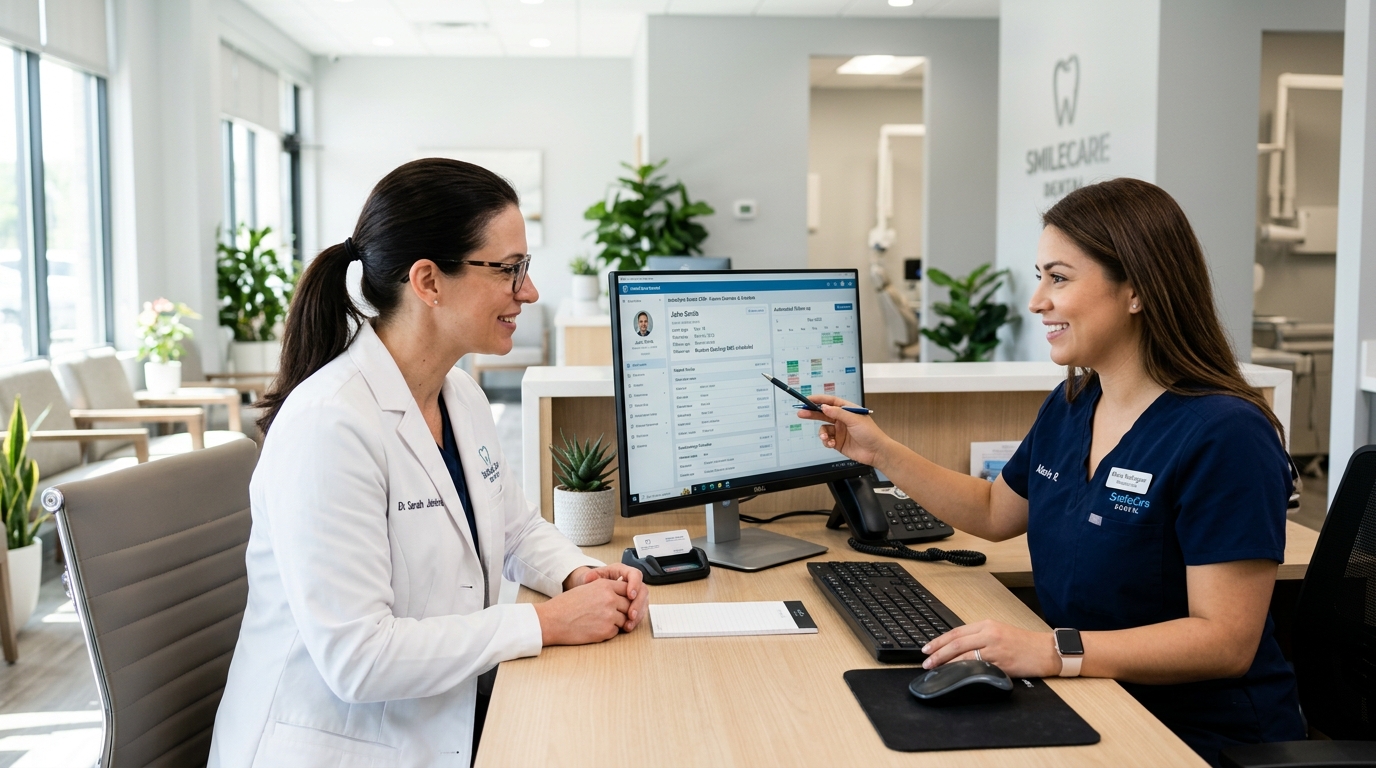
There’s a critical distinction between a practice management system (like Dentrix or Eaglesoft) and a dedicated CRM for dentists. Practice management software handles clinical records, charting, billing, and appointment booking. A CRM handles the patient relationship layer — the communication, follow-up, and marketing automation that sits on top of scheduling. The two systems aren’t in competition; they’re complementary. The most effective dental practices run both — and the ones that have implemented both consistently outperform peers on patient retention metrics and production per active patient.
Centralized Patient Contact Records
A dental CRM gives you a unified view of every patient interaction: appointment history, communication log, treatment plan status, outstanding balance, and last contact date — all in one place. When a patient calls in, your front desk sees their full relationship context instantly. When a patient goes 18 months without a visit, the system flags them automatically for reactivation. This centralized visibility is the foundation that makes everything else possible. Without it, your team is operating on incomplete information — making educated guesses about patient status instead of acting on real-time data.
Automated Follow-Up Sequences
The most immediate ROI from any CRM for dentists comes from automated follow-up. Here’s what a well-configured dental CRM runs without any manual input from your team:
- Appointment reminders: 3-day, 1-day, and same-morning texts or emails that reduce no-shows by 30–50%
- Post-appointment follow-ups: Check-in messages 24–48 hours after a procedure, collecting feedback and reinforcing the relationship
- Treatment plan follow-ups: Sequences for patients who received a treatment plan but haven’t yet scheduled — with educational content addressing common objections
- Recall reminders: Automated 6-month and annual hygiene recall sequences so patients book their next cleaning without your team lifting a finger
- Reactivation campaigns: Multi-touch sequences for patients who’ve been inactive for 12+ months, timed with seasonal hooks or new service announcements
A research report published in the Journal of the American Dental Association found that automated patient communication systems significantly improved recall appointment rates and patient retention in practices that implemented them. The data is clear: consistency in patient communication drives measurable practice growth.
Treatment Plan Pipeline Tracking
One of the most underutilized capabilities of a dental patient management system is treatment plan pipeline tracking. When a patient accepts part of a treatment plan but defers elective procedures — a crown, whitening, implants — that’s not a lost opportunity. It’s a pending opportunity with a documented price tag. A well-configured CRM tracks exactly where each patient sits in the treatment acceptance lifecycle and automates the right follow-up at the right time. Practices that systematically follow up on deferred treatment plans typically recover 15–25% more accepted cases per quarter, with no additional clinical overhead.
The 6 Core Features Every CRM for Dentists Must Have
Not every CRM platform is built with dental practices in mind. General-purpose tools like Salesforce and HubSpot are designed for B2B sales pipelines, not patient recall cycles and treatment plan follow-ups. Here’s the feature set to evaluate when choosing a crm for dentists — and why each one matters for practice revenue.
1. Two-Way SMS and Email Communication
Your patients live on their phones. Any dental CRM that doesn’t include native two-way SMS is already behind. Two-way texting means patients can reply to appointment confirmations, ask questions, and reschedule directly in the conversation — without calling the front desk. This dramatically reduces phone volume while improving patient satisfaction scores. Look for a platform that consolidates all patient conversations (text, email, and web chat) in a single unified inbox so no patient message falls through the cracks between channels.
2. Automated Appointment Reminders
Appointment reminders are the entry point for most dental CRM implementations, and for good reason — the ROI is immediate. Multi-step reminder sequences (email at 3 days, text at 24 hours, SMS on the morning of) consistently reduce no-show rates. A well-configured CRM automates this entire sequence once, and it runs indefinitely without any manual effort. Practices typically see no-show rates drop from 15–20% to under 8% within the first 60 days of implementing automated reminders.
3. Patient Reactivation Campaigns
Every dental practice has a list of patients who were active at some point but haven’t been seen in over a year. That list is a dormant revenue asset. A purpose-built CRM for dentists makes it easy to segment those patients, build targeted reactivation sequences, and track conversion. The best platforms let you set up a reactivation campaign once — “patients inactive for 12+ months” — and have it run automatically on a rolling basis, continuously converting dormant patients back into active ones.
4. Online Reputation Management
Google reviews are the first thing prospective patients check before booking with a new dentist. A BrightLocal survey found that 87% of consumers read online reviews for local businesses, with healthcare being among the highest-impact categories. A CRM with built-in reputation management automatically sends review requests after positive appointments, timing them when patient satisfaction is highest — immediately after a smooth procedure or a positive check-in. This systematically builds your Google star rating without manual outreach.
5. Online Booking Integration
A friction-free booking experience converts website visitors and social media audiences into patients. Your CRM should offer an embeddable online booking widget that integrates directly with your scheduling system. When a reactivation email sends, the CTA button should take the patient directly to a booking page — no phone call required. Every extra step in the booking process reduces conversions; removing friction is one of the highest-leverage improvements any dental practice can make.
6. Analytics and Reporting Dashboard
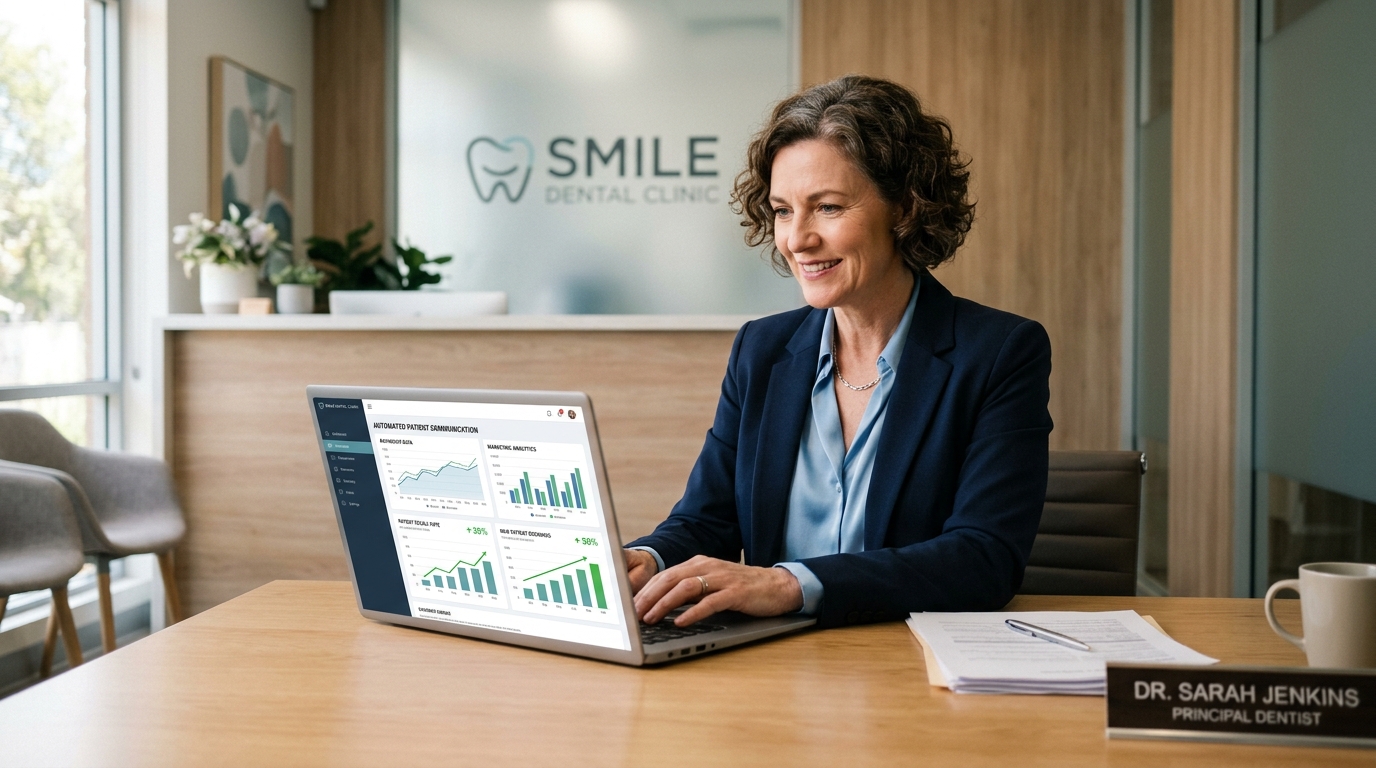
You can’t manage what you can’t measure. The right CRM for dentists surfaces the metrics that matter: patient lifetime value, reactivation conversion rate, no-show percentage by provider, recall booking rates, and treatment plan acceptance by procedure type. These aren’t vanity metrics — they’re the KPIs that directly connect to practice revenue. When you can see exactly where patients are falling off, you can build targeted interventions rather than running blanket campaigns.
CRM for Dentists vs. Practice Management Software: Key Differences
This is the question most dental practice owners get wrong when they first start evaluating software. Practice management software and a CRM for dentists serve fundamentally different functions — and conflating the two leads to underinvestment in patient communication infrastructure.
What Practice Management Software Does
Platforms like Dentrix, Eaglesoft, Open Dental, and Curve Dental are clinical record systems. They handle treatment charting, X-ray management, insurance billing, appointment scheduling, and clinical notes. These systems are essential for running a dental practice. They are not built — and were never intended — to manage proactive patient communication and marketing automation. Asking your PMS to handle CRM functions is like using Microsoft Word to manage a customer pipeline: technically possible in a pinch, not fit for purpose.
What a CRM for Dentists Adds
A dedicated CRM for dentists operates on the patient relationship layer: automated communications, follow-up sequences, reactivation campaigns, reputation management, and pipeline visibility. It integrates with (not replaces) your PMS, pulling in patient data and appointment history to power personalized, timely communication. The combination of a robust PMS and a purpose-built CRM is the infrastructure profile of a high-performing dental practice — each system doing what it was designed to do.
How to Implement a CRM in Your Dental Practice: A 30-Day Playbook
Implementation fear is the #1 reason dental practices delay adopting a CRM — the assumption that it will require months of onboarding and technical expertise. In reality, a modern CRM for dentists can be operational within a week. Here’s the proven 30-day rollout framework used by service businesses in the dental, med spa, and healthcare verticals.
Week 1: Import and Organize Patient Data
Export your active patient list from your PMS and import it into the CRM. Most platforms support CSV import with field mapping. At minimum, you need: full name, email address, phone number, last appointment date, and treatment status. Segment your list immediately into three buckets: active (seen in the last 6 months), at-risk (6–12 months), and dormant (12+ months). This segmentation powers everything that follows.
Week 2: Build Your Core Automation Sequences
Configure your appointment reminder sequence first — this delivers immediate ROI and is the simplest automation to implement. Once live, build your post-appointment follow-up sequence. Then set up your 6-month recall automation. These three sequences cover the patient communication lifecycle and will run indefinitely once deployed. Do not try to build everything at once; these three cover 80% of the revenue impact.
Week 3: Launch a Reactivation Campaign
Pull your dormant patient segment — everyone inactive for 12+ months — and run your first reactivation campaign. A simple three-touch sequence (text → email → final text) with a compelling offer (“We miss you — schedule your cleaning this month and get $X off X-rays”) typically converts 5–15% of dormant patients back to active status on the first campaign. For a practice with 500 dormant patients, that’s 25–75 reactivated patients from a single campaign run. That’s the compounding power of a well-implemented crm for dentists: a one-time setup that generates recurring revenue recovery every month it runs.
Week 4: Review Metrics and Scale
After 30 days, review your CRM dashboard: How has your no-show rate changed? How many reactivation conversions did week 3 generate? What’s your review request conversion rate? Use the data to refine your sequences, adjust timing, and identify the next automation to build. From here, the CRM compounds — each month adding more automation layers, more data, and more patient revenue recovered.
Why Automated Sales Machine Is the Best CRM for Dentists
Most CRM platforms are built for large enterprise sales teams — not for dental practices managing thousands of patient relationships. A generic platform requires months of configuration, a dedicated admin, and often a consultancy engagement before it does anything useful. Automated Sales Machine was designed for the opposite: service-based businesses that need powerful automation without a dedicated marketing team to configure and maintain it. The platform ships with the workflows, templates, and structures that dental practices actually need — not a blank canvas that requires you to build everything from scratch.
All-in-One vs. Disconnected Point Solutions
The typical dental practice is paying for a separate scheduling tool, an email marketing platform, a review management app, and a texting service — four monthly subscriptions, four logins, and zero data integration between them. An all-in-one CRM for dentists like Automated Sales Machine consolidates all of these into a single platform: SMS, email, two-way conversations, automation sequences, reputation management, online booking, and a full analytics dashboard. The cost consolidation alone typically offsets the platform fee within 60 days.
Built for Service Businesses, Without the Enterprise Tax
Enterprise CRM platforms charge enterprise prices and require dedicated admins to configure and maintain them. Automated Sales Machine was built for practice owners and office managers who need to set up powerful automation in hours, not months. The platform ships with pre-built dental practice templates for recall campaigns, reactivation sequences, and review requests — so you’re not starting from a blank canvas. Practices go live in days, see measurable impact in the first 30 days, and never need a consultant to maintain the system.
Ready to see exactly how it works for dental practices? Book a live demo and we’ll walk through a build-out specific to your practice size and patient volume.
The Bottom Line: A CRM for Dentists Is a Revenue Infrastructure Decision
Every dental practice that isn’t running a dedicated patient communication and automation platform is leaving predictable, recoverable revenue on the table — in no-shows that could have been reminded, in dormant patients who needed a single reactivation message, and in treatment plans that were accepted but never followed up. The question isn’t whether your practice needs a CRM; it’s how quickly you can get one running and capturing that revenue.
The practices that install a purpose-built CRM for dentists, configure their core automations, and execute a disciplined reactivation playbook consistently see 20–40% improvements in patient retention, significant reductions in no-show rates, and measurable growth in treatment plan acceptance. None of that requires adding headcount. It requires the right system.
If you’re ready to build the patient communication infrastructure your practice deserves, get started with Automated Sales Machine today — and have your first automation sequences running by end of week.