
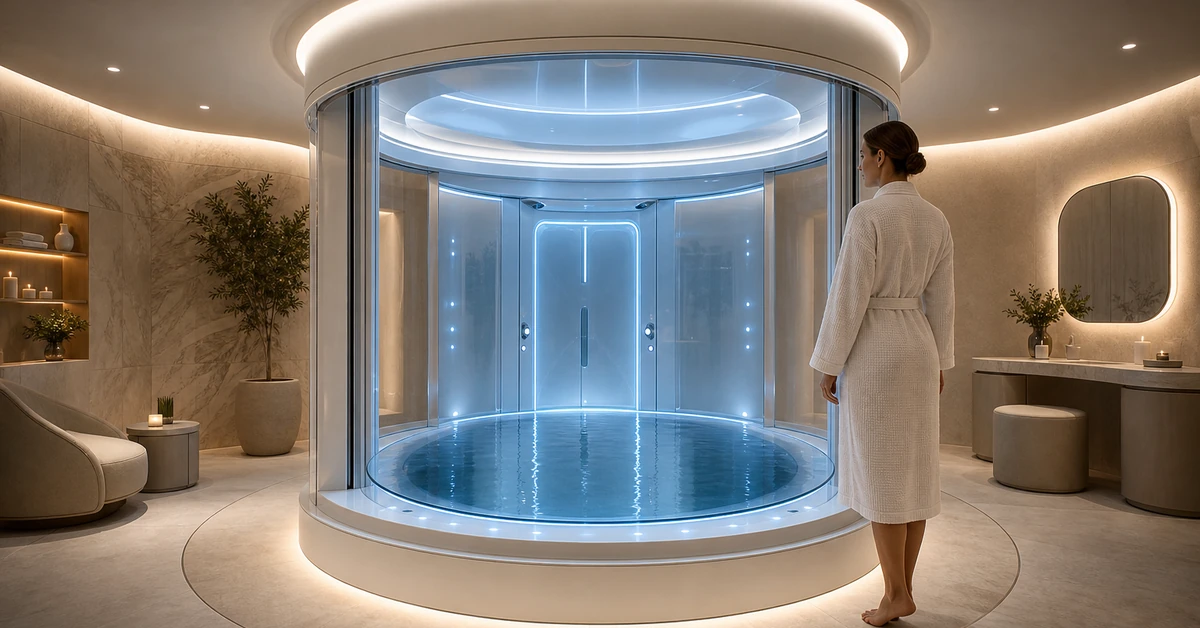

TL;DR: David Holz, the founder of Midjourney, has built the first new whole-body medical imaging modality in 50 years — a full-body scanner using 358,000 ultrasonic sensors firing 100 million times per second inside a pool of water, producing sub-millimeter 3D anatomy 60 times faster than MRI at one-tenth the hardware cost. The first scanner is being deployed inside a 25,000-square-foot spa that, by Midjourney’s own projections, will run more body scans per year than every MRI machine on Earth combined.
If you’re a business owner watching where the next decade’s most significant disruptions are forming, this is one of those moments worth slowing down for. Explore how Automated Sales Machine helps forward-thinking businesses stay ahead of AI-driven shifts.
Last week, Elon Musk responded to a technology announcement with one word: “Cool.”
That word — from a person who moves more slowly to impress — came in response to Midjourney’s announcement that they had built a full-body medical scanner. Not an upgrade to existing technology. Not a research paper. The first new whole-body medical imaging modality built in the last half century.
The same week, a cardiologist with 33 years of clinical experience published a detailed scientific breakdown of the announcement. His conclusion: this would change the future of medicine more than anything he had covered in his entire career.
I’ve been watching David Holz since the early days of Midjourney. I was an early adopter — one of the people who recognized from the beginning that what Holz was building wasn’t a product company. It was a physics experiment wrapped in a startup. He doesn’t ship software iterations. He builds at the edge of what computation, optics, and human-machine interaction can do, and then he ships the result before anyone else realizes it’s possible.
This is the story behind the David Holz Midjourney medical scanner — and why it’s the logical culmination of a 20-year trajectory that most people are only now beginning to understand.
Who Is David Holz? A Physicist Who Never Sold Out
The Florida Kid Who Grew Up Around Medicine
David Holz grew up in Florida with medicine woven into the fabric of his daily life. His father ran a dental office — from a sailboat. That detail isn’t a quirk or a footnote. It’s a reliable preview of how Holz has operated his entire career: doing conventional things in radically unconventional ways, usually because the unconventional approach simply works better.
He studied physics and mathematics, but what obsessed him wasn’t the elegance of equations — it was the gap between predicting reality and actually understanding it. There’s a meaningful difference between being able to calculate an outcome and genuinely comprehending the mechanism behind it. That friction became the animating question of his professional life, and it’s the reason the David Holz Midjourney medical scanner isn’t a pivot. It’s the natural destination of a career that has always been about closing epistemic gaps.
His connection to medicine is personal. He grew up around it. He watched a parent build a clinical practice with an unconventional operating model. And he carried forward, for decades, a specific frustration: the instruments medicine uses to see inside the human body are architecturally unchanged from 50 years ago, expensive to manufacture and operate, and largely inaccessible to the majority of the world’s population. That frustration eventually became a product roadmap.

Leap Motion: $10 Million in 48 Hours From a Single Landing Page
Before Midjourney and before the scanner, there was Leap Motion.
Holz founded Leap Motion at 22 and built a hand-tracking device that let users control computers through natural gesture movements. The product shipped. And the market’s response was immediate: Leap Motion pulled in $10 million in pre-orders in 48 hours. Not through a Kickstarter campaign, not through a press junket, not through venture-funded advertising. From one website. A landing page he built and pointed at the world.
What that moment reveals isn’t a lucky product launch. It’s a specific operating philosophy: build something genuinely real, demonstrate it honestly, and let the market decide. The $10 million in 48 hours happened because the technology earned it.
In 2015 — years before TensorFlow had become a household name in the developer community — Holz built a 600-million-parameter hand-tracking AI model running on a CPU cluster. That’s not a footnote. Modern AI infrastructure was still largely theoretical to most of the industry. While Silicon Valley was debating whether deep learning had commercial applications, Holz was shipping production neural networks on commodity hardware. The David Holz Midjourney medical scanner’s 2 petaflops of on-site compute is, in retrospect, a direct descendent of that 2015 CPU cluster — the same engineering philosophy applied to a harder problem.
Northstar, the Exit He Didn’t Take, and the Mentor Who Changed Everything
While still at Leap Motion, Holz designed and released Northstar — an open-source augmented reality headset. Not because there was a business case. Because he thought the world needed one and nobody else was building it. He gave it away.
Then he did something that requires more courage than most founders in his position demonstrate: he left Leap Motion not because the company failed, but because it succeeded in the wrong direction.
He wanted, as he described it, a “home.” Not a 100x return. Not a fund exit. A place where he could build the things that mattered most, on his own terms, for as long as it took to build them correctly. His mentor, Bill Warner — the inventor of non-linear video editing and founder of Avid Technology — told him it was possible to bootstrap his next venture without taking institutional capital. Holz listened.
That single decision — to take Warner’s advice and build without a board, without a fund cycle, without external pressure to optimize for an exit — is the structural reason the David Holz Midjourney medical scanner exists. You cannot build a first-of-its-kind medical imaging modality while also managing a 10-year fund timeline. The timeline for genuine scientific breakthroughs doesn’t fit on a venture capital spreadsheet.
Building Midjourney on $200K and a Phone Call to Google
Nine People. $200 Million Per Year. Zero Outside Investors.
Holz started Midjourney with $200,000 of his own money. That’s the capitalization number for what would become one of the most influential AI companies in the world. Two hundred thousand dollars.
He then called Google and asked for 10,000 GPUs — on trust. No term sheet, no institutional credibility beyond a physicist’s track record of shipping real things. They said yes.
Four years later, Midjourney is generating approximately $200 million per year in revenue. Zero outside investors. A team of nine people. Nine. A company smaller than most Series A startups is producing more revenue per employee than virtually any other AI company currently operating.
According to research from McKinsey & Company on AI commercialization, companies that retain full operational sovereignty — without outside board pressure or fund-driven timelines — consistently demonstrate meaningfully different capital allocation patterns than venture-backed peers. Midjourney is the most extreme modern example of this principle in practice. They have total sovereignty over what to build next. And what they chose to build next is the David Holz Midjourney medical scanner.
The self-funding model is not incidental to the scanner’s existence. It’s the enabling condition. A company with institutional investors doesn’t allocate its R&D budget to a novel medical imaging modality. A company owned entirely by its founder does — when that founder has spent 20 years thinking about the gap between what medicine can currently see and what it needs to see.
The David Holz Midjourney Medical Scanner: What It Actually Does
358,000 Sensors. 100 Million Pulses Per Second. From Inside a Pool of Water.
The specifications of the David Holz Midjourney medical scanner are worth reading slowly, because they are far enough outside the envelope of existing medical imaging technology that they require a moment to absorb.
The scanner uses 358,000 ultrasonic sensors arranged around a patient inside a pool of water. The sensors fire 100 million times per second. The system processes 17 gigabytes of raw acoustic data every second, handled by 2 petaflops of on-site compute. The output is sub-millimeter 3D anatomical imaging derived entirely from sound waves.
No ionizing radiation. No magnetic field limitations (which means patients with metal implants can use it without restriction). No claustrophobic tube. Sessions run 60 times faster than an MRI. The hardware costs approximately one-tenth the price of an MRI machine to manufacture.
The water medium is both the engineering key and the element that most surprises people when they first encounter the design. Ultrasound waves transmit poorly through air and ideally through water. By immersing the patient and surrounding them with sensors on all sides, Holz’s team achieved uniform acoustic coverage that the single-probe ultrasound approach used in hospitals for decades can never approximate. The result is comprehensive volumetric imaging, not a narrow cross-sectional slice.
Why It Already Beats MRI Before AI Is Even Applied
On day one of operation, before any machine learning has been applied to the acoustic data stream, the David Holz Midjourney medical scanner already outperforms conventional MRI on specific anatomical categories: muscle fiber resolution and vein boundary mapping. These are not marginal gains. They represent genuinely superior imaging fidelity in domains that directly affect diagnostic accuracy for cardiovascular disease, musculoskeletal injury, and early-stage soft tissue cancer detection.
Holz said on stage, with notable understatement, that the scanner “barely uses AI.” This is a striking claim from the founder of one of the most commercially successful AI companies in the world. It is either the most self-aware line in the history of medical technology presentations, or it is a setup — a baseline from which the application of deep learning to a 17 GB/second acoustic data stream will produce diagnostic capabilities far beyond what any current imaging modality can offer. Probably both.
The cardiovascular implications alone are significant. According to the World Health Organization’s Global Health Estimates, cardiovascular diseases account for 17.9 million deaths annually — approximately 32% of all global deaths. A substantial portion of these deaths involve conditions that could be identified significantly earlier with more accessible, higher-resolution whole-body imaging. The global MRI installed base cannot close that gap. According to the OECD’s Health Statistics database, the United States has approximately 39 MRI machines per million people — among the highest density in the world. In most countries, access is dramatically lower. Cost, throughput, and infrastructure requirements have made comprehensive medical imaging a resource that billions of people cannot realistically access.
The David Holz Midjourney medical scanner changes the denominator of that equation.

The Spa That Will Outpace Every MRI Machine on Earth — From One Location
The first commercial deployment of the David Holz Midjourney medical scanner is going inside a spa.
Not a hospital. Not a research facility. Not a university medical center. A 25,000-square-foot wellness spa, featuring nine to ten full-body scanners running 24 hours a day, seven days a week — alongside hot tubs, saunas, cold plunges, European spa amenities, and a gym.
The scan, in Holz’s framing, happens almost as a side effect of the visit. You come for the wellness experience. You get the most comprehensive non-invasive medical imaging currently available to a civilian consumer, delivered in a setting designed to feel like a premium wellness retreat rather than a clinical facility. The psychological friction of medical screening — the anticipation, the sterile environment, the clinical associations — is replaced by the context of self-care.
By Midjourney’s own projections, that single location — ten scanners, running continuously — will run more body scans per year than every MRI machine on Earth combined. The entire global MRI fleet produces an estimated several hundred million scans annually across approximately 50,000 machines in hospitals and imaging centers worldwide, per estimates from the International Society for Magnetic Resonance in Medicine. One building. One city. Ten machines. More scanning throughput than the entire global MRI infrastructure produces in a year.
The long-term stated goal of this technology, delivered by Holz on stage without hedging: prevent 30% of all human deaths.
That number, sourced from Midjourney’s own analysis, is consistent with research published in The Lancet as part of the Global Burden of Disease study, which identifies a substantial fraction of preventable deaths globally as attributable to conditions that are detectable with earlier, more systematic whole-body imaging. The scanner’s ability to identify early-stage disease processes across multiple organ systems simultaneously — in a single wellness session — represents a model of preventive medicine that has no structural precedent in the current healthcare system.
What I Saw as an Early Adopter — And Why This Feels Inevitable
I’ve been using Midjourney since the early days. I remember the early outputs — rough, unfinished, but already demonstrating a physics-informed intuition about how light and form interact that other AI image generators didn’t have. It didn’t approximate art. It reasoned about it. That difference was legible from the beginning to anyone paying close attention.
That early signal — the sense that Holz wasn’t building a text-to-image tool but was actually building a system that modeled visual reality — was the tell. It was the same tell Leap Motion gave in 2012, when he shipped gesture-recognition technology that felt categorically different from everything else available: not faster, not cheaper, but operating from a different theory of the problem.
As an early adopter, I’ve watched this trajectory unfold in real time. Watching the David Holz Midjourney medical scanner announcement, I felt the same recognition. This is not a medical technology company pivoting into hardware. This is a physicist who has spent two decades building tools at the edge of the computable, who finally has the capital, the operational sovereignty, and the institutional trust to aim everything he’s built at the hardest unsolved problem in preventive medicine.
The scanner isn’t a side project. It isn’t a hedge. It’s the thing his entire career has been training him to ship. The Leap Motion hand tracking. The 600-million-parameter CPU model in 2015. The Northstar headset. Midjourney’s revenue engine. Each of these was a step in a building sequence that ends, apparently, with a full-body ultrasonic scanner inside a spa that performs more medical imaging than all the world’s MRI machines combined.
If you’re building or running a business, there’s something worth extracting from this beyond the technology story itself. The companies and founders that produce outcomes at this scale share a common trait: they don’t optimize for the current quarter’s metrics. They build infrastructure for a problem they understand more clearly than anyone else, and they wait until they have the resources to do it correctly. That’s a competitive posture. Understanding it — and applying it to your own category — is one of the most durable strategic advantages available. Start building that infrastructure for your business today with Automated Sales Machine.
The Verdict: Why Medicine Won’t Look the Same After This
When a cardiologist with 33 years of clinical practice reads a technology announcement and concludes it will change medicine more than anything he has covered in his career, that’s a clinical assessment — not hype from a technology reporter. That’s someone who has spent three decades evaluating diagnostic tools, imaging modalities, treatment protocols, and the practical limits of what medicine can do for patients, saying that this is the most important thing he’s seen.
The David Holz Midjourney medical scanner has achieved something genuinely unprecedented: a new whole-body imaging modality — the first in 50 years — built by nine people, self-funded entirely with revenue from an AI art generator, and deployed first into a wellness spa. The hardware costs one-tenth of an MRI. It runs 60 times faster. It already exceeds MRI performance on specific tissue categories on day one, before AI is applied. And its distribution strategy sidesteps the entire healthcare procurement infrastructure — hospitals, insurance reimbursement timelines, FDA clearance cycles — in favor of direct consumer access through a premium wellness context.
Elon Musk called it cool. He wasn’t wrong. But “cool” doesn’t fully capture what’s been announced. A physicist bootstrapped $200 million in annual revenue from a $200,000 starting capital, built one of the most consequential AI companies of the decade with a team smaller than most early-stage startups, and used that platform to fund the first genuinely new medical imaging technology in half a century — deployed not in research hospitals, but in a spa designed to make the technology feel accessible, human, and routine.
The goal, as Holz stated from the stage: prevent 30% of all human deaths. He said it plainly. He didn’t hedge.
What This Means for the Future of Human Health — And What Forward-Thinking Operators Do Next
The David Holz Midjourney medical scanner isn’t just a remarkable piece of hardware. It’s a signal about how the next wave of genuinely transformative technology will arrive: not through institutional channels, not through traditional R&D pipelines with 20-year development cycles, but through founders with total operational sovereignty, deep technical foundations, and the patience to wait until they have the resources to build what they actually intended to build from the beginning.
The pattern is legible if you’ve been paying attention. The most durable technological breakthroughs of the last decade haven’t come from well-capitalized corporate labs. They’ve come from individuals and small teams who refused to optimize for a fund cycle and instead spent years getting ready for the real problem. David Holz is the cleanest living example of this thesis. Leap Motion was preparation. Northstar was preparation. Midjourney was preparation. The scanner is the thing he was preparing for.
For business owners and operators: the lesson isn’t “build a medical scanner.” The lesson is that radical capability improvements — made accessible and affordable — create markets that previously couldn’t exist. The companies that understand how to reach those markets early, before the mainstream recognizes the shift, are the ones that build compounding advantage over time. The tools to do that in your category exist right now.
The businesses that will thrive over the next decade are the ones building on AI-native, automation-first infrastructure today — not waiting for the market to demand it. David Holz didn’t wait. He built. Book a free demo with Automated Sales Machine and see how AI-powered automation can give your business the same kind of compounding advantage — starting today.