
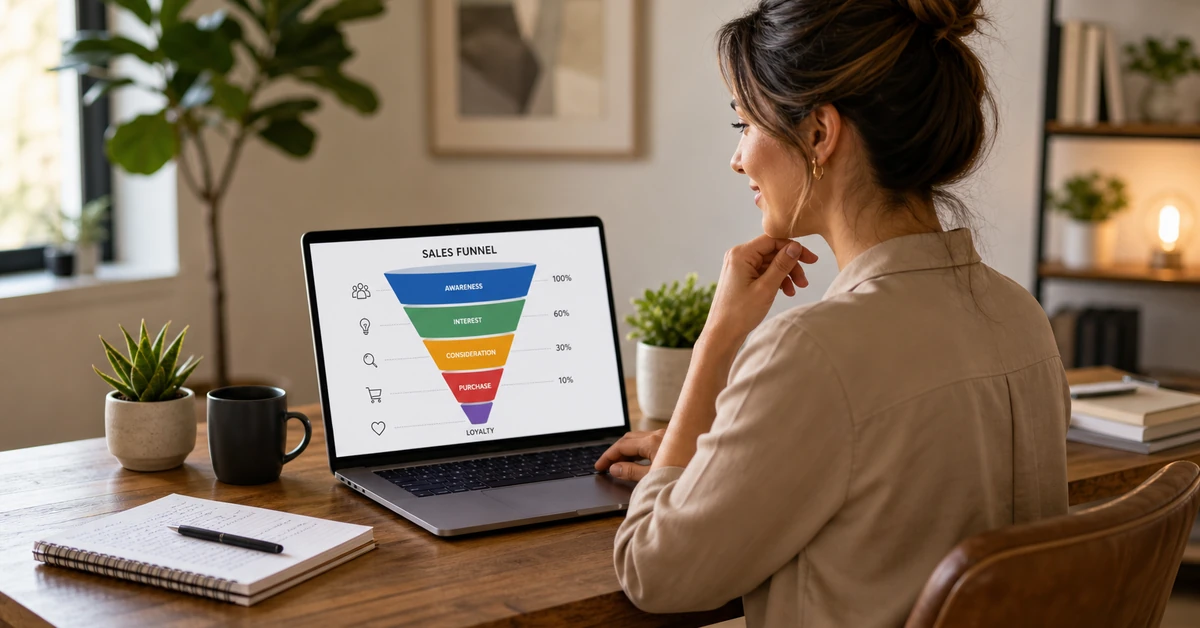

TL;DR: A sales funnel example maps every step a prospect takes from discovering your business to becoming a paying customer — and knowing where each stage breaks down is what separates businesses that scale from those that stall. The most effective funnels are not complicated: they are deliberate, automated, and relentlessly focused on one thing — moving the right person to the next step. Small business owners who implement a structured sales funnel example consistently see higher close rates, lower acquisition costs, and a pipeline they can actually predict.
Ready to build a funnel that books appointments on autopilot? See how Automated Sales Machine automates your entire pipeline — book a free demo.
What Is a Sales Funnel?
A sales funnel is the structured sequence of steps a potential customer moves through — from first contact with your brand to a completed purchase (and beyond). The “funnel” shape reflects a hard reality: you will start with many prospects at the top, and a smaller percentage will make it through each stage to become customers at the bottom.
That narrowing is not a failure. It is the system working as intended. The goal is not to convert every prospect — it is to convert the right prospects faster, at lower cost, and with less manual effort on your part.
Think of it this way: a dental practice running Google Ads might drive 500 visitors a month to a landing page. If 20% opt in for a free consultation offer, that’s 100 leads. If 40% of those book an appointment and 60% of those become patients — that’s 24 new patients from 500 visitors. Without a defined sales funnel example tracking each stage, you’d never know if the drop-off was happening at the opt-in, at the booking step, or at the show-up rate. The funnel makes the invisible visible.
According to Salesforce’s State of Sales research, high-performing sales teams are 2.8 times more likely to use a documented, structured sales process than their average-performing peers. That structure is what a sales funnel provides.
Most businesses have a sales funnel — they just haven’t mapped it. When you make the process explicit, you gain the ability to diagnose breakdowns, plug leaks, and automate the repetitive touchpoints that eat your time. A mapped funnel is also a saleable asset: buyers of small businesses routinely pay a premium for companies that have documented, predictable systems over those that run on institutional knowledge and owner hustle.
The 4 Core Stages of a Sales Funnel Example
Every effective sales funnel example — regardless of industry — runs through four fundamental stages. The specifics vary by business type, but the logic is universal.
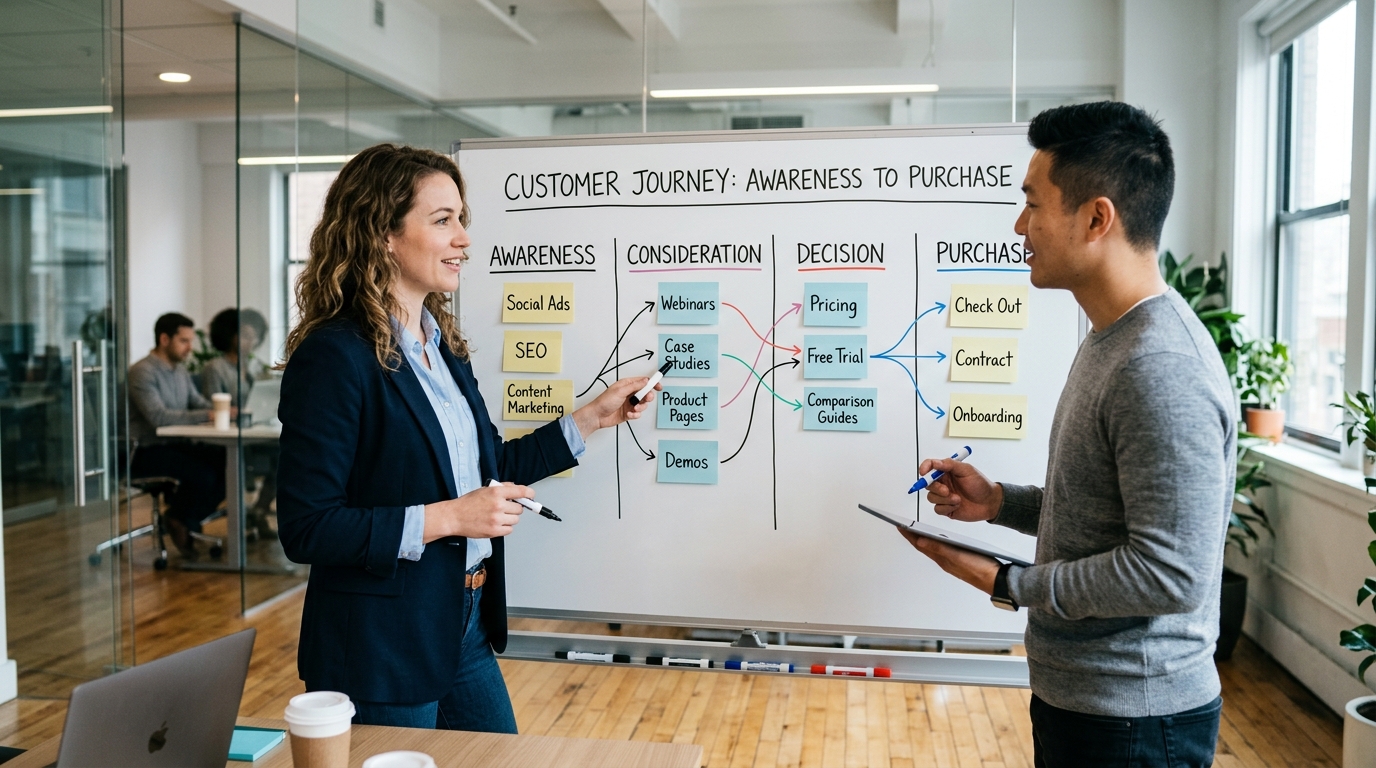
Stage 1 — Awareness: Getting in Front of Cold Prospects
Before anyone can buy from you, they have to know you exist. The Awareness stage is your top-of-funnel: the moment a prospect first encounters your brand through a Google search, a social post, a referral, a paid ad, or a piece of content you published.
Your job at this stage is singular — capture attention and earn a second look. This is not where you sell. It is where you demonstrate relevance.
Awareness stage tactics:
- SEO-optimized blog content targeting high-intent keywords
- Paid search and social advertising
- Referral and affiliate programs
- Podcast appearances and guest content
- Organic social media and short-form video
Stage 2 — Interest: Turning Visitors Into Engaged Leads
Once someone lands in your world, you have seconds to give them a reason to stay. The Interest stage converts anonymous visitors into identifiable leads — typically by offering something of value in exchange for an email address or phone number.
This is where lead magnets, opt-in forms, and landing pages do the heavy lifting. According to HubSpot Research, companies that use targeted lead nurturing sequences generate 50% more sales-ready leads at a 33% lower cost than those relying on broad, un-segmented outreach.
Interest stage essentials:
- Lead magnets (checklists, guides, templates, free audits)
- Landing pages with a single, clear CTA
- Immediate follow-up email sequences
- Retargeting ads for visitors who didn’t convert
Stage 3 — Decision: Converting Leads Into Buyers
The Decision stage is where warm leads evaluate whether your offer is the right fit. They are comparing you to alternatives, researching reviews, and calculating whether the investment is justified. Your job is to make that decision easy — and to reduce every point of friction standing between the prospect and a “yes.”
This stage is where nurture sequences, case studies, social proof, and objection-handling content pay off. McKinsey & Company research consistently shows that personalized, relevant communication at the decision stage drives conversion lift — companies implementing personalized journey sequences report revenue improvements of 10–15% compared to generic outreach.
Decision stage assets:
- Automated email nurture sequences with segmented messaging
- Case studies and before/after client results
- Free trials, demos, or consultation calls
- FAQ content that pre-handles objections
- Limited-time offers that create urgency without being gimmicky
Stage 4 — Action: Closing the Sale
The Action stage is the conversion event — the signed contract, the completed purchase, the booked appointment. But the best funnels don’t stop here. Post-purchase onboarding, upsell sequences, and retention flows extend the funnel into lifetime customer value.
A strong action stage removes every possible friction point from the final step: clean checkout flows, one-click booking, or frictionless proposal acceptance. Speed matters here — Forrester Research data shows that companies responding to inbound leads within five minutes are 100x more likely to close than those who wait 30 minutes or more.
5 Real-World Sales Funnel Examples by Business Type
The mechanics of a sales funnel example vary significantly depending on your business model, average deal size, and sales cycle length. Here are five concrete templates you can adapt immediately.
1. Service Business Sales Funnel Example (Med Spa, Dental, Fitness)
Top of Funnel: Google Ads targeting “[city] + [service]” keywords, organic local SEO, Instagram content showing results.
Middle of Funnel: Landing page with before/after photos and patient testimonials → email/SMS opt-in for a special offer or free consultation → automated 3-email welcome sequence.
Bottom of Funnel: Appointment booking link with real-time calendar, automated confirmation and reminder messages, post-visit review request sequence.
Where ASM plugs in: CRM automation captures every lead, fires the nurture sequence, books the appointment, and sends the post-visit review request — without a single manual step. Start automating your service business funnel today.
2. E-Commerce Sales Funnel Example
Top of Funnel: Product-focused paid social ads, SEO product pages, influencer content.
Middle of Funnel: Product page with reviews and UGC → add-to-cart → abandoned cart email/SMS sequence (3-touch).
Bottom of Funnel: Purchase confirmation → post-purchase upsell offer → loyalty/referral program sequence.
Key metric to watch: Cart abandonment rate. Industry average sits around 70%. A 3-step abandoned cart sequence can recover 10–15% of those lost sales.
3. SaaS / Software Sales Funnel Example
Top of Funnel: Content marketing targeting problem-aware keywords, G2 and Capterra reviews, product-led growth loops.
Middle of Funnel: Free trial or freemium sign-up → onboarding email sequence → in-app feature discovery prompts → check-in call from sales rep at day 7.
Bottom of Funnel: Trial-to-paid conversion offer → annual plan upgrade prompt → expansion offer (additional seats or features).
4. Local Business Sales Funnel Example (Home Services, Real Estate)
Top of Funnel: Google Business Profile optimization, local service ads, Nextdoor presence.
Middle of Funnel: Instant quote form or estimate request → automated response within 2 minutes → follow-up call trigger if no response in 30 minutes.
Bottom of Funnel: Digital estimate or proposal sent automatically → e-signature request → job confirmation text → post-service review request via SMS.
5. Agency / B2B Services Sales Funnel Example
Top of Funnel: LinkedIn content, cold outbound sequences, SEO-driven case study landing pages.
Middle of Funnel: Lead magnet (audit, scorecard, or strategy template) → discovery call booking → pre-call qualification questionnaire.
Bottom of Funnel: Proposal delivery → automated follow-up sequence (3 touches over 7 days) → contract and onboarding flow.

How to Build Your Sales Funnel Step by Step
Most sales funnel examples fail not because the strategy is wrong, but because execution stalls. Here is the practical build sequence that works for small business owners who don’t have a dedicated marketing team.
Step 1 — Define Your Ideal Customer and Their Decision Journey
Before you build a single landing page, map the mental journey your best customers take from problem recognition to purchase. Ask: What triggers them to search for a solution? What objections do they have? What evidence convinces them to act? Every funnel element you build should answer a specific question that customer has at a specific stage.
Step 2 — Build Your Lead Magnet and Opt-In Page
Your lead magnet is the first transaction in the funnel — you give value, they give contact information. The best lead magnets solve a specific, immediate problem your ideal customer is already trying to solve. A 5-page guide that answers the single most common question you get from prospects will outperform a 40-page “ultimate guide” every time.
Your opt-in page should have one job: the email address. Remove navigation links, secondary CTAs, and anything that creates a decision other than “yes” or “no.”
Step 3 — Choose Funnel Software That Automates the Follow-Up
The moment a lead opts in, the clock starts. Manual follow-up is a liability at scale — you will miss leads, follow up too late, and leave deals in the pipeline indefinitely. The right CRM and automation platform fires the right message at the right time without requiring you to remember to do it.
Automated Sales Machine handles this entire layer — capturing leads, triggering personalized email and SMS sequences, routing hot leads to your calendar, and tracking every touchpoint in one pipeline view.
Step 4 — Set Up a 3–5 Touch Nurture Sequence
Not every lead is ready to buy the day they opt in. A nurture sequence keeps your brand present while prospects move toward a decision on their own timeline. A proven structure for service businesses:
- Email 1 (Immediate): Deliver the lead magnet + introduce the company in 3 sentences
- Email 2 (Day 2): Share a client result or case study — proof, not pitch
- Email 3 (Day 4): Address the single most common objection directly
- Email 4 (Day 7): Soft CTA — “Ready to talk through your situation?” with booking link
- Email 5 (Day 14): Last-chance offer or limited availability nudge
Step 5 — Track, Measure, and Optimize One Stage at a Time
The fastest way to improve funnel performance is to identify the single stage where the most leads drop off, then fix that one stage before moving to the next. Running optimization experiments on all stages simultaneously makes it impossible to attribute results. Focus: find the biggest leak, plug it, then move to the next.
Common Sales Funnel Mistakes (And How to Fix Them)
The sales funnel example above only works if these critical errors are avoided:
Mistake 1 — No Defined Lead Magnet
Most small businesses send traffic directly to a service page or homepage. This is the equivalent of walking a stranger into your store and expecting them to buy on the first visit. Define a specific lead capture asset before driving any paid traffic.
Mistake 2 — Manual Follow-Up at Scale
If your follow-up depends on a person remembering to send an email or make a call, it will fail. A lead that doesn’t hear from you within the first hour is 21x less likely to convert than one contacted within the first five minutes, per data cited in the HubSpot Research body of work on lead response time. Automation is not optional at volume — it is the only sustainable answer.
Mistake 3 — A Funnel With No Bottom
Many business owners build an awareness strategy (content, ads) and a conversion page (landing page, booking form) but skip the middle — the nurture sequence that moves cold leads to warm leads to buyers. This gap is where most revenue is lost.
Mistake 4 — Measuring Inputs, Not Outputs
Traffic volume, social followers, and email open rates are inputs. Revenue, booked appointments, and pipeline value are outputs. Build your reporting around outputs and work backward to identify which inputs are driving them.
Sales Funnel Metrics You Must Track
A sales funnel is only as optimizable as the data you collect from it. These are the non-negotiable metrics for any operational funnel:
- Lead Capture Rate: Percentage of page visitors who complete the opt-in form. Industry benchmark: 10–25% for a tightly targeted landing page.
- Lead-to-Appointment Rate: How many opted-in leads book a call or demo. Benchmark: 15–30% for a warm sequence.
- Appointment-to-Close Rate: How many appointments convert to paying customers. Benchmark varies widely by industry, but 30–50% is achievable with solid qualification.
- Cost Per Lead (CPL): Total ad spend ÷ total leads generated. Critical for evaluating paid channel efficiency.
- Customer Acquisition Cost (CAC): Total sales and marketing spend ÷ new customers acquired in the same period.
- Average Time to Close: How many days from first touch to signed contract or completed purchase. Shortening this is a direct lever on cash flow.
Track all six metrics weekly. A single dashboard that shows the full funnel — from first click to closed deal — is not a luxury. It is the minimum infrastructure for making data-driven decisions.
One additional metric worth tracking as your funnel matures: funnel velocity. This is the average number of days it takes a lead to move from first opt-in to closed customer. As you tighten your nurture sequences and remove friction from your booking and checkout processes, this number will drop — and every day you shave off the average sales cycle is a day you can reinvest into acquiring new leads. The compound effect of a faster, tighter funnel is not incremental — it is multiplicative.
Automated Sales Machine’s built-in analytics give you every one of these metrics inside a single dashboard, updated in real time. No spreadsheets. No manual reporting. No guessing which stage is bleeding leads.
Start Building Your Proven Sales Funnel Today
A sales funnel example is only useful if it gets built. The businesses that consistently out-compete in their markets are not spending more on ads or working harder — they are running a structured, automated funnel that turns cold traffic into booked appointments while the owner focuses elsewhere.
Automated Sales Machine gives you the full stack in one platform: CRM, landing pages, email and SMS automation, appointment scheduling, reputation management, and pipeline tracking — built specifically for small business owners who want to replace their entire fragmented tech stack with one system that works.
Book a free demo with Automated Sales Machine and see exactly how your sales funnel example becomes a revenue engine — in 30 minutes or less.