
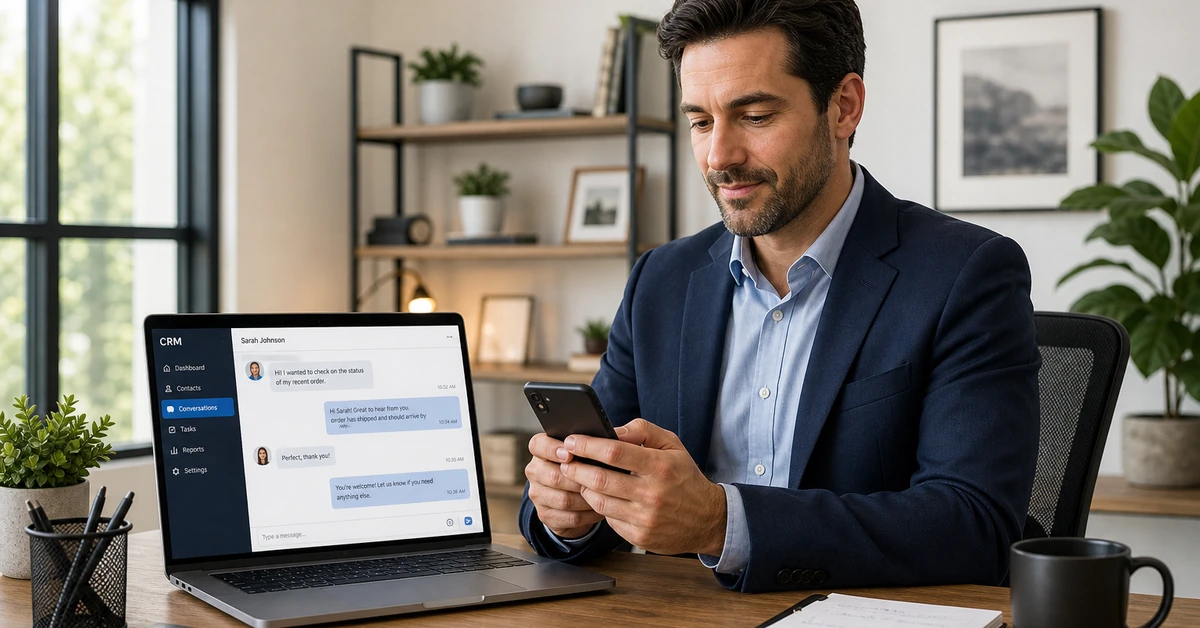

Business texting software is a dedicated platform that lets companies send, receive, and automate SMS messages from a business phone number — separate from personal devices, fully logged, and built for scale. The best platforms combine two-way texting, automated drip sequences, and CRM integration so small businesses can follow up with leads in minutes, confirm appointments without phone tag, and run promotions that actually get read. With a 98.2% open rate versus 21% for email, business texting software delivers the highest-engagement direct channel available to SMBs today.
Ready to add SMS to a platform that already includes your CRM, funnels, and automations? Book a free Automated Sales Machine demo and see it running in minutes.
What Is Business Texting Software (and How Is It Different from Personal Texting)?
At its core, business texting software is a cloud-based platform that gives companies a dedicated phone number for two-way SMS communication. Think of it as the difference between emailing clients from your personal Gmail and sending from a branded company domain. The message still arrives — but the infrastructure, logging, compliance, and team access are completely different.
Why the distinction matters in practice:
- Personal texting has no shared inbox, no opt-in tracking, no audit trail
- Business texting platforms maintain a complete conversation history accessible to your whole team
- Compliance tools — TCPA opt-in management and automatic opt-out handling — are built in
- Messages send from a recognizable business number, not a random personal cell
Standalone business texting software like Textline, TextUs, and Sakari solve the channel problem. But they don’t connect your contacts, deals, and automation in one place. That’s the gap a modern all-in-one CRM platform fills.
Two-Way Texting vs. Broadcast SMS: Two Very Different Use Cases
Broadcast SMS is one-to-many: send a promo to 5,000 customers at once. Two-way business texting is one-to-one — a prospect replies “interested,” and a salesperson picks up the thread.
The best business texting software handles both. A broadcast tool alone won’t win the appointment. Two-way texting without a broadcast engine limits your marketing reach. The question isn’t which mode you need — it’s whether the platform you pick handles both without making you toggle between dashboards.
Key Features to Look for in Business Texting Software
Not all platforms are equal. Here’s what separates a tool that moves revenue from one that just sends messages.
Dedicated business number. Your texts should come from a consistent number customers recognize — not a rotating short code that looks like spam.
Two-way messaging with a shared inbox. Your whole team needs to see and respond to conversations. Solo-inbox tools create bottlenecks the moment you hire your second person. A unified inbox that consolidates SMS alongside email, Facebook, and Instagram messages in a single stream is the standard worth aiming for.
Automated drip sequences. Set a lead as “new inquiry” and the software texts them at +1 minute, +24 hours, +3 days — no manual follow-up required. Conversion rates on automated text sequences consistently outperform cold email drips across every vertical that’s tested both.
CRM integration or native CRM. The moment you separate your contacts from your texting tool, you create a gap where leads fall through. Every unanswered text that sits in a separate inbox — disconnected from your CRM — is a lost opportunity. If your business texting software doesn’t know who sent that message, you’re doing extra work every time.
10DLC registration support. Since 2023, U.S. businesses sending application-to-person (A2P) SMS must register with carriers through 10DLC (10-Digit Long Code). Any platform that doesn’t walk you through this registration is setting you up for deliverability problems and carrier filtering.
Opt-in/opt-out management. TCPA compliance is not optional. Platforms must automatically honor STOP requests and maintain a full opt-in log. Non-compliance carries fines starting at $500 per unsolicited message.
Reporting and analytics. Open rates, click rates, response rates, and conversion tracking. You can’t optimize what you can’t measure — and without per-campaign data, every text you send is a guess.
Features Worth Skipping for Most SMBs
AI conversation prediction, advanced NLP sentiment analysis, and enterprise-tier compliance workflows are built for Fortune 500 teams — not a small dental practice or fitness studio. Don’t pay enterprise pricing for features your team won’t use in year one. Start with the fundamentals, scale when you need to.
Business Texting vs. Email Marketing: What the Data Actually Shows
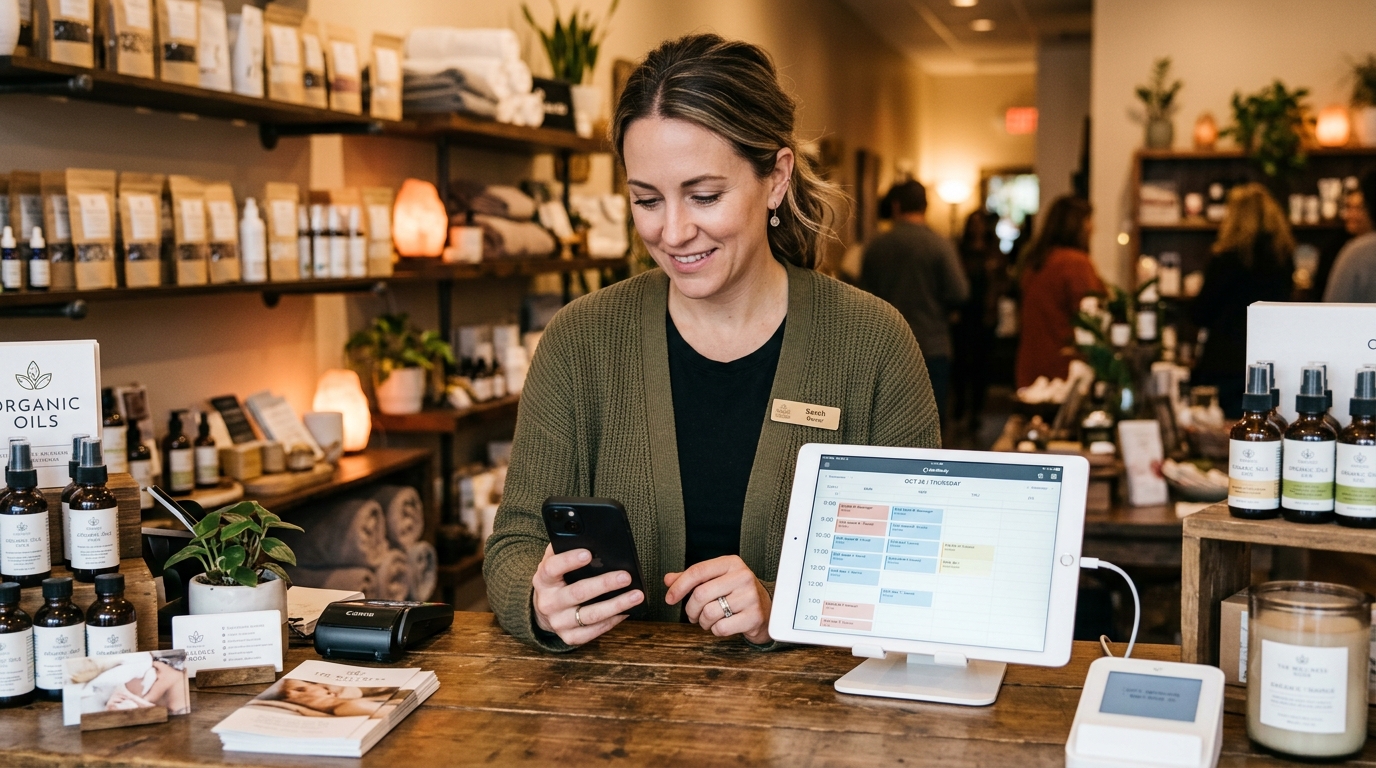
The performance gap between SMS and email isn’t a matter of opinion. The numbers are definitive.
According to DMText’s 2025 SMS Marketing Benchmarks — based on analysis of 38 million messages across 2,847 businesses:
- SMS open rate: 98.2% vs. email open rate: 21%
- SMS click-through rate: 24.7% vs. email CTR: 2.6%
- SMS read time: 90 seconds on average vs. email read time: 4+ hours
- E-commerce SMS campaigns: 42:1 average ROI across all industries
Those aren’t rounding errors. That’s a structural performance advantage. SMS gets read. Email gets sorted.
Per SimpleTexting’s 2025 SMS Marketing Survey — polling 1,000 consumers and 400 business owners — businesses that text their customers are 5.89 times more likely to report digital marketing success than those that don’t. And 84% of consumers have already opted in to receive business texts in 2025, up 35% from a few years ago.
The counterargument: email builds deeper relationships over time, handles long-form content, and costs less per send at volume. Both channels belong in an SMB’s playbook.
The difference is urgency. For a flash promotion, appointment reminder, or same-day follow-up with a warm lead, text wins every time.
When to Use SMS vs. Email
| Situation | Better Channel |
|---|---|
| Appointment reminder (24 hours out) | SMS |
| Weekly newsletter | |
| Hot lead just filled out a form | SMS (respond within 5 minutes) |
| Monthly product update | |
| Flash sale or limited-time offer | SMS |
| Onboarding sequence (multi-week) | Email + SMS touchpoints |
| Follow-up after no email response in 48 hours | SMS |
The Best Business Texting Software Options for Small and Medium Businesses
Here’s an honest look at the most-used platforms and who each one is built for.
SlickText — Rated highly for SMS marketing campaigns, with a clean dashboard and solid list management. Best fit for retail and e-commerce businesses running promotions and loyalty programs. Limited CRM functionality means you’ll need a separate tool for contact management.
EZ Texting — One of the more accessible entry points for businesses new to SMS marketing. Fast setup, good template library, and reasonable pricing for small volumes. Their small business SMS marketing guide is genuinely useful for first-timers figuring out where to start.
Textmagic — Strong for international sending and API-first teams that want to build custom workflows. Less polished for non-technical users who want a point-and-click experience.
TextDrip — Specializes in drip automation and follow-up sequences. Good fit for real estate agents and insurance reps whose entire business depends on timely follow-up. Narrower scope than a full CRM platform.
Textedly — A budget-friendly option for small businesses sending bulk broadcasts. Affordable entry tier; two-way conversation features are limited at lower price points.
Bitrix24 — Free plan available with CRM bundled in. A reasonable starting point for teams that want a taste of integrated CRM and SMS before committing to a subscription. Scales awkwardly once you outgrow the free tier.
The all-in-one alternative: Automated Sales Machine takes a different approach entirely. Instead of bolting business texting software onto a standalone platform, ASM builds it directly into the same system that handles your CRM, automated follow-up workflows, sales pipelines, reputation management, and appointment booking. Your contacts don’t live in two tools. Your conversations, deals, and campaigns share the same record. For service businesses — med spas, dental practices, real estate teams, home services companies — that consolidation removes hours of weekly data wrangling.
Top Use Cases: Customer Service, Sales Follow-Up, and Appointment Reminders

According to Text Request’s 2025 State of Business Texting Report — surveying 500+ North American businesses — customer service is the #1 use case for business texting at 75.9%, followed by appointment reminders and sales follow-up. And 97% of businesses that already use business texting would recommend it to others.
Here’s how these use cases play out day-to-day:
Customer service: A customer texts “I need to reschedule” at 9 PM. Your team responds at 9 AM with a single click to open a new slot. No voicemail tag, no call center queue. The entire exchange takes 45 seconds.
Appointment reminders: Real estate agents and med spas consistently report 30–40% reductions in no-shows when they switch from phone call reminders to text reminders. The math is simple — a text takes three seconds to read and respond to. A phone call takes three to four minutes and often goes to voicemail.
Sales follow-up: A prospect fills out your lead form. They get an email acknowledgment — and 60% of them never open it. The same prospect gets a text within two minutes of form submission: response rates jump to 30–40%. That speed gap is why SMS follow-up for inbound leads is one of the highest-ROI moves a small business can make. Pair it with a missed-call text-back workflow and you’re capturing leads that would have otherwise slipped away.
Promotional campaigns: 72% of consumers have made a purchase after receiving a text from a brand, per Klaviyo’s global SMS survey of 8,781 respondents. And 86% of those SMS buyers made two or more purchases in the last year. SMS doesn’t just drive one sale — it builds repeat purchase behavior.
Business Texting for Specific Verticals
Real estate: Automate new listing alerts via text. Follow up with open house attendees within the hour. Most agents report SMS response rates on cold real estate leads running 4–5x higher than email.
Med spas and fitness studios: Text confirmation plus reminder sequences reduce no-shows and fill last-minute cancellations faster than any other channel. A two-text reminder sequence (48 hours out + 2 hours out) costs you one automation setup; the revenue recovery pays for months of platform costs.
Home services: Text-based dispatching and quote approvals cut phone time dramatically. Customers get a status update, not a voicemail they’ll return hours later.
Business Texting Software Pricing: What to Expect at Every Budget Level
Pricing structures across business texting platforms follow two models: per-message pricing and monthly subscription tiers.
Per-message pricing suits low-volume senders — you pay only when you send. Rates typically range from $0.01 to $0.05 per message depending on volume and destination. The cost compounds fast once you’re running automated campaigns at any real scale.
Subscription tiers make more sense for businesses sending 1,000+ messages per month. Common breakdowns:
- Starter tier (up to 500 contacts): $20–$50/month
- Growth tier (up to 2,500 contacts): $75–$150/month
- Business tier (5,000+ contacts): $150–$300/month
- Enterprise: custom pricing
The raw message cost is rarely what breaks the budget. Setup fees, 10DLC registration fees ($4–$10 one-time per brand, plus per-campaign fees), and the ongoing cost of maintaining a separate CRM alongside your texting tool — those add up faster than the base subscription.
An all-in-one platform that includes SMS inside the same subscription as your CRM, email marketing, and automation typically costs less than the combined monthly tab for three separate tools. For most small businesses, that consolidation math is the actual pricing story. See how all-in-one marketing platforms compare to point solutions when you add up the total stack cost.
How to Get Started with Business Texting Software: Compliance, Setup, and Your First Campaign
Getting compliant is the most important step — and the one most businesses skip until something goes wrong.
TCPA compliance, the short version:
- You must have explicit opt-in consent before texting anyone for marketing purposes
- Every message must include an easy opt-out instruction (“Reply STOP to unsubscribe”)
- You must honor opt-outs within 10 business days — most platforms handle this automatically
- Store opt-in records (date, method, and consent language) indefinitely
10DLC registration: All A2P SMS sent from a 10-digit long code in the U.S. requires carrier registration. Your business registers once (basic vetting, ~$4 one-time fee) and then registers each messaging campaign. Unregistered traffic gets filtered. Your business texting software should walk you through this during onboarding — if it doesn’t, treat that as a red flag.
Your first campaign in three steps:
1. Build your opt-in list. Add a text opt-in checkbox to your website forms, booking pages, and checkout flows. Import existing contacts only if you have documented consent for each one.
2. Set up your first automated sequence. For most service businesses, start here: new inquiry → text within 2 minutes → follow-up at 24 hours if no response → follow-up at day 3 if still no response. Three touches, fully automated, built once.
3. Send your first broadcast. Pick a segment (active customers from the past 90 days), write a message under 160 characters, and schedule it for late morning on a weekday. Measure open rate and click rate. Optimize from there.
Global SMS marketing spend is expected to reach $790 million this year, with U.S. companies accounting for approximately 40% of all SMS advertising spend, per Constant Contact’s SMS marketing statistics report. The channel is growing because it works — not because it’s new.
Business Texting Software: Frequently Asked Questions
Is business texting software the same as SMS marketing software?
Not exactly. SMS marketing software typically focuses on broadcast campaigns — sending bulk promotional messages to large contact lists. Business texting software is broader: it includes two-way conversations, team-shared inboxes, compliance management, and often CRM integration. Many platforms cover both, but the distinction matters when you’re buying. If you only need one-way broadcast campaigns, SMS marketing software is sufficient. If your team needs to hold real conversations with customers via text, you need business texting software built for two-way messaging.
How does 10DLC registration work?
10DLC stands for 10-Digit Long Code — the standard phone number format for business texting in the U.S. Since 2023, carriers require businesses to register their brand and their messaging campaigns before sending A2P (application-to-person) SMS at volume. The registration process involves verifying your business entity (EIN, business name, address) and describing the type of messages you’ll send. Registration fees are modest — typically $4–$10 for brand registration, plus $10–$15 per campaign use case. Unregistered traffic gets filtered or blocked by carriers. Most reputable business texting software platforms walk you through 10DLC setup during onboarding.
What’s a realistic opt-in rate for business texting?
It depends heavily on how you ask. Adding a text opt-in checkbox to a checkout flow or booking form typically converts 15–30% of customers. A dedicated SMS opt-in landing page with an offer (discount, early access, useful resource) can convert 20–40%. Cold outreach — importing contacts who haven’t explicitly opted in — isn’t permitted under TCPA. Build your list through natural touchpoints: checkout, scheduling, web forms, and in-store signage with a text keyword.
Ready to Replace Your Disconnected Texting Tool?
Business texting software earns its cost fast. A 98.2% open rate and 5.89x higher digital marketing success rate are not incremental improvements — they’re structural advantages over the channels most small businesses are still relying on exclusively.
The platform you pick matters less than getting started. Pick one. Build your opt-in list. Set up one automated sequence. Measure it.
When you’re ready to stop managing a business texting tool alongside a separate CRM, a separate email platform, and a separate automation engine — that’s when Automated Sales Machine makes sense. One platform, every channel, one contact record per customer.
Automated Sales Machine builds business texting software directly into the same system that runs your sales pipeline, appointment booking, email campaigns, and reputation management — so your team works from a single screen instead of three tabs. Book a free demo of Automated Sales Machine today or start your free trial and see the unified inbox running in minutes.