
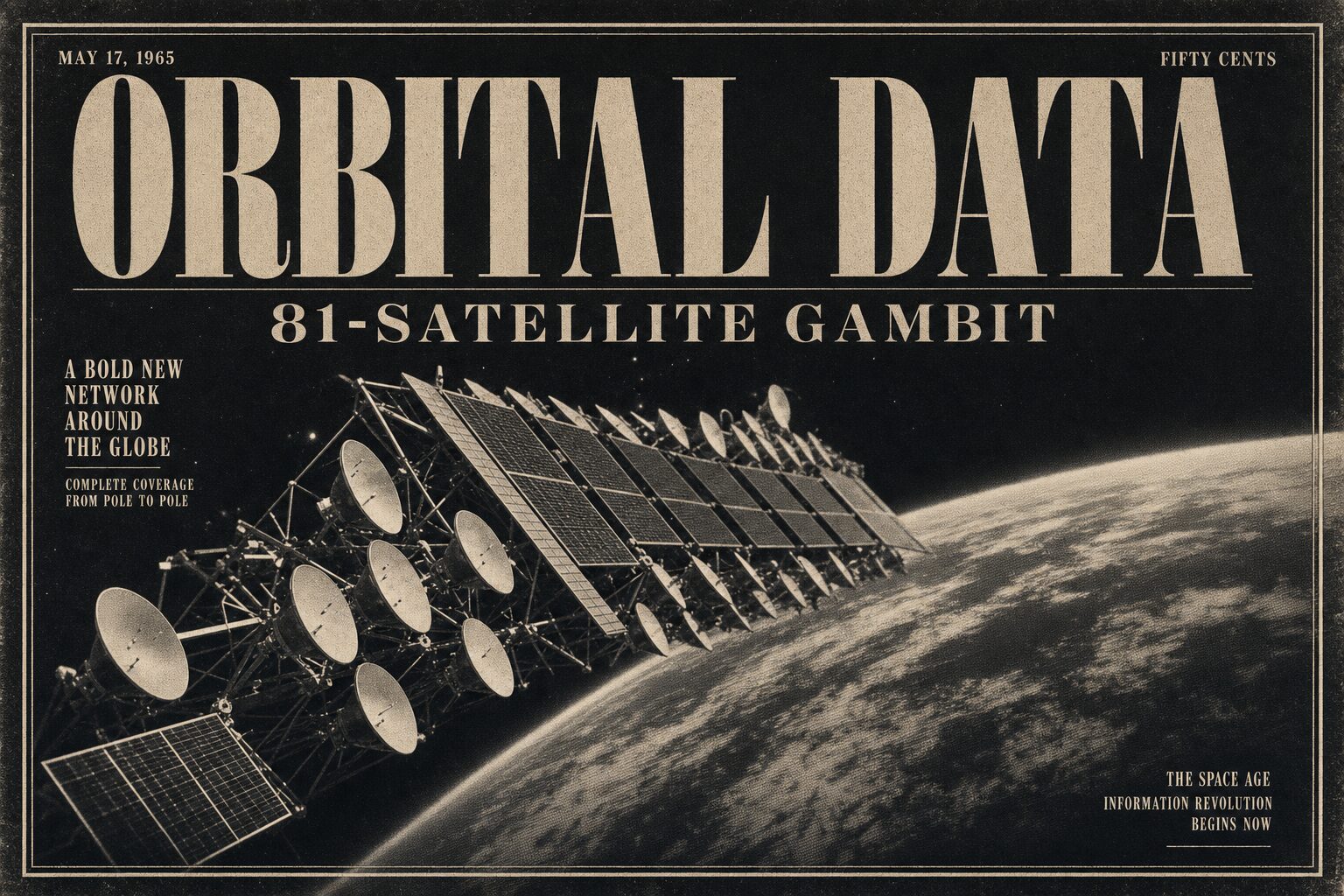

In what may be the most audacious infrastructure bet in the history of computing, Google and SpaceX are in advanced discussions to deploy orbital data centers — fully operational AI compute clusters launched into low Earth orbit, powered by solar arrays, and cooled by the vacuum of space itself. First reported by the Wall Street Journal on May 12, 2026, the talks signal that two of the most powerful technology companies on the planet have concluded that Earth is running out of room for artificial intelligence.
The Details: Project Suncatcher and the Orbital Data Centers Constellation
Google’s internal initiative, known as Project Suncatcher, envisions an 81-satellite constellation operating at an altitude of 650 kilometers. The satellites would be equipped with Google’s own TPU v6e accelerators — the same tensor processing units that underpin Gemini model training at terrestrial data centers — adapted for the radiation environment of low Earth orbit.
According to reporting from Data Center Dynamics, the architecture relies on free-space optical inter-satellite links capable of transmitting tens of terabits per second between nodes. Power generation would come entirely from solar arrays, sidestepping the terrestrial grid dependency that has become one of the defining constraints of the modern data center industry. Heat would be dissipated through radiative cooling into the vacuum of space.
Initial prototypes are targeted for an early 2027 launch, with Planet Labs named as a potential partner. End-to-end latency to Earth is estimated at 20 to 30 milliseconds — competitive with many cloud regions today. Radiation-hardened processors are designed with five-year operational lifespans.
- Constellation size: 81 satellites at 650km altitude
- Processors: Google TPU v6e, radiation-hardened
- Communication: free-space optical links (tens of terabits/sec)
- Power: solar arrays with radiative vacuum cooling
- Prototype launch target: early 2027
Why This Matters: The Terrestrial Infrastructure Crisis
To understand why Google is contemplating orbital data centers, consider what is happening on the ground. Google is on track to spend more than $185 billion on data center infrastructure in 2026 alone. That capital is chasing a resource trifecta that is becoming structurally scarce: land, power, and permitting.
The power problem is particularly acute. A single one-gigawatt data center campus requires grid interconnection agreements that can take three to seven years to negotiate in the United States. The comparison to the $10 billion data center development in Waco, Texas is instructive: even with favorable state-level incentives, projects of that scale face multi-year timelines and community opposition.
Furthermore, space offers a paradoxical efficiency advantage: cooling. Data centers on Earth spend between 30 and 40 percent of their total energy budget on thermal management. In orbit, that cost approaches zero. For compute-dense workloads, this is not a marginal improvement — it is a structural one.
The Bigger Picture: SpaceX’s IPO, Cost Curves, and Skepticism
The timing of these discussions is not incidental. SpaceX is pitching orbital compute capabilities to investors ahead of a planned June 2026 IPO at an approximately $1.75 trillion valuation. As TechCrunch noted, the Google partnership would represent a flagship commercial anchor for SpaceX’s orbital services business.
However, the economics remain genuinely challenging. Current orbital compute costs run approximately three times the equivalent terrestrial investment — roughly $50 billion versus $15 to $20 billion for comparable one-gigawatt capacity. Starship launch costs need to reach approximately $200 per kilogram by 2035 for orbital data centers to achieve terrestrial cost parity, down from the current $500 per kilogram.
Skeptics are not hard to find. Gartner analysts have characterized the concept as reaching “peak insanity” — a pointed assessment reflecting legitimate concerns about hardware obsolescence cycles, the $100 million estimated cost of a single satellite failure, and compounding space debris risk. Unlike a failed server rack, a failed orbital node cannot be retrieved, diagnosed, or replaced.
What This Means for Your Business
For small and mid-sized businesses, the immediate practical implications of this orbital infrastructure are admittedly indirect. No SMB is procuring compute from a Google satellite constellation in 2027. Nevertheless, the forces driving these investments have direct consequences for the cost and accessibility of AI tools.
The infrastructure arms race — whether it plays out in Texas data center campuses or low Earth orbit — exists because demand for AI inference capacity continues to outpace supply. When supply constraints ease, the result is downward pressure on AI compute costs. Historically, each successive wave of infrastructure investment has translated, within three to five years, into cheaper and more capable AI services at the application layer.
That trajectory is already visible in tools available today. Platforms like Automated Sales Machine bundle AI-powered capabilities — including AI voice agents, automated follow-up sequences, CRM pipelines, and intelligent chatbots — that would have required enterprise-scale budgets five years ago. The all-in-one marketing platform approach consolidates CRM, email, SMS, funnels, and automation under a single system, directly benefiting from falling AI compute costs.
Orbital Data Centers FAQ
What are space-based data centers?
Orbital data centers are compute facilities deployed on satellites in low Earth orbit rather than at fixed ground-based locations. They process AI workloads using solar power and dissipate heat through radiative cooling in the vacuum of space, addressing the primary constraints facing terrestrial expansion.
What is Google’s Project Suncatcher?
Project Suncatcher is Google’s internal initiative to develop a constellation of 81 satellites equipped with TPU v6e AI accelerators, operating at 650 kilometers altitude. Initial prototype launches are targeted for early 2027 in partnership with Planet Labs.
How much would orbital data centers cost?
Current estimates place orbital compute costs at roughly three times terrestrial equivalents — approximately $50 billion versus $15-20 billion for comparable one-gigawatt capacity. Commercial viability depends on Starship launch costs dropping to around $200 per kilogram by 2035.
What are the biggest risks?
Key risks include high launch costs, impossibility of on-orbit repair ($100 million per satellite failure), hardware obsolescence given rigid five-year replacement cycles, and space debris in an increasingly congested low Earth orbit environment.