


Last updated September 17, 2026
Different types of marketing refer to the specific strategies, techniques, and channels businesses use to attract and retain customers. These are typically categorized by intent, such as inbound or outbound, and medium, including digital, social, and traditional paths. Modern marketing requires integrating these silos into a single, unified operations stack.
Key takeaways
- Digital dominance. Digital marketing has surpassed traditional methods in ROI through granular targeting and automated triggers.
- Audience specific. B2B marketing focuses on high-value trust building, while B2C prioritizes direct emotional resonance and rapid sales cycles.
- The fragmentation cost. The modern tech stack tax impacts SMBs by requiring the management of separate, non-integrated tools for email, CRM, and SMS.
- Agentic AI. This is the newest marketing category, using autonomous agents to qualify leads and book meetings without human input.
- Platform consolidation. A flat-fee AI operating system can replace a variety of fragmented tools at a competitive monthly price point.
Understanding the Different Types of Marketing
Marketing is an ecosystem of strategies designed to guide a prospect from initial awareness to a final purchase. According to Salesforce, marketing efforts are typically categorized into specific approaches or "types" stretching from research to retention. Rather than viewing these as isolated tasks, you should see them as a spectrum of intent. You are either pulling customers in through value or pushing messages out to them to spark interest.
Foundational principles like the "Four Ps" defined by Coursera—product, price, promotion, and place—still matter. However, the execution has evolved into complex layers like SEO, social media engagement, and high-conversion paid advertising. Successful brands focus on building a cohesive environment. Every channel must feed the next.
For example, a local bakery might use a physical storefront sign (place) combined with an Instagram page (promotion). They might also run a loyalty program managed through a marketing stack including AI tools strategy. This ensures customers return. This multi-layered approach captures different market segments simultaneously.
The Strategic Divide: B2B vs B2C Marketing
The fundamental difference between B2B and B2C marketing lies in the complexity of the buyer’s journey and the emotional weight of the purchase. B2B Marketing (Business to Business) focuses on building trust and long-term value for other companies. It relies on logic, data, and relationship nurturing. Because B2B sales cycles can last months, marketing must emphasize professional authority and ROI. Often, this requires Account-Based Marketing (ABM) to target specific high-value stakeholders within a single corporation.
B2C Marketing (Business to Consumer) is different. It speaks the customer’s language for direct sales by tapping into immediate desires. These strategies thrive on high-volume channels like social commerce and rapid-response SMS marketing. The goal is a quick transaction. A B2B buyer might need five case studies and a demo, but a B2C buyer might only need a well-timed coupon delivered via a text message to make a decision.
| Feature | B2B Marketing | B2C Marketing |
|---|---|---|
| Primary Goal | Relationship & Lead Quality | Sales Volume & Brand Loyalty |
| Decision Driver | Logic & Financial ROI | Emotion & Immediate Need |
| Sales Cycle | Long (Months to Years) | Short (Minutes to Days) |
| Core Channel | LinkedIn, Email, Webinars | Instagram, TikTok, SMS |
Inbound vs Outbound Marketing Intent
Inbound marketing focuses on creating value-driven content that draws prospects to your brand naturally over time. Instead of fighting for attention, you earn it. You answer questions through blogs, videos, and social media posts. This method is highly effective for long-term growth. It builds a library of assets that generate leads without additional ad spend.
Outbound marketing involves proactive outreach. This includes cold calls, ringless voicemail, and traditional television or radio spots. While often criticized as intrusive, outbound remains a powerful tool for immediate lead generation. You need it to fill a sales pipeline quickly. The current shift is toward "Permission Marketing." Even outbound efforts are triggered by user behavior data. This makes the outreach feel helpful rather than disruptive.
| Strategy Type | Pros | Cons |
|---|---|---|
| Inbound | High trust, lower long-term cost, builds authority. | Takes time to see results, requires consistent content. |
| Outbound | Immediate feedback, reaches non-searchers, fast scaling. | Higher cost per lead, can be seen as intrusive. |
We recommend a balanced strategy. Inbound efforts provide the foundation for your SEO, while outbound triggers help you close deals in real-time. By using a workflow for visual marketing automation builder, you can set up sequences that respond to inbound signals with outbound actions. For example, send an immediate SMS when someone downloads a whitepaper.
Digital Marketing Categories and Search Engine Marketing
Digital marketing has become the dominant force in business growth. It allows for granular tracking that traditional media cannot match. Search Engine Marketing (SEM) involves using paid strategies to increase visibility in search engine results pages. It provides instant traffic for businesses willing to bid on high-intent keywords. While SEM offers speed, content marketing serves as the foundation for modern SEO. It builds authority through blogs and case studies that rank organically.
Social media marketing (SMM) has evolved into social commerce. The entire buyer journey, from discovery to checkout, happens inside a single app. This reduces friction. It increases conversion rates for impulse buys. Proximity Marketing focuses on using cellular technology to send marketing messages to mobile device users near a specific location. This bridges the physical-digital gap for brick-and-mortar stores.
Newer models like our resource for affiliate marketing explain how businesses can leverage third-party influencers. In these scenarios, digital marketing becomes a performance-based ecosystem. You only pay for the actual sales generated. This level of precision ensures that even small businesses can compete with global brands. You target niche audiences with surgical accuracy.
Marketing Automation for SMBs
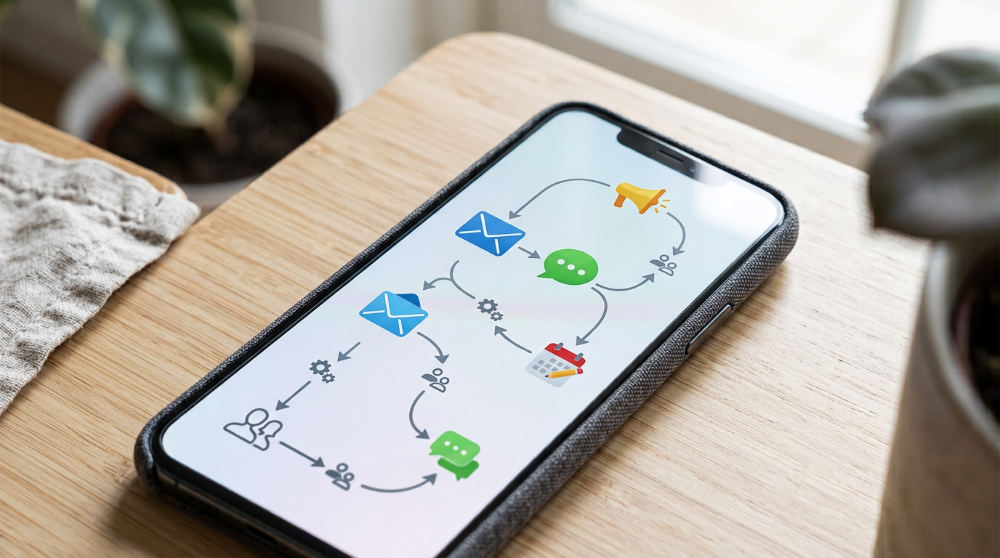
SMB marketing automation has moved beyond simple email drips to multi-channel triggers spanning SMS, voice, and web chat. Businesses are no longer manually sending every follow-up. Instead, they use automated systems to ensure no lead falls through the cracks. For instance, if a lead visits your pricing page three times in one hour, an automated workflow can trigger a ringless voicemail from a sales rep to offer assistance.
ASM utilizes visual, no-code nodes for marketing automation. These nodes span email, SMS, and ringless voicemail in one single workflow. You can build complex customer journeys without needing a developer. Modern systems now use Agentic AI. This is a modern marketing innovation where AI agents handle scheduling and lead qualification without human intervention. Your marketing isn’t just sending messages. It is actively booking appointments on your calendar while you sleep.
Automating reputation management is another critical component for local growth. By triggering review requests the moment a deal closes in your CRM, you can systematically boost your Google and Facebook ratings. This social proof directly impacts your local SEO. It creates a self-sustaining loop where automation drives reviews, which drive rankings, which drive more customers to your door.
All-in-One Sales and Marketing Platform
An all-in-one marketing platform is a unified software suite that combines CRM, email marketing, funnel builders, and automation into one interface. These all-in-one marketing solutions consolidate fragmented tools into a single management point. By centralizing your data, you avoid the "sync lag" that happens when your email tool doesn’t talk to your CRM. Your customer data is always accurate and actionable.
The Cost Rule: Stop paying per contact. If your marketing platform increases your bill as your business grows, you are being penalized for success. Seek flat-rate solutions.
Traditional systems often lack native funnel builders or integrated reputation management. This forces users to buy additional software like ClickFunnels or Podium. ASM eliminates the duct-taped tech stack by unifying all these marketing types into one AI Operating System. Unlike competitors who charge per contact, like ActiveCampaign or Salesforce, we offer flat-rate pricing for contacts and users. At $150 per month, the price is fixed regardless of your growth. If you are tired of managing a dozen logins, you can view this HubSpot Alternative for Small Business to simplify your business operations.
Consider a coaching business that currently pays for Mailchimp for email, Calendly for booking, and WordPress for their site. By moving to an all-in-one marketing software, they can host their courses, manage their pipeline, and use AI agents to qualify leads in one place. This consolidation saves in monthly fees. It also provides a Unified Inbox where every text, email, and DM from a customer appears in one single stream.
Comparing Marketing Stacks: Unified vs Fragmented
Unified marketing stacks consolidate all customer data and communication channels into a single software environment. Fragmented stacks rely on multiple separate applications connected by third-party integrations. Fragmented stacks frequently lead to "data silos," where your email marketing tool has no record of a specific promise a sales representative made during a recent phone call. A unified platform allows for a single source of truth. Every customer interaction is logged in one place for any team member to access.
Integrated reputation management is a primary advantage of consolidation. It connects review requests directly to the CRM, a feature often siloed in traditional stacks. This ensures that a request for a Google review is only sent immediately after a transaction is marked as successful in the sales pipeline. The following table illustrates the cost and functional differences between these two approaches.
| Feature | Fragmented (Duct-Taped) Stack | Unified AI Operating System |
|---|---|---|
| Monthly Cost | Higher costs due to multiple subscriptions | Simplified $150/mo flat-rate pricing |
| Data Flow | Delayed sync via Zapier/API | Instant, native data sharing |
| Lead Tracking | Often broken or incomplete | End-to-end attribution |
| Communication | Separate tabs for SMS/Email | Single Unified Inbox |
| Contact Limits | Pay more as your list grows | Unlimited contacts and users |
The Tech Stack Tax and Fragmented Tool Risks
The Tech Stack Tax is the cumulative monthly cost and operational friction a business pays for maintaining separate subscriptions. Paying for individual services like ClickFunnels, Calendly, and Mailchimp results in a significant drain on SMB budgets. This is especially true when those tools charge "per contact" or "per seat" premiums.
Practical Rule: Never duct-tape your CRM to your funnel builder. Using separate tools for these core functions creates a ‘leaky bucket’ where leads are frequently lost in the sync.
Fragmented systems often fail at the point of integration. This leads to lost leads and broken automation workflows that disrupt the customer journey. Managing multiple logins and billing cycles creates unnecessary administrative overhead. Small marketing teams should be focused on strategy, not troubleshooting software connections. The industry is shifting toward AI platforms that run the entire marketing stack. This trend is highlighted by the Ex-Webflow CTO raising $27M for Ploy to build integrated solutions. To avoid these risks, businesses should look for visual marketing automation that handles email, SMS, and funnels within a single, native workflow builder.
All-in-One Marketing Operations for Growing Agencies

All-in-one marketing operations refer to the centralized management of people, processes, and technology. You scale marketing output from a single command center. Agencies using these systems reduce software overhead while improving client reporting accuracy. Unified dashboards pull data from every channel simultaneously. Organizations must prioritize all-in-one marketing operations to maintain a competitive advantage. Speed to lead determines success.
Modern agencies can now offer "Snapshots." These deploy entire marketing machines for new clients in seconds. This includes pre-built funnels, email sequences, and automation logic. This centralized approach allows for consistent branding across email, SMS, and sales funnels. There is no need to manually update every individual tool. Automation at the agency level enables a small team to manage hundreds of client accounts without increasing headcount. Tasks like lead qualification and reporting are handled by the system. By adopting modern tools for business growth, agencies can move away from being software integrators. They return to being strategic growth partners. A small agency can now outperform enterprise firms by utilizing the best email marketing platforms integrated directly into a wider CRM.
When One Marketing Type is Not Enough
Relying solely on one marketing type, such as SEO, leaves a business vulnerable. Algorithm changes can wipe out traffic and revenue overnight. While content is a powerful long-term asset, over-automation can lead to a lack of brand personality. This makes messages feel robotic and untrustworthy to modern consumers.
Diversification across multiple categories is essential for stable growth. You need Content, Email, and Search Engine Marketing. This multi-channel approach ensures that if one lead source underperforms, others remain active. High-ticket B2B services should not rely on pure automated B2C tactics. They require human-in-the-loop CRM management to nurture relationships over long sales cycles. For businesses looking to expand their reach, exploring an affiliate marketing guide can provide insights into leveraging third-party partnerships. Use this to supplement internal marketing efforts and reach new audiences safely.
Conclusion: Choosing Your Marketing Operating System
The future of marketing isn’t about adding more tools. It is about unifying the types of marketing you already use into a cohesive system. Whether you focus on B2B trust or B2C speed, your CRM should be the central engine. Use it to plan, track, and align all marketing tactics across the organization. Moving to a flat-fee AI operating system provides the predictability SMBs need. You scale without fear of rising costs or integration failures. Consolidate your operations today. Eliminate the tech stack tax. Focus on what matters: growing your business.
Frequently asked questions
What are the 4 main types of marketing?
The four primary categories are Inbound, Outbound, Digital, and Traditional marketing. Inbound focuses on attracting customers through content, while Outbound uses direct ads and cold outreach. Digital marketing covers all electronic channels, and Traditional marketing utilizes physical media like print and billboards to reach local audiences.
What are the 7 types of digital marketing?
Modern digital marketing includes Search Engine Optimization (SEO), Pay-Per-Click (PPC), Social Media Marketing, and Content Marketing. The list also encompasses Email Marketing, Affiliate Marketing, and Mobile/SMS Marketing. These categories allow businesses to target customers across different devices and stages of the buying cycle for maximum impact.
What is an all-in-one marketing platform and do I need one?
An all-in-one platform is a single software suite containing CRM, email, funnels, and automation tools. You need one if you are currently paying for three or more separate marketing tools or struggling with data syncing between systems. It provides a unified view of the customer journey from first click to sale.
Can one tool handle email, SMS, and funnels effectively?
Yes, modern AI operating systems integrate these channels natively into a single workflow builder. Unified tools prevent the "sync lag" often found when connecting separate providers like Mailchimp and ClickFunnels. Natively integrated SMS and email allow for complex, multi-channel automated triggers that respond instantly to customer behavior.
What are the different types of marketing automation for SMBs?
SMBs typically utilize Lead Nurturing, Sales Automation, and Reputation Automation. Lead Nurturing involves automated email and SMS follow-ups for new inquiries. Sales Automation moves leads through pipeline stages based on their activity, while Reputation Automation triggers review requests automatically after a successful transaction is completed.
Choosing the right marketing strategies is essential for building a sustainable business. By moving away from fragmented tools and adopting a unified operating system, you can reduce costs while increasing your efficiency. To see how consolidation can transform your workflow, start your 14-day free trial and take full control of your marketing operations.