
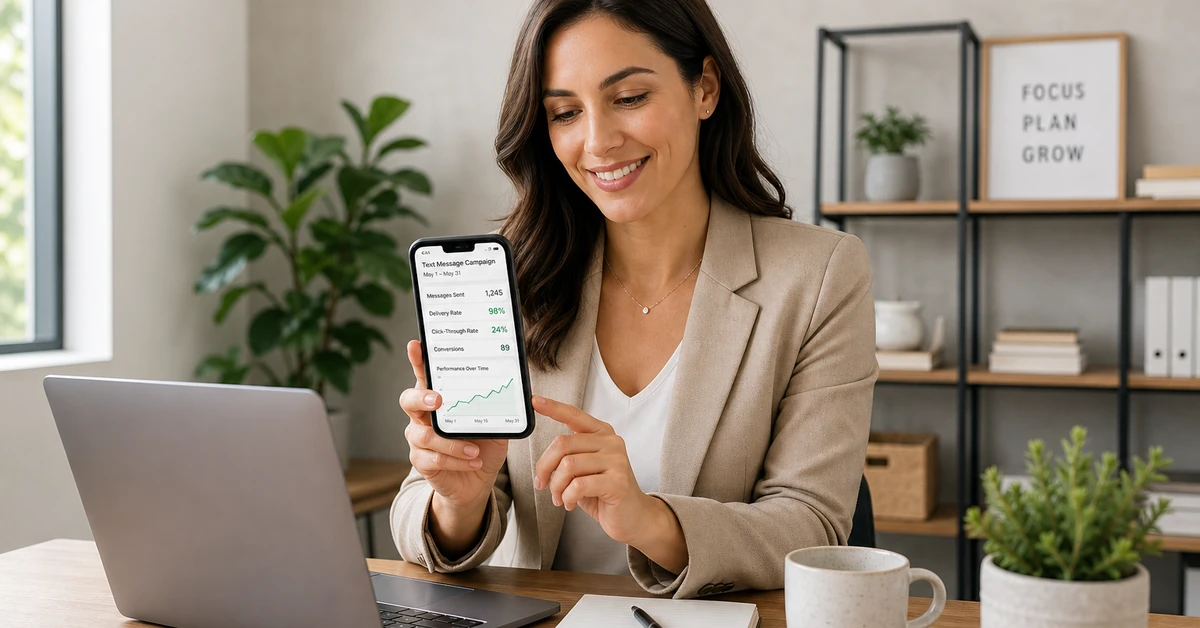

TL;DR: Text message marketing for small business delivers open rates of 98%—with 80% of messages read within five minutes of delivery—and ROI estimates between $21 and $41 for every dollar spent. Businesses that text their customers are nearly 5x more likely to report digital marketing success than those that don’t. Automated Sales Machine gives service businesses a single platform to send, automate, and track SMS campaigns without adding a separate texting tool to an already crowded tech stack.
Ready to replace your disconnected texting app with a full CRM that does it all? Book a free demo of Automated Sales Machine and see SMS in action.
Text message marketing for small business has moved past the “emerging channel” conversation. In 2026, SimpleTexting reports that 85.6% of consumers are opted in to receive business texts—a nearly 40% jump from 2021. That’s not a niche tactic. That’s the majority of your customer base already expecting you to reach them by text.
The channel works because it’s impossible to ignore. Email gets buried. Social media posts get scrolled past in three seconds. Text messages appear on a locked screen and demand a response. The average consumer reads a text within five minutes. No other marketing channel delivers that kind of immediacy—and no other channel gives small businesses a more direct line to the customers who matter most.
This guide covers every aspect of text message marketing for small business—from the stats that prove the ROI to the exact campaigns that drive revenue, the compliance rules you can’t skip, and how to run everything without juggling a separate SMS tool alongside your CRM. Whether you’re running a med spa, a fitness studio, a dental practice, or a home services operation, the playbook here applies directly to how your customers behave.
Why Text Message Marketing for Small Business Outperforms Every Other Channel
The fundamental problem with most small business marketing: the message never lands. Open rates for email sit at 20–30% on a good day. Organic social reach has collapsed. Paid ads require budget most SMBs can’t sustain. Text message marketing for small business solves all three problems at once—with a single channel that costs a fraction of paid advertising and out-engages email by every measurable standard.
The Open Rate Advantage Nobody Can Match
SMS open rates consistently hit 90–98%, per Sakari’s SMS marketing data for 2025–2026. Compare that to email’s industry average of 20–30% and you’re talking about a 3–5x improvement on the most basic metric that matters: did your customer actually see the message?
Response rates back this up. SMS pulls a 45% response rate versus 6% for email, according to Notifyre’s 2025 SMS benchmarks. That’s not a rounding error. That’s a structural channel advantage that compounds across every campaign you run.
ROI That Justifies Every Dollar Spent
The numbers on return are even more compelling. Sakari’s data places SMS marketing ROI between $21 and $41 for every dollar invested, with some seasonal campaigns reporting up to $71 per dollar. Most businesses attribute 21–30% of their total revenue to text message campaigns, per SimpleTexting.
Put that in context: for a local med spa running $500/month in SMS spend, that’s potentially $10,500–$20,500 in attributed revenue per month. The math works at every scale, which is exactly why text message marketing for small business has become the highest-priority channel for operators who need real returns without enterprise-level budgets.
Businesses that use SMS are also 4.99x more likely to report digital marketing success than businesses that don’t, according to SimpleTexting’s 2026 research. That single data point explains why 67% of businesses are actively increasing their SMS budgets this year.
7 High-Converting SMS Campaigns for Service-Based Businesses
Not all text campaigns are equal. The highest-performing use cases in text message marketing for small business tend to cluster around appointment-based businesses—dental practices, med spas, fitness studios, salons, home services—because the transaction cycle maps perfectly to SMS touchpoints.
Appointment Reminders
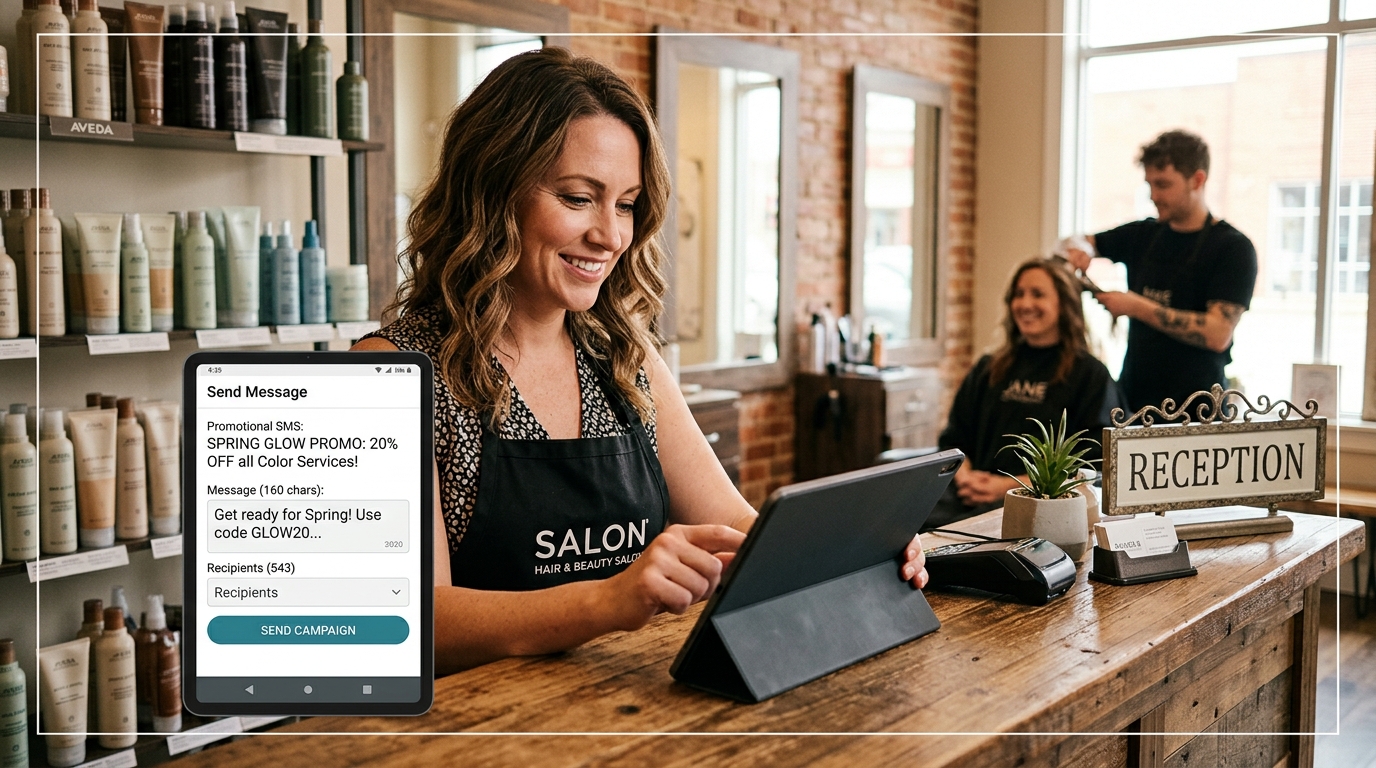
A simple “Your appointment is tomorrow at 2 PM — reply CONFIRM or CANCEL” text can cut no-show rates by 38% or more. For service businesses where every empty slot is direct revenue loss, this is the first campaign to set up. Automate it through your CRM so it fires 24 hours and 2 hours before every appointment without lifting a finger.
Promotional Flash Sales
Time-sensitive offers work because SMS creates urgency. “This weekend only: 20% off our signature facial — book by Friday. Reply BOOK or click here: [link].” Klaviyo’s research shows 65% of consumers who bought via SMS made the purchase earlier than they planned specifically because of a promotional text. The channel accelerates decisions.
Win-Back Sequences
Customers go cold. It happens to every business. A 2–3 message win-back sequence targeting contacts who haven’t booked in 60–90 days can reactivate significant revenue that’s just sitting dormant in your contact list. “We miss you, [first name]. Your next visit is on us—claim your 15% off here.” That kind of personal, direct message lands differently in an SMS inbox than it would in email.
Review Request Campaigns
Google reviews drive local SEO rankings. Sending an automated text 30–60 minutes after a completed appointment—”Thanks for visiting us today, [name]. Mind leaving us a quick review? It takes 30 seconds: [link]”—consistently outperforms email review requests. People are already on their phone. The friction is nearly zero.
Loyalty Reward Nudges
If you run a points or rewards program, text is the right channel to move members toward their next reward. “You’re 50 points away from a free service—book your next visit to claim it.” These campaigns drive repeat visits without discount dependency.
New Service Announcements
Launching a new treatment, product, or service tier? A short announcement text to your opted-in list is faster and cheaper than any paid ad. The list already opted in—they want to hear from you. Just keep it concise and always include a booking link.
Post-Service Follow-Ups
A simple check-in text two or three days after a service appointment does two things: it shows customers you care, and it gives you a natural opening to prompt a follow-up booking. “How’s that new haircut treating you? When you’re ready for your next appointment, we’re booking here: [link].” Low effort. High relationship value.
How to Build Your SMS Subscriber List from Scratch
Text message marketing for small business only works with a quality opted-in list. Buying lists is illegal under TCPA rules—and beyond legality, purchased lists perform terribly because those contacts never asked to hear from you. Build your list organically. It’s slower at first, but every subscriber is genuinely interested and that shows up immediately in your open and response rates.
Opt-In Methods That Work for Local Businesses
The most effective list-building tactics for service businesses:
- In-store keyword opt-ins: “Text BOOK to 55551 for exclusive deals and appointment reminders.” Post this on your front desk, mirrors, and checkout counter.
- Website pop-up with SMS capture: “Get 10% off your first visit—enter your mobile number.” Pair it with an immediate confirmation text so the subscriber feels the value instantly.
- QR code at checkout: A printed QR code that triggers an opt-in form works for businesses with physical foot traffic. Fast, frictionless, low-cost.
- Post-booking confirmation flow: After a customer books an appointment through your website, offer SMS updates as a checkbox during the confirmation flow. Most people opt in because reminders are genuinely useful.
None of these require a massive budget. They require consistency. Every customer touchpoint is an opportunity to add a subscriber.
List Quality Over List Size
A 500-person SMS list that actively responds is worth more than a 5,000-person list of cold contacts. Clean your list regularly. Remove non-responders after 60–90 days of inactivity. Segment by service type, purchase history, or location so messages stay relevant. Relevant messages = higher engagement = higher revenue per text sent.
How to Set Up Your First SMS Campaign in Under an Hour
Here’s the practical setup path that most service businesses can execute same day:
- Choose a platform with two-way texting. You need to both send and receive messages—customers will text back, and you need to handle responses. A platform embedded in your CRM handles this automatically through a unified inbox that captures SMS, email, and social messages in one place.
- Register your number for 10DLC. This is a legal requirement (covered below). Most modern SMS platforms handle registration for you, but you need a business name, EIN, and a description of your campaign type.
- Import your contact list. Upload your existing customer contacts with opt-in consent documentation. If you’re starting from scratch, use the opt-in methods above to build the list before your first send.
- Create your first template. Keep it under 160 characters. Include a clear CTA, personalization where possible, and an unsubscribe option (e.g., “Reply STOP to unsubscribe”).
- Schedule your first automated trigger. Start with appointment reminders—they deliver immediate, measurable ROI and require zero manual effort after setup.
The entire setup takes less than an hour with the right platform. The problem most businesses run into is doing this in a standalone SMS tool that doesn’t talk to their CRM. That’s where the missed-call text-back use case becomes essential—if a customer calls and you can’t answer, your platform should automatically send a text within seconds. That’s not a manual workflow. That’s automation built into Automated Sales Machine’s missed-call text-back feature, which captures leads you’d otherwise lose entirely.

SMS Compliance in Text Message Marketing for Small Business: TCPA Rules That Apply
This is where a lot of small businesses get into trouble, and it’s also where many abandon text message marketing for small business prematurely. The Telephone Consumer Protection Act (TCPA) governs the channel at the federal level. Violations start at $500 per message and climb to $1,500 for willful violations. With class-action exposure, the risk is real.
TCPA Consent Requirements
You need written prior express consent before sending marketing texts. That means:
- The customer must have actively opted in—pre-checked boxes don’t count
- The opt-in must clearly disclose that they’re agreeing to receive marketing texts
- You must provide a clear unsubscribe mechanism (STOP keyword is standard)
- Keep records of opt-ins—timestamps, IP addresses, and the exact consent language shown
Transactional texts (appointment confirmations, order updates) operate under different consent rules than marketing texts, but when in doubt, get explicit written consent for both.
10DLC Registration: What It Is and Why It Matters
10DLC stands for 10-digit long code. It’s the phone number format most businesses use for SMS marketing. Since 2023, carriers require businesses to register their 10DLC numbers with The Campaign Registry (TCR) before sending marketing messages at scale.
Unregistered numbers get filtered or blocked by carriers. Registered numbers get higher throughput and better deliverability. Registration takes 2–4 weeks, so plan ahead. Most enterprise SMS platforms (and Automated Sales Machine) handle this registration as part of onboarding.
The short version: don’t skip registration. It’s not optional, and the deliverability hit from skipping it will tank your campaign performance before it starts.
SMS vs. Email Marketing: What the Data Actually Shows
Let’s put the two channels head-to-head on the metrics that matter most. For teams investing in text message marketing for small business for the first time, this comparison tends to settle the budget conversation quickly:
| Metric | SMS Marketing | Email Marketing |
|---|---|---|
| Open Rate | 90–98% | 20–30% |
| Response Rate | 45% | 6% |
| Average ROI (per $1) | $21–$41 | $36 (industry avg) |
| Time to Read | Under 5 min | Hours to days |
| Opt-In Rate | 85.6% of consumers (2026) | Declining with inbox saturation |
Email isn’t dead. It’s still the right channel for long-form content, newsletters, and nurture sequences that benefit from richer formatting. But for time-sensitive campaigns, appointment communications, and anything requiring immediate action, SMS wins on every meaningful metric.
According to Klaviyo’s SMS marketing data, 72% of consumers have made a purchase after receiving a text from a brand—and 86% made two or more purchases in the past year from SMS messages alone. These aren’t passive opens. They’re conversions.
The practical answer for most service businesses: run both. Email handles your newsletter, lead nurture, and post-purchase sequences. SMS handles appointment communications, time-sensitive offers, and re-engagement. They’re complements, not competitors. The businesses winning at this combination don’t run them through two separate tools—they use Automated Sales Machine’s integrated marketing platform to manage both channels from a single dashboard.
Measuring Your SMS Marketing ROI: The Metrics That Actually Matter
Most SMS platforms give you a fire hose of data. Here’s what actually tells you whether your text message marketing for small business investment is working—and which metrics to ignore:
Delivery Rate
What percentage of your messages are reaching subscribers? Below 95% suggests list quality issues or carrier filtering. Clean your list and verify your 10DLC registration.
Click-Through Rate (CTR)
SimpleTexting’s 2026 data shows 66.2% of businesses achieve SMS CTRs of 20% or higher. If you’re running below 10%, your call-to-action or offer needs work—not your channel selection.
Opt-Out Rate
A spike in STOP requests after a specific campaign tells you the message was off-brand, too frequent, or irrelevant to that segment. Keep opt-out rates under 2% per campaign.
Revenue Per Message Sent
This is the number that justifies the investment. Divide total attributed revenue from SMS campaigns by your total messages sent. Track it monthly. If the number is climbing, scale up. If it’s dropping, audit your segmentation and offer strategy before increasing send volume.
List Growth Rate
A healthy SMS list grows by 10–20% per month through active opt-in campaigns. If growth has stalled, revisit your in-store and website capture mechanisms.
The All-in-One Advantage: Why SMS Inside Your CRM Changes Everything
Here’s the honest problem with running standalone SMS tools: they don’t know anything about your customers. They can’t trigger a win-back text when a contact hasn’t booked in 90 days. They can’t pause a promotional campaign when a customer has an open support ticket. They can’t tie revenue back to the exact text that converted the appointment. You end up manually exporting lists, importing them somewhere else, and hoping the timing works.
Text message marketing for small business reaches its full potential when SMS is embedded inside the same system that holds your CRM data, appointment calendar, review management, and sales pipeline. That’s the architectural difference that separates Automated Sales Machine from standalone SMS tools like SimpleTexting or EZTexting.
When a dental practice runs its appointment reminders, win-back sequences, and promotional campaigns through ASM, every contact’s full history is visible in context. You know the last appointment date, the services booked, whether they’ve left a review, and how many times they’ve responded to previous texts. That context turns generic blasts into genuine conversations—which is what actually drives loyalty in service businesses.
The US SMS marketing market is projected to hit $12–19 billion by 2030, growing at roughly 20% CAGR per Sakari’s research. Businesses building their SMS infrastructure now, inside a unified CRM instead of as a disconnected point solution, will hold a compounding advantage as that market matures.
Start Driving Results with Text Message Marketing for Your Small Business Today
The case for SMS is closed. Open rates of 98%, $21–$41 ROI per dollar, and nearly 5x higher odds of digital marketing success. What separates the businesses seeing those numbers from everyone else isn’t access to a secret strategy—it’s execution. They picked a platform, built their list, set up their automated sequences, and let compounding do its work.
Text message marketing for small business doesn’t require a marketing team or a massive budget. It requires the right platform and a clear setup path. Automated Sales Machine combines SMS marketing with CRM, appointment automation, reputation management, and a unified inbox—so the work you put into building a subscriber list pays dividends across every channel simultaneously, not just one.
See how Automated Sales Machine helps service businesses launch and automate their entire SMS strategy from day one — book a free demo and watch the platform in action.