
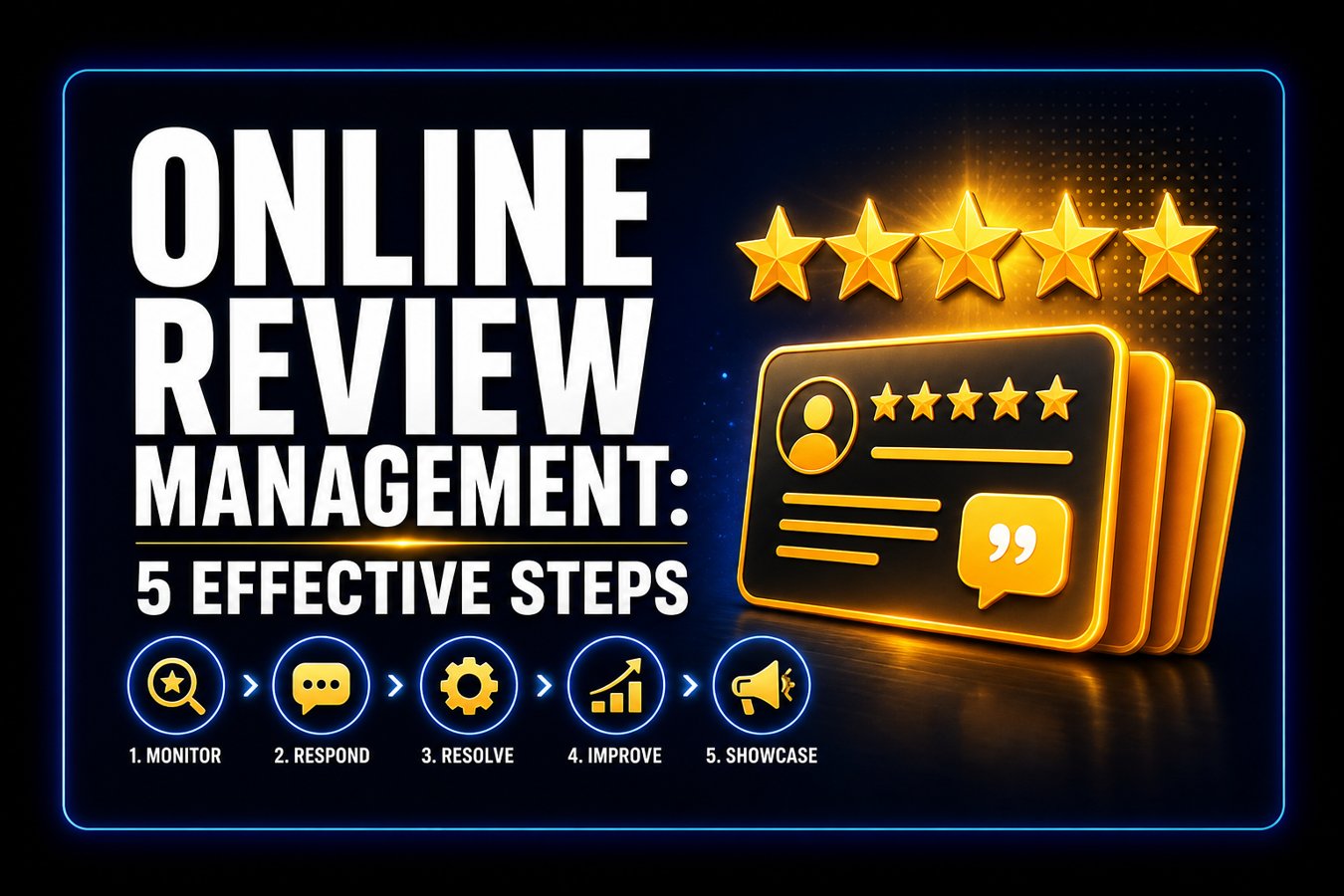

Online review management is one of the highest-leverage activities a business can invest in — yet most companies still treat it as an afterthought. A single unanswered negative review on Google can cost a business 22% of its customers. One additional star on a profile can lift revenue by up to 9%. The gap between companies that actively manage their reviews and those that do not shows up directly on the bottom line, and it is widening.
This guide covers what online review management involves, why the revenue stakes are higher than most businesses realize, seven field-tested strategies, a comparison of the major tools, and how to build a fully automated review pipeline.

Quick Answer / TL;DR
Online review management is the systematic process of monitoring what customers say across review platforms, responding promptly, and actively generating new reviews at scale. Businesses that execute all three disciplines consistently see higher local search rankings, better conversion rates, and measurable revenue growth. The most efficient approach combines automated SMS and email review requests, templated response protocols, and a centralized reputation dashboard — ideally inside a single platform that handles CRM, automations, and customer communications.
What Online Review Management Actually Involves
The term gets used loosely, but effective online review management has three distinct and equally important components. Treating any one in isolation produces incomplete results.
Monitoring
Monitoring means maintaining continuous visibility across every platform where customers can leave feedback — Google Business Profile, Yelp, Facebook, and industry-specific directories. Reactive monitoring (checking manually every few days) is no longer sufficient. Businesses need real-time alerts the moment a review lands so response windows stay short. According to industry data, 52% of customers expect a response within seven days — and businesses winning the trust battle respond in hours.
Responding
Responding to reviews — both positive and negative — is a documented revenue driver. Reviews that receive a business response generate 12% more revenue than those left unanswered. For negative reviews, the stakes are higher: 45% of consumers say they are more likely to visit a business that responds thoughtfully to criticism. A well-crafted response can convert skeptical prospective customers who view it as evidence that the business takes accountability seriously.
Generating
Generating reviews — proactively asking satisfied customers for feedback — is the component most businesses neglect. Reviews do not accumulate organically at the pace needed for competitive visibility. Google rewards businesses that receive reviews consistently, and 44% of consumers say they will not purchase from a business with no reviews at all. Structured request campaigns triggered automatically by customer interactions are the only scalable solution: up to 70% of reviews come from post-transactional email and SMS requests sent at the right moment.
Why Reviews Matter for Revenue
The business case for investing in online review management is no longer debatable. The data is extensive and consistent across industries.
- 93% of consumers say online reviews influence brand trust decisions.
- A one-star increase on a Google Business Profile can boost revenue by up to 9%.
- Strategically placed reviews can increase conversion rates by up to 370%.
- 52% of consumers require a minimum 4-out-of-5-star average before considering a local business.
- 88% of all business reviews come from just five major review platforms, with Google alone dominating by a wide margin.
- 84% of executives in PwC’s 2025 CEO Global Pulse ranked brand and reputation risk as their top external concern — above cybersecurity.
- The reputation management software market is projected to grow from $5.2 billion (2024) to $14.02 billion by 2031 at a 13.2% CAGR.
Perhaps the most striking data point: only 17% of businesses maintain an active reputation management plan, meaning 83% are ceding a measurable competitive advantage to the minority that operates systematically. For businesses exploring a CRM for small business, layering review management into the same operational system creates compounding benefits across acquisition and retention.

7 Essential Strategies for Managing Reviews
1. Centralize Monitoring Across All Platforms
Fragmented monitoring — logging into Google separately from Yelp, separately from Facebook — creates gaps that result in missed reviews and delayed responses. The first move is consolidating all review feeds into a single dashboard with real-time alerts for low-rated reviews. Multi-platform aggregation also makes competitive benchmarking possible: tracking how a business’s average rating and review velocity compare to direct competitors in the same market.
2. Establish Response Time Standards
Response time standards separate businesses with reputational discipline from those that react only when a crisis forces it. Best practice is responding to all reviews within 24 hours, with negative reviews prioritized for same-day turnaround. Teams should maintain templated response frameworks for common review types — five-star praise, specific service complaints, vague criticism — that can be personalized quickly. Consistency at scale requires templates.
3. Build Automated Post-Interaction Review Requests
The single most impactful tactic is automating the ask. Every completed appointment or delivered service should trigger a review request via SMS, email, or both within a defined window. SMS converts at a 45% higher rate than email, and 90% of texts are read within three minutes — but a combined workflow captures the widest audience. Tools integrated with a business’s marketing automation software fire these requests automatically, turning review generation into a background process.
4. Route Unhappy Customers to Private Feedback First
Not every dissatisfied customer should be directed immediately to a public review platform. A smart review funnel asks a satisfaction question first — routing negative responses to a private feedback form so the business can resolve the issue before it becomes a one-star public post. Satisfied customers go directly to Google or the relevant platform. This creates a first-pass resolution opportunity without suppressing legitimate feedback.
5. Respond to Negative Reviews With a Recovery Framework
Negative reviews, handled correctly, are among the most powerful trust signals a business can display. Prospective customers reading a one-star review are simultaneously reading the response. The framework is straightforward: acknowledge the concern, apologize without defensiveness, act by offering to resolve the issue offline. Never argue publicly. The goal is not to win the argument — it is to win the next customer reading the thread.
6. Showcase Reviews Across Marketing Channels
Reviews earned should be actively deployed. High-value testimonials belong on landing pages, in email sequences, on social, and in sales follow-up communications. A business using the best website builder for its industry should include review widgets on every high-intent page. Reviews presented in context — specific to a product, service, or outcome — convert at higher rates than generic star-count displays.
7. Analyze Review Data for Operational Insights
Review content is a real-time customer research feed. Recurring themes in negative reviews reveal operational gaps; consistent praise identifies what to amplify in marketing. Sentiment analysis tracked over time provides a leading indicator of satisfaction trends that appear in reviews before they show up in churn data. Businesses that treat review analytics as a feedback loop close the gap between reputation management and service improvement.
Tools Compared: Which Platforms Handle What
Several dedicated review management platforms serve different segments of the market. Understanding what each does well — and where each falls short — helps businesses make an informed choice.
| Platform | Best For | Starting Price | Key Strengths | Notable Gaps |
|---|---|---|---|---|
| ReviewTrackers | Multi-location analytics | ~$119/mo per location | Deep sentiment analysis, review aggregation | Email-only alerts, limited integrations |
| Birdeye | Enterprise brands, franchises | ~$299/month | AI review generation, 200+ site monitoring | Expensive for small businesses |
| Podium | SMS-first local businesses | ~$289/month | Text-based review collection, unified inbox | Focuses mainly on Google and Facebook |
| Reputation.com | Enterprise data analysis | Custom/enterprise | Competitive benchmarking, multi-location | Complex, expensive, not SMB-friendly |
| BrightLocal | Local SEO + review tracking | ~$39/month | Local citation management, review monitoring | Limited automation capabilities |
| Sprout Social | Social-first review tracking | ~$249/month | Social listening, unified social inbox | Weak on non-social review platforms |
| Trustmary | Review collection and display | ~$19/month | Embeddable widgets, video testimonials | Narrow focus, limited workflow automation |
The pattern is consistent: dedicated review tools do one part of the job well but require separate systems for CRM, email, SMS, and automations. For businesses trying to get more leads and convert them efficiently, that fragmentation creates data silos and process gaps that undermine the full customer journey.

Building an Automated Review Pipeline With ASM
Automated Sales Machine builds reputation management natively into the same platform that handles CRM, pipelines, calendars, automations, email, and SMS — eliminating the integration tax that standalone tools impose. Here is how the automated review pipeline works inside ASM:
Trigger: Interaction Completion
When a contact moves to a specific pipeline stage — “Job Complete” or “Appointment Attended,” for example — ASM’s automation engine fires a review request sequence. Triggers connect to calendar bookings, form submissions, or manual pipeline updates. The automation builder handles the logic without any developer involvement.
Channel: SMS and Email in Sequence
ASM sends the initial review request via SMS, followed by an email if no response arrives within a defined window. Both messages are personalized using contact data in the small business CRM — the customer’s name, the service purchased, and the team member they worked with. That level of personalization, automated at scale, matches what enterprise tools charge thousands per month to deliver.
Filtering: Happy Path vs. Recovery Path
ASM’s review funnel logic routes customers based on their initial satisfaction response. Customers indicating a positive experience receive a direct link to the business’s Google Business Profile (or any other configured platform). Customers indicating dissatisfaction are routed to an internal feedback form, triggering a notification to the business owner or customer success team so the issue can be addressed privately before it becomes a public complaint. The missed call text-back feature works in parallel, ensuring no customer interaction — including those that start as phone calls — falls through the cracks.
Monitoring: Centralized Reputation Dashboard
All incoming reviews appear in ASM’s reputation management dashboard, enabling teams to respond without switching between Google, Yelp, or Facebook. Saved response templates keep turnaround times short. For businesses running an AI chatbot for business through ASM, the same contact data informs every chatbot interaction — creating a unified view of the customer across all touchpoints.
The Compounding Advantage
Because ASM’s reputation management operates inside the same system as the CRM, pipeline, automations, and communications, every review earned feeds back into the contact record. Businesses can segment five-star reviewers for referral campaigns or course upsells using ASM’s built-in membership tools. The review becomes a data point that drives the next stage of the customer relationship — not just a standalone reputation metric sitting in a disconnected tool.
Frequently Asked Questions
What is the difference between online review management and reputation management?
Reputation management is the broader category, covering media coverage, social sentiment, and crisis communications. Online review management is a specific subset focused on monitoring, responding to, and generating customer reviews on platforms like Google, Yelp, and Facebook. Most small and mid-sized businesses see the fastest returns by focusing on review management first, since review platforms have the most direct impact on local search visibility and purchase decisions.
How many reviews does a business need to be competitive?
There is no universal number, but 43% of consumers prefer businesses with over 100 reviews, and nearly half avoid companies that have zero feedback at all. For local search, review velocity matters as much as total volume — a business with 80 reviews earned in six months may outrank one with 200 reviews accumulated over five years, because Google’s algorithm weighs recency.
Is it against Google’s policy to ask customers for reviews?
No. Google explicitly allows businesses to solicit reviews. What Google prohibits is incentivizing reviews (offering discounts or payment for feedback), review gating (blocking unhappy customers from public platforms), and posting fake reviews. Routing dissatisfied customers to a private feedback form before directing satisfied ones to Google is a common practice businesses should evaluate with their legal counsel.
How quickly should a business respond to a negative review?
Within 24 hours is the professional standard. More than half of reviewers anticipate hearing back within a week, but businesses that lead on customer experience respond to negative reviews within hours. A rapid, thoughtful response signals to prospective customers reading the thread that the business is attentive and accountable. Delayed responses read as indifference — often more damaging than the original complaint.
Can review management improve search rankings?
Yes, in local search specifically. Google’s local ranking algorithm weighs review quantity, review velocity, average star rating, and the presence of business responses. Businesses with higher ratings and consistent review activity appear more frequently in the local pack. Reviews also contribute keyword signals: a plumber with reviews mentioning “burst pipe” or “emergency service” ranks better for those queries than a competitor with no review content mentioning them.
Conclusion
Online review management is not a marketing nice-to-have. Businesses that monitor consistently, respond promptly, and generate reviews systematically outperform those that do not — in search rankings, in conversion rates, and in revenue. The gap is not awareness; it is execution. Most businesses understand that reviews matter. Far fewer have built the automated workflows needed to manage them at the pace the market demands.
The most durable advantage comes from embedding review management inside the same system that handles customer relationships, communications, and automations — rather than treating it as a separate tool with a separate login and budget. Automated Sales Machine offers reputation management natively alongside CRM, automations, email, SMS, calendars, and funnels. The tools are there. The next step is putting them to work.