


Tired of HubSpot’s per-contact pricing? The best HubSpot alternative for small businesses in 2026 is Automated Sales Machine (ASM) — an all-in-one platform that gives SMBs CRM, email, SMS, funnels, AI agents, and reputation management for one flat fee with unlimited contacts, no $3,000 onboarding tax, and no per-seat math. This guide compares the real 2026 cost of HubSpot Marketing Hub Professional against ASM, with the math you need to make a switching decision.
Skip the comparison — start a free 14-day trial of ASM →
What you’ll learn in this guide
Why are SMBs leaving HubSpot in 2026?
Small businesses are leaving HubSpot in 2026 because the platform’s pricing penalizes growth. HubSpot’s published prices look reasonable at the Starter tier — but the moment a business needs real automation, custom reporting, or A/B testing, the only option is Marketing Hub Professional starting at $890/month, plus a mandatory $3,000 one-time onboarding fee that HubSpot doesn’t waive [FIXSTACK, 2026].
The other reason: HubSpot still doesn’t include the channels SMBs need most. The base Pro plan has no SMS marketing, no AI voice agents, no missed-call text-back, no built-in scheduling beyond basic meetings, and no reputation management. Each of those is either a paid add-on or requires a third-party tool wired in via Zapier — meaning a “single platform” quickly becomes a stack of five or six again.
What we hear from SMBs evaluating switches: the published “$890/month” feels manageable. The real bill — once contacts grow, seats expand, and add-ons stack — looks more like $1,500–$2,500/month. That’s the gap an all-in-one alternative closes.
How does HubSpot’s pricing actually work?
HubSpot uses a tiered, per-contact, per-seat pricing model that scales with growth — and that’s the problem for SMBs. Here’s the structure for 2026:
- Free CRM: Up to 1 million contacts, but with HubSpot branding on every email and form, plus minimal automation [StackCompare, 2026].
- Marketing Hub Starter: $20/month for 1,000 marketing contacts. Adds basic automation but excludes A/B testing, custom reporting, and advanced workflows.
- Marketing Hub Professional: $890/month for 2,000 contacts on annual commitment, plus a mandatory $3,000 onboarding fee. This is where most SMBs land when they need real automation.
- Marketing Hub Enterprise: Starts around $3,600/month for 10,000 contacts, climbing past $5,000/month with the typical add-ons [Sidekick Strategies, 2026].
The pricing mechanic that catches most teams off guard: Marketing Hub charges per contact while Sales Hub, Service Hub, and Operations Hub charge per seat. So a growing list inflates Marketing costs, and a growing team inflates everything else. Every additional 5,000 marketing contacts beyond your tier adds approximately $250/month [FIXSTACK, 2026].
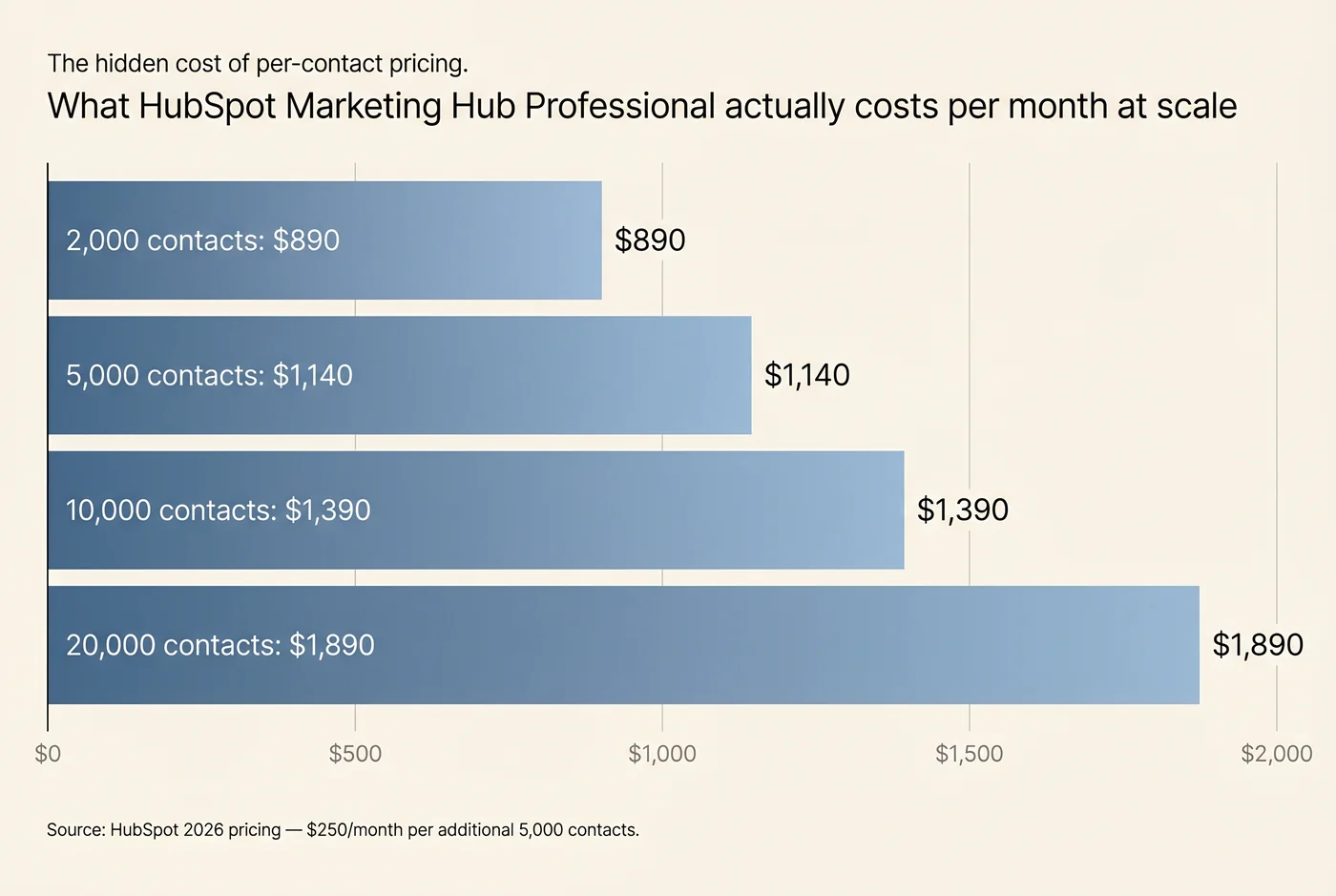
What’s missing from the $890/mo Marketing Hub Professional plan?
HubSpot Marketing Hub Professional at $890/month includes email marketing, basic automation, and CRM — but it does NOT include the channels and features modern SMBs treat as table stakes. Here’s what most teams discover they still need to buy or bolt on:
- SMS marketing — not native. Requires a paid integration or a third-party tool like Twilio or SimpleTexting.
- AI voice agents — not available at any tier without custom integrations. (For context, ASM’s native AI voice agents answer inbound calls and book appointments 24/7.)
- Missed-call text-back — requires a third-party local-business tool.
- Round-robin booking with payments — basic meeting links only at Pro; advanced scheduling needs Sales Hub Professional ($100/seat/month) or a Calendly add-on.
- Funnel and landing-page builder with checkout — separate from your CRM unless you also pay for Content Hub.
- Google/Yelp review automation — not available natively. Most SMBs add Podium ($289+/month) or Birdeye for this.
- Conversation AI / chat widget AI — limited at Pro tier; full AI assistants require add-ons.
Add a typical SMB stack to HubSpot Pro — Twilio for SMS, Calendly for scheduling, Podium for reviews, ConvertFlow or Unbounce for funnels — and the real monthly cost climbs past $1,500/month before you’ve added a single contact past the 2,000 base tier.
What’s the best HubSpot alternative for small businesses in 2026?
The best HubSpot alternative for small businesses is Automated Sales Machine (ASM) — an all-in-one AI operating system that consolidates CRM, marketing automation, funnels, websites, AI voice agents, scheduling, and reputation management into a single platform with unlimited contacts and a flat monthly fee. We’ve published a full HubSpot vs ASM comparison with side-by-side features and pricing for the buyers who want even more depth.
Here’s what ASM replaces from a typical HubSpot-plus-stack setup:
- HubSpot Marketing Hub — replaced by ASM’s built-in email, SMS, and workflow automation
- HubSpot Sales Hub — replaced by ASM’s CRM, pipelines, and deal management
- HubSpot Service Hub — replaced by ASM’s unified inbox and ticketing
- Calendly — replaced by ASM’s native scheduling (round-robin, class booking, collective, intake forms, payments on booking)
- Twilio / SimpleTexting — replaced by ASM’s built-in SMS and missed-call text-back
- Podium / Birdeye — replaced by ASM’s reputation management (Google + Yelp review automation)
- ClickFunnels / Unbounce — replaced by ASM’s funnel and landing-page builder
- Zapier glue between all of them — eliminated entirely
Trusted by 2 million+ businesses worldwide, ASM is built specifically for SMBs and creators who need full marketing-and-sales infrastructure without enterprise complexity or per-contact billing. It runs on the same backbone as the platforms many top creators and AI agency operators use — branded and operated as Automated Sales Machine.
See it in action before you switch. ASM’s full feature set — including the AI voice agent, funnel builder, and missed-call text-back — works differently than HubSpot. Watch the 4-minute demo →
How does Automated Sales Machine compare to HubSpot, feature by feature?
Feature-by-feature, ASM matches HubSpot Marketing Hub Professional on core CRM and automation — and exceeds it on SMS, AI voice, scheduling, and reputation — all at a flat monthly fee with unlimited contacts.
| Capability | HubSpot Marketing Pro ($890/mo + add-ons) | Automated Sales Machine (flat fee) |
|---|---|---|
| CRM with smart lists & custom fields | ✓ | ✓ |
| Marketing automation (workflows, drips) | ✓ | ✓ |
| Email marketing | ✓ (capped by contact tier) | ✓ (unlimited contacts) |
| SMS marketing | Add-on (Twilio integration) | Native |
| Funnel & landing-page builder | Limited (Content Hub upgrade) | Native, drag-and-drop |
| Round-robin scheduling with payments | Sales Hub Pro ($100/seat) or Calendly | Native |
| AI voice agents (24/7 call answering) | Not available | Native |
| Missed-call text-back | Third-party tool required | Native |
| Google + Yelp review automation | Add-on (Podium/Birdeye) | Native |
| Unified inbox (SMS, FB, IG, WhatsApp, Google) | Partial (paid integrations) | Native |
| Mandatory onboarding fee | $3,000 one-time | $0 |
| Per-contact billing | +$250/mo per 5,000 contacts | None — unlimited contacts |
The pattern is consistent: anything HubSpot treats as an add-on or upcharge, ASM treats as core. That’s the structural difference between an enterprise CRM repackaged for SMBs (HubSpot) and a platform built natively for SMBs (ASM).
What does the cost difference actually look like at 10,000 contacts?
For a typical SMB at 10,000 marketing contacts on Marketing Hub Professional, HubSpot’s real monthly bill — including a typical add-on stack — is about $1,734/month, while ASM runs at a flat fee with no contact-based scaling. Here’s the math at three common contact thresholds:
| Stack component | 2,000 contacts | 5,000 contacts | 10,000 contacts |
|---|---|---|---|
| HubSpot Marketing Pro base | $890 | $890 | $890 |
| Per-contact overage | $0 | $150 | $400 |
| Calendly Teams (3 seats) | $48 | $48 | $48 |
| SimpleTexting (SMS) | $59 | $109 | $199 |
| Podium reputation | $289 | $289 | $289 |
| Onboarding fee (year 1) | +$250/mo amortized | +$250/mo | +$250/mo |
| HubSpot total (year 1) | $1,536 | $1,736 | $2,076 |
| ASM total (flat fee) | Flat | Flat | Flat |
Even at 2,000 contacts (the base Marketing Hub Pro tier), the typical SMB stacked on HubSpot is paying ~$1,536/month in year one once the onboarding fee, scheduling, SMS, and reputation tools are layered in. By 10,000 contacts, the stack runs over $2,000/month. ASM consolidates all of that into a single platform at a flat fee — which is where the savings compound at scale.
How do you migrate from HubSpot to Automated Sales Machine?
Migrating from HubSpot to ASM typically takes 5–10 business days for a small business and follows a clear sequence:
- Export contacts and properties from HubSpot (CRM → Contacts → Actions → Export). Include all custom fields and tags.
- Map fields into ASM’s CRM — ASM supports custom fields and Custom Objects (e.g., “Properties” for real estate, “Vehicles” for dealerships) which extend the schema beyond standard contact records.
- Recreate workflows in ASM’s Workflow Builder — most HubSpot workflows have a one-to-one equivalent. Drips, score-based triggers, and pipeline-stage actions all port over.
- Migrate funnels and landing pages — rebuild in ASM’s drag-and-drop builder, or paste in the HTML if your pages are pre-built. Keep the existing URLs by setting up redirects from HubSpot.
- Move email templates — copy HTML from HubSpot’s email editor into ASM’s email builder. Test deliverability with the new sending domain.
- Connect channels — link your phone number for SMS, your Google Business Profile for reviews, your Facebook/Instagram for unified inbox.
- Run both in parallel for 7 days — a soft cutover lets you catch any data drift before fully decommissioning HubSpot.
Most agencies and consultants who help with this migration recommend starting with the smallest pipeline first (e.g., one campaign or one product line) to validate the workflow, then expanding. ASM’s onboarding includes a guided checklist to walk through each step.
Who should still choose HubSpot over an alternative?
HubSpot remains the right choice for a specific kind of business: enterprise teams with 50+ users, deep Salesforce/NetSuite integration needs, or compliance requirements that mandate enterprise vendor selection. If you’re a public company, a regulated industry (healthcare, financial services with very specific HIPAA/SOC requirements that go beyond the standard), or you’ve already invested heavily in HubSpot’s marketplace of certified integrations, the switch may not pencil.
For everyone else — solopreneurs, agencies, coaches, course creators, local service businesses, real estate agents, and growing SMBs in the 2,000–50,000 contact range — the all-in-one alternative model wins on cost, channel coverage, and operational simplicity. That’s the gap ASM is built for.
Frequently asked questions
Is there a free HubSpot alternative for small businesses?
HubSpot’s own free CRM is the closest “free alternative” — but it includes HubSpot branding on every email and form, lacks marketing automation, and forces an upgrade the moment you outgrow basic contact management. ASM offers a 14-day free trial with no credit card required, giving you full access to the entire platform (CRM, automation, funnels, AI agents) before paying. After the trial, ASM is paid; the difference is unlimited contacts and a flat fee instead of HubSpot’s per-contact escalator.
Can I really replace HubSpot with one tool?
For SMBs and growing companies up to ~50,000 contacts, yes. The platform that replaces HubSpot needs to cover CRM, marketing automation, email, SMS, funnels, scheduling, and ideally reputation management and AI agents. Automated Sales Machine consolidates all of those into a single workspace. Enterprise teams with 100+ users and complex integration ecosystems may still need HubSpot’s marketplace, but the typical SMB stack — HubSpot + Calendly + SMS tool + reviews tool + funnel builder — collapses cleanly into ASM.
How much can I actually save by switching from HubSpot to an alternative?
For a typical SMB at 10,000 marketing contacts running HubSpot Marketing Hub Professional plus the standard add-on stack (scheduling, SMS, reputation), the year-one cost is approximately $2,076/month including amortized onboarding. Switching to a flat-fee all-in-one alternative like Automated Sales Machine consolidates that bill into a single subscription, eliminating per-contact overage charges and the $3,000 onboarding fee. Real-world savings compound as contact lists grow.
What about HubSpot’s CRM data — will I lose it if I switch?
No. HubSpot lets you export all contacts, companies, deals, and properties as CSV files. ASM’s CRM imports those CSVs directly and supports custom fields, so your data structure carries over. You may need to recreate workflows and email templates, but the underlying data — contact records, interaction history, pipeline stages — migrates cleanly. Plan for 5–10 business days of migration work for a small team.
Does HubSpot’s REST API work with most tools?
Yes — HubSpot has a mature API and a large marketplace of certified integrations, which is one of its strongest selling points. However, this matters most for enterprises with deep custom integration needs. SMBs typically use 5–10 standard tools (email, SMS, scheduling, reviews, payments), and an all-in-one platform like ASM eliminates the need for those integrations by including the functionality natively. The “integration breadth” advantage shrinks the simpler your stack needs to be.
Is the 14-day free trial really free?
Yes. ASM’s 14-day free trial requires no credit card to start. You get full access to the platform — CRM, automations, funnels, AI agents, unified inbox, reputation, all of it — for the full 14 days. You can cancel anytime, no charges. The free trial is the cleanest way to validate that ASM covers everything your current HubSpot setup is doing before committing.
Key takeaways
- HubSpot’s published Marketing Hub Pro price ($890/mo) is rarely the real cost — most SMBs end up at $1,500–$2,000/month once onboarding, per-contact overages, and add-on tools are stacked on.
- SMBs miss SMS, AI voice, missed-call text-back, advanced scheduling, and reputation at the Pro tier. Each of those is a separate tool or paid add-on.
- The all-in-one alternative model — exemplified by Automated Sales Machine — replaces the entire HubSpot-plus-stack setup with a single platform, flat fee, and unlimited contacts.
- Migration takes 5–10 business days for a small business. Data exports cleanly; workflows and templates need to be rebuilt.
- HubSpot still wins for enterprise teams with 50+ users, complex integrations, or compliance requirements.
Ready to replace your HubSpot stack?
Join 2 million+ businesses growing on Automated Sales Machine. Try the full platform — CRM, AI voice, funnels, missed-call text-back, reputation, all of it — risk-free for 14 days. No credit card required.