
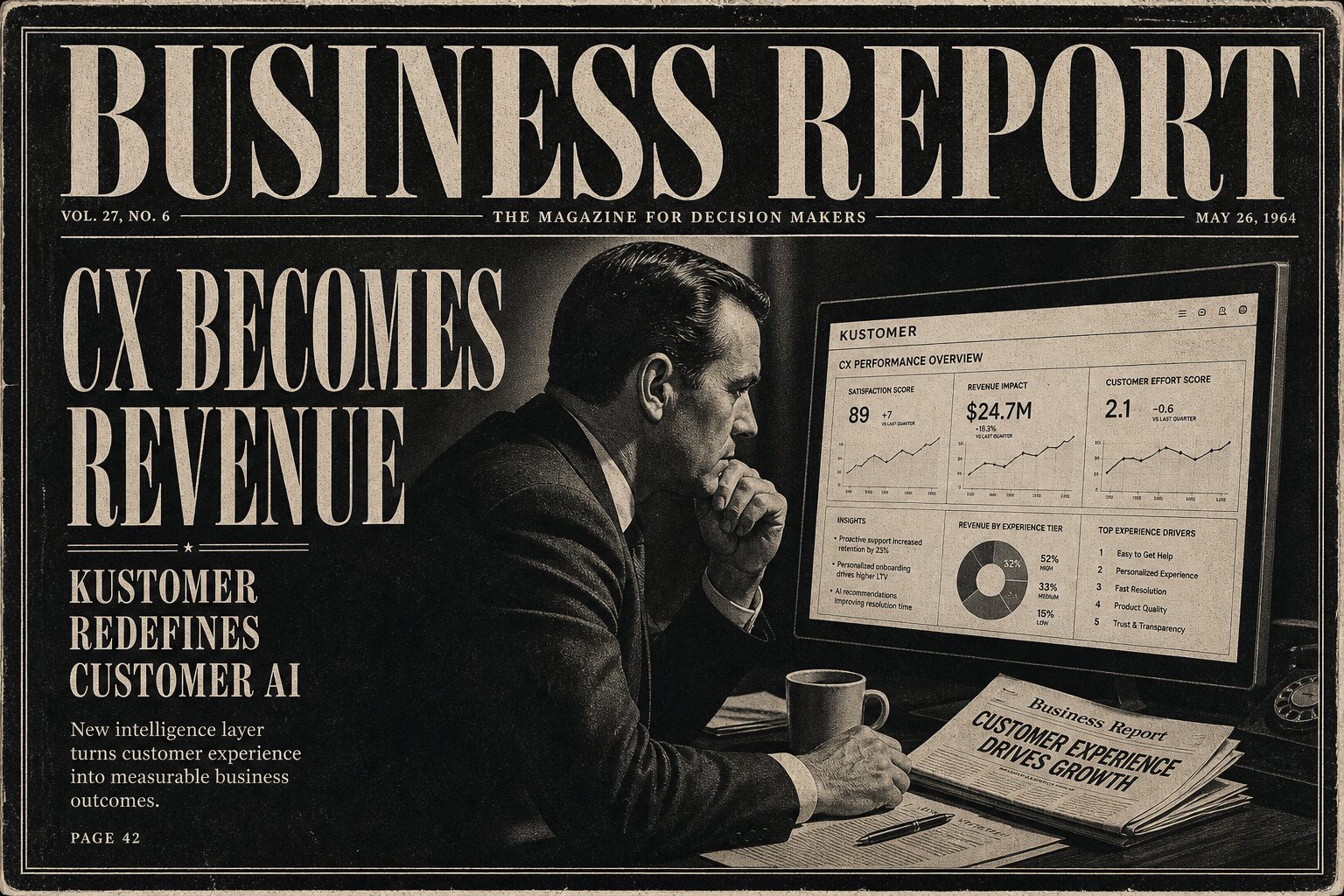

On May 21, 2026, Kustomer announced the launch of Kustomer Architect — an customer experience platform built from the ground up to replace deflection-based support logic with a unified, outcome-driven model that treats customer interaction as a revenue function, not a cost center. The launch is the clearest signal yet that the CX software industry is undergoing a structural realignment, one with direct implications for businesses of every size.
The announcement, reported across GlobeNewswire and CMSWire, positions Kustomer Architect not as an incremental upgrade but as a ground-level rethink of what customer experience software should actually measure. Ticket volume is out. Revenue impact is in.
From Ticket Counts to Revenue Outcomes
For the better part of two decades, customer support has been measured by the wrong numbers. Average handle time. First-contact resolution rates. Tickets opened versus tickets closed. These metrics were never designed to answer the question that actually matters to a business owner: is our customer experience platform helping us grow, or quietly killing retention?
Kustomer Architect is built on the premise that the answer to that question requires a different kind of data architecture entirely. Traditional helpdesk platforms were designed to route and resolve. They record what happened in a conversation but rarely connect that conversation to what the customer did next — whether they churned, renewed, upgraded, or referred someone. That disconnection is not a minor gap. It is a fundamental misalignment between what support teams optimize and what businesses actually need.
The shift Kustomer is making explicit is one that forward-looking operators have been quietly attempting for years: linking every customer interaction to a downstream business outcome. Did this service touchpoint reduce churn? Did this resolution conversation generate an upsell? Did this proactive outreach prevent a cancellation? These are the metrics that change how a business thinks about CX investment.
How a Customer Experience Platform Should Be Built
The platform’s architecture is designed around a single unified layer that combines five elements most CX stacks have historically kept separate: customer data, full conversation history, workflow automation, knowledge bases, and both AI and human agents operating from the same interface and the same data set.
When an AI agent handling an inbound inquiry has access to the same customer timeline as a human agent — purchase history, prior support interactions, sentiment signals, loyalty status — the quality of that interaction improves structurally, not just marginally. The AI is not guessing at context. It is operating from the same complete picture a skilled human representative would have, but at a speed and scale no human team can match.
The workflow layer connects these components to business outcomes by automating follow-up actions based on conversation results: flagging a resolved complaint for a retention offer, triggering a satisfaction survey after a high-value interaction, escalating a pattern of negative sentiment to account management before a renewal date.
3 Ways This Shift Affects Small Business CX Strategy
- Redefine what good looks like in your support data. If your current dashboard shows ticket resolution time but not customer lifetime value post-interaction, you are measuring the wrong thing. These questions require connecting your support data to your CRM and revenue records.
- Treat AI agents as a first-line retention tool, not a cost-reduction mechanism. The ROI calculation changes entirely when you measure retention saved rather than labor cost avoided. A well-configured AI chatbot for business is not a support cost reduction — it is a revenue protection mechanism.
- Make reputation a CX metric, not a marketing afterthought. Reputation management software and CX automation are increasingly the same category, and businesses that treat them as separate are leaving measurable value on the table.
How Automated Sales Machine Already Ties CX to Revenue
The architecture Kustomer Architect is pioneering at the enterprise level reflects capabilities that Automated Sales Machine has built into its platform for small and mid-sized businesses. ASM’s approach connects the same critical layers — customer data, communication history, automation, and reputation signals — into a unified operational picture designed around one priority: whether your customer relationships are generating and protecting revenue.
ASM’s CRM software is not a contact list. It is a live record of where every customer relationship stands. When that data is connected to automated workflows, the system can act on relationship signals without requiring manual intervention at every step.
The automation layer in ASM is the connective tissue between CX data and revenue outcomes. Combined with ASM’s reputation tools, the platform closes the loop between customer experience and the public signals that influence future acquisition. Strong online review management is itself a revenue function when it is integrated into the post-interaction workflow.
For businesses exploring how marketing automation and CX can work together, ASM’s integrated approach offers a practical entry point into outcome-driven customer experience without the complexity of assembling multiple enterprise platforms.
What Outcome-Driven CX Looks Like in Practice
Outcome-driven CX starts with connecting your support or communication records to what customers do after an interaction. Do customers who contact you for help within the first 30 days of a purchase have a higher or lower 90-day retention rate than those who do not? That single question, answered with real data, often changes how a business thinks about onboarding support.
Strong lead management principles apply equally to existing customers. The same structured follow-up cadences that convert prospects into buyers can be adapted to convert satisfied customers into loyal advocates.
Frequently Asked Questions
What is Kustomer Architect?
Kustomer Architect is an AI-native customer experience platform launched on May 21, 2026, that unifies customer data, past interactions, automated workflows, and shared knowledge bases bases, and both AI and human agents into a single system focused on revenue and retention outcomes.
How does a customer experience platform differ from traditional helpdesk software?
Traditional helpdesk software is optimized for routing and resolving support requests. A modern customer experience platform connects conversation data to customer lifetime value, retention signals, and revenue outcomes — enabling automated actions that protect and grow revenue rather than simply closing tickets.
Can small businesses implement outcome-driven CX without enterprise tools?
Yes. The core requirements — connected customer data, automated follow-up workflows, and reputation management integrated into the post-interaction process — are available in platforms built specifically for small and mid-sized businesses.
The Kustomer Architect launch is a useful signal for any business operator paying attention to where CX technology is heading. See how ASM connects CX to revenue outcomes — schedule a demo.