


Email authentication has crossed a point of no return. As of early 2026, the three largest inbox providers in the world — Google, Yahoo, and Microsoft — have moved from recommending SPF, DKIM, and DMARC compliance to actively rejecting messages from domains that haven’t implemented it. For small businesses that rely on email to send quotes, invoices, appointment reminders, and marketing campaigns, the consequences are no longer theoretical: emails are disappearing silently, and most owners have no idea it is happening.
How the 2026 Enforcement Wave Unfolded
The shift did not happen overnight, but the cumulative impact arrived like a wall. Google and Yahoo launched formal bulk sender requirements in February 2024, mandating that any domain sending more than 5,000 emails per day to their platforms implement SPF, DKIM, and DMARC. The rules carried warnings at first. By November 2025, Gmail escalated to hard rejections at the SMTP level — meaning non-compliant messages are turned away before they ever reach a recipient’s infrastructure. The recipient sees nothing. The sender typically receives no clear bounce notification. The message simply ceases to exist.
Microsoft followed a parallel track. Microsoft’s official Outlook sender requirements, announced in May 2025, moved through a phased enforcement schedule: warnings in August 2025, gradual rejections beginning in September, and full enforcement locked in by November 2025.
As of January 2026, non-compliant email destined for Outlook.com, Hotmail, and Microsoft 365 accounts now generates specific rejection codes — 550 5.7.15 for DMARC failures, 550 5.7.23 for SPF failures — when any configuration is broken. For B2B companies whose customers live inside Microsoft 365 tenants, this is an existential deliverability risk.
The convergence is deliberate. Industry analysis tracking over one million domains globally found that as of March 2026, only 10.7% of domains have full protection under a strict reject policy. An additional 18.4% operate under partial enforcement. The remaining 70.9% of domains globally have no effective DMARC protection at all — and they are now sending email into an infrastructure that is quietly turning them away.
What Email Authentication Actually Requires
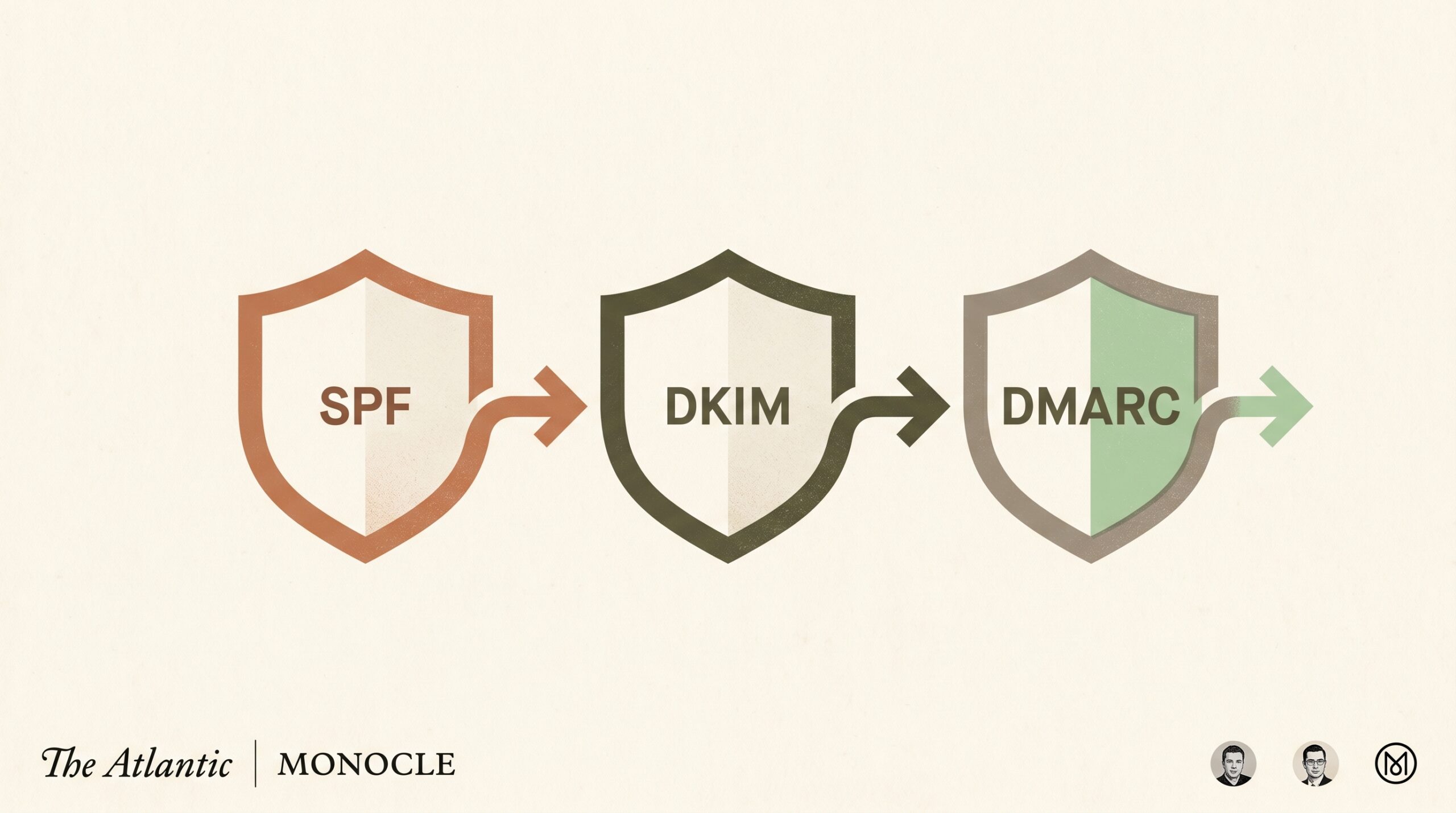
Email authentication is built on three interlocking standards that work together to prove a message genuinely originates from the domain it claims to represent. SPF, or Sender Policy Framework, publishes a DNS record listing every server authorized to send mail on behalf of a domain — when an email arrives, the receiving server checks whether the sending IP is on that list. DKIM, or DomainKeys Identified Mail, attaches a cryptographic signature to each outgoing message that the recipient can verify using a public key published in DNS, confirming the message has not been altered in transit.
DMARC, or Domain-based Message Authentication, Reporting, and Conformance, ties both together and instructs receiving servers what to do when either check fails: monitor, quarantine, or reject. Together, the three protocols form the authentication infrastructure that every major inbox provider now actively enforces.
The compliance landscape has grown more demanding than many small business owners realize. For bulk senders, Google and Yahoo require both SPF and DKIM to pass, a DMARC record published at a minimum policy of p=none, and one-click unsubscribe headers on all marketing and promotional email. Microsoft applies equivalent standards. The real pressure, however, is not just meeting the minimum threshold. Industry data shows that maintaining a “none” monitoring-only DMARC policy indefinitely is increasingly treated by providers as a negative trust signal — an indication that a domain has not taken the next step of enforcement. Security researchers consistently recommend moving to p=quarantine as the operational baseline, with p=reject as the long-term target.
The regulatory dimension adds further urgency. PCI DSS version 4.0, the Payment Card Industry Data Security Standard now actively enforced in 2026, explicitly requires DMARC implementation for any organization that handles credit card data. Violations can carry fines of $5,000 to $100,000 per month and risk the loss of payment processing capabilities. Meanwhile, the EU’s NIS2 and DORA regulations require email security controls across critical sectors including banking, healthcare, and digital infrastructure, with potential fines reaching €10 million or 2% of global revenue.

The Business Cost of Broken Email Authentication
The operational damage from non-compliance is specific and often invisible until it has compounded for weeks. Invoices routed through accounting platforms fail silently when those services send from a domain without DKIM signing. Appointment reminders built on third-party scheduling tools land in junk folders — raising no-show rates — because the sending domain’s SPF record does not include the scheduler’s mail servers.
Marketing campaigns launched from an email service provider return open rates that appear catastrophic, when in reality a significant portion of messages are being rejected at the gateway. One documented case from a SaaS company describes open rates dropping from 38% to under 2% within 72 hours after SMTP-level rejection began, traced to three lines of broken DNS configuration.
The financial modeling behind poor email authentication compliance is rarely tracked, but researchers estimate that a company sending 10,000 emails monthly at a $50 average customer value loses approximately $18,000 in monthly revenue at a 12% deliverability failure rate — an amount that compounds as sender reputation degrades over time. Validity’s 2025 Email Deliverability Benchmark Report documented global inbox placement rates falling to 83.5%, with spam placement nearly doubling from 4.5% in Q1 to 8.6% by Q4 2024. That trajectory has continued into 2026 as enforcement has tightened.
The adoption gap between enterprise and small business operators is particularly stark. Research finds that 95% of Fortune 500 companies now have DMARC implemented, with 62.7% at enforcement level. For smaller firms, only 15.2% have reached the reject policy level. That gap represents the primary vulnerability surface for deliverability failures, brand spoofing, and phishing attacks that leverage small business domains as cover.
What Small Businesses Should Do Now
The practical starting point for any small business is a full audit of every system that sends email from its domain. Most businesses operate more sending infrastructure than they realize: an email service provider for marketing campaigns, a transactional service for order confirmations, a CRM for sales sequences, a support desk for customer communications, and potentially legacy internal systems. Every one of these must be accounted for in the domain’s SPF record, and each must be configured to sign outbound messages with DKIM.
A business using email and SMS marketing tools through a unified platform has a significant advantage here — a single sending infrastructure means fewer DNS records to manage and a cleaner path to DMARC alignment. Businesses piecing together multiple disconnected tools face the harder task of achieving alignment across all of them simultaneously.
Once email authentication protocols are in place, the next priority is monitoring and enforcement. Publishing a DMARC record at p=none with aggregate reporting enabled provides weekly visibility into every source sending email claiming to be from the domain — including unauthorized sources attempting spoofing. Moving the policy toward p=quarantine within 90 days is the path security professionals recommend.
Businesses managing their contacts and send history through a CRM and contact management system should cross-reference engagement data against authentication status, since a drop in open rates that coincides with a DMARC configuration change is a reliable signal that enforcement is suppressing delivery. For businesses not yet certain where to begin, a platform demo can surface how consolidated sending infrastructure reduces authentication complexity.

What to Watch
- Apple Mail enforcement: Apple has not yet announced mandatory email authentication requirements for iCloud Mail, but its aggressive Mail Privacy Protection features already suppress pixel tracking — a pattern that signals tightening standards are likely coming for sender authentication as well.
- BIMI adoption acceleration: Brand Indicators for Message Identification, which displays a verified logo in supported inboxes when DMARC is at enforcement level, is gaining traction as a trust signal. As more providers support it, BIMI will become a visible competitive differentiator for authenticated senders.
- AI-generated phishing pressure: Security analysts predict that generative AI is producing phishing email indistinguishable from legitimate business communication at scale, which will accelerate provider pressure on all senders to demonstrate stronger email authentication.
- State-level CAN-SPAM successors: Multiple US states are drafting stricter email consent and authentication requirements that build on the federal CAN-SPAM framework. Businesses that wait for a single federal standard may find state-level enforcement arriving first.
- PCI DSS audit scrutiny: As DMARC becomes an explicit audit requirement under PCI DSS v4.0, small businesses that accept credit cards and have not implemented email authentication face compliance risk during their next payment security review.
Email authentication is no longer a back-end technical task deferred to a future IT project. It is the infrastructure layer on which every outbound message — every invoice, every follow-up, every marketing campaign — now depends for delivery. Businesses that align their automated workflows with properly authenticated sending domains will see more of their email land where it belongs. Those that have not addressed SPF, DKIM, and DMARC alignment should treat that gap as an active revenue leak — because by the definitions now enforced by the three largest inbox providers on the planet, that is exactly what it is.