
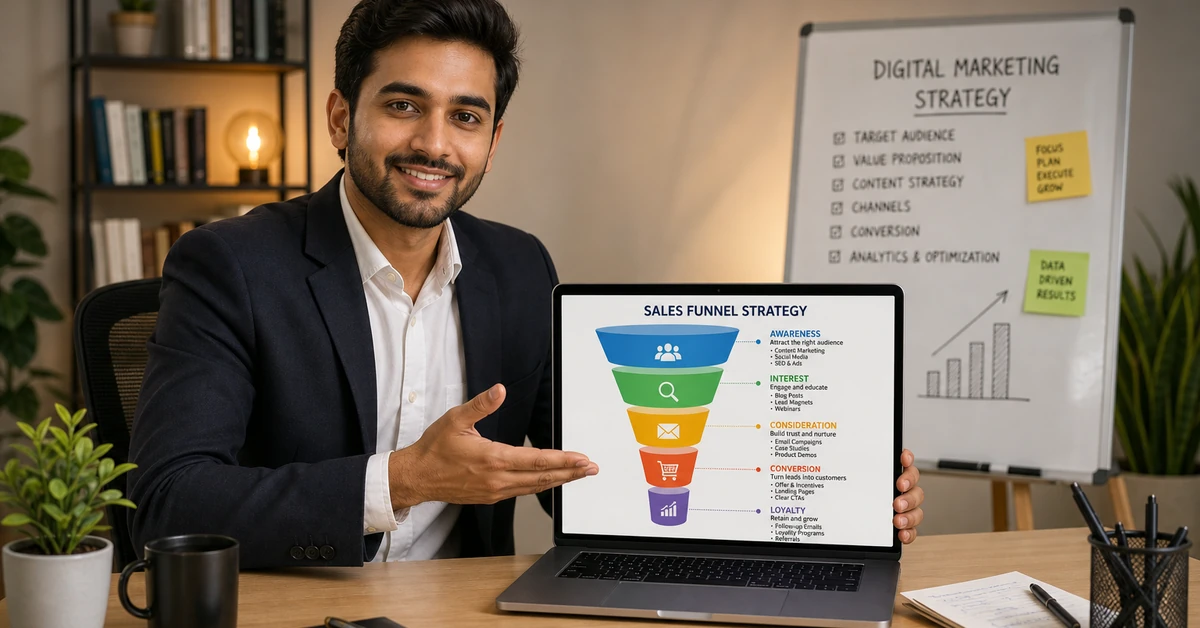

TL;DR: Effective funnel building strategies move prospects through a structured journey — from awareness to closed deal — by delivering the right message at precisely the right stage. High-performing small businesses don’t leave this process to chance: they engineer each funnel stage with intentional content, automation, and clear conversion triggers. The result is a predictable revenue system that runs without constant manual intervention.
Ready to stop chasing leads and start closing them? See how Automated Sales Machine automates your entire funnel — book a free demo.
Why Most Funnels Fail Before They Start
Building a funnel sounds deceptively simple: attract someone, nurture them, close the deal. In practice, most small business funnels collapse because they’re assembled backwards — starting with a product pitch rather than a buyer problem.
According to HubSpot Research, 68% of businesses have not identified or attempted to measure their sales funnel. That statistic explains why so many marketing budgets disappear into paid ads and email blasts without producing predictable revenue.
The core problem is structural. Businesses treat their funnel like a leaky pipe — patching holes as leads fall out — instead of designing the pipeline from the ground up with a clear decision architecture. A sound approach to building a sales funnel starts with a different question: not “how do I sell?” but “how does my buyer decide?”
When you reverse-engineer the funnel from your buyer’s perspective, three failure patterns become instantly visible:
- Stage mismatch: Sending bottom-of-funnel sales content (demos, pricing) to cold prospects who haven’t yet recognized a problem.
- Friction accumulation: Requiring too many steps — form fills, redirects, manual follow-ups — between interest and conversion.
- No follow-up velocity: Waiting days to respond to an inquiry in a market where the average lead response window is under five minutes before a competitor answers.

Core Funnel Building Strategies That Actually Work
The best funnel building strategies share a single underlying principle: every stage must earn the next one. No stage should exist to fill a checklist. Each touchpoint either moves a prospect toward a decision or removes friction blocking it.
Know Your Buyer’s Journey Cold
Before mapping a single funnel stage, you must document the specific mental steps your best customers take from first awareness to signed contract. This is not the generic “awareness → consideration → decision” framework from a marketing textbook. It’s the specific sequence of realizations, objections, and validations your actual buyer goes through.
For a med spa owner evaluating a new CRM and marketing platform, that journey looks very different than for a real estate broker or dental practice. Generic funnel templates fail here. Vertical-specific funnel building strategies that match your buyer’s actual decision logic outperform generic frameworks by a significant margin — McKinsey & Company found that companies delivering personalized experiences at each funnel stage see 40% more revenue growth than those using one-size-fits-all messaging.
Engineer Each Stage for One Job
Every funnel stage has exactly one objective. When a stage tries to accomplish multiple goals — generate awareness AND capture an email AND present pricing — it accomplishes none of them effectively.
Here’s the clean framework for stage-specific job assignments:
- Awareness stage: The one job is attention capture. Content, ads, or referrals that surface the problem your prospect didn’t know they had.
- Consideration stage: The one job is problem validation and solution education. Show the prospect that their situation has a defined solution and that you understand it.
- Decision stage: The one job is risk elimination. Remove every objection and fear standing between the prospect and conversion.
- Retention stage: The one job is experience reinforcement. Deliver on the promise that closed the deal and create conditions for referral and repeat purchase.
Stage-by-Stage Funnel Building Strategies
Now that the structural logic is clear, let’s move into the tactical funnel building strategies that drive performance at each stage of the pipeline.
Top-of-Funnel — Generating Qualified Awareness
Top-of-funnel traffic isn’t your job to entertain. It’s your job to interrupt a pattern — to show a prospective customer that the way they’re currently doing something is costing them money, time, or growth they don’t know they’re losing.
Effective top-of-funnel lead generation tactics for small businesses using this framework include:
- Problem-aware content SEO: Articles targeting high-intent queries that surface around specific pain points (not product features). A home service business should rank for “how to stop losing leads after hours” — not “best CRM for home services.”
- Short-form video: 60-90 second content on Reels and TikTok that names the specific frustration your audience lives with every day. The content doesn’t sell — it validates the problem and builds recognition.
- Referral triggers: Systematized ask-for-referral sequences embedded in your post-delivery workflow. Satisfied customers who are never asked don’t refer. Satisfied customers who are asked at the right moment — when they’re experiencing the peak outcome — refer frequently.
The critical discipline at the top of the funnel is lead qualification. Not every click belongs in your pipeline. Approaches that try to convert every lead waste follow-up resources on unqualified prospects. Build qualification into the top of funnel: use intake forms, quiz funnels, or behavioral signals to filter in prospects who match your ICP before they consume sales resources.
Middle-of-Funnel — Converting Interest Into Intent
The middle of the funnel is where most businesses bleed revenue. A prospect visits the website, reads a blog post, maybe downloads a lead magnet — and then disappears into a sequence of generic “just checking in” emails that get progressively easier to ignore.
The middle-of-funnel job is trust compression: accelerating the timeline between “this looks interesting” and “I’m ready to talk.” Effective funnel building strategies at this stage replace generic nurture with high-specificity education:
- Case study sequences: Automated email flows that deliver vertical-specific success stories. A fitness studio prospect shouldn’t receive the same sequence as a real estate investor. Segmentation by industry and business type dramatically increases mid-funnel engagement rates.
- Objection-addressing content: Map your top five objections from lost deals and build content that addresses each one proactively before the prospect can raise it. If price is objection #1, send an email with subject: “Here’s what it actually costs to not solve [problem]” — before they’ve seen your pricing.
- Social proof triggers: Review highlights, testimonial videos, and third-party validation delivered at the moment a prospect shows renewed engagement signals (email opens after a gap, revisiting the pricing page).

Bottom-of-Funnel — Closing With Precision
By the time a prospect reaches the bottom of the funnel, two problems dominate: decision delay and competitive comparison. Funnel building strategies at the bottom-of-funnel stage are about removing both.
Decision delay — the prospect who says “I need to think about it” — is almost always a symptom of unresolved risk. They’re not unconvinced; they’re uncertain. Address this with:
- Risk reversal guarantees: Money-back windows, pilot programs, or performance-based commitments that transfer risk from buyer to seller.
- Scarcity that’s real: Limited onboarding capacity or cohort-based intake creates genuine urgency without manufactured pressure.
- The 5-minute response rule: Speed-to-lead is a documented predictor of conversion. A prospect who submits a form and gets a response within five minutes is nine times more likely to convert than one who waits 30 minutes. Automated lead response sequences that fire instantly — text, email, and voicemail drop — eliminate this gap without requiring a human to monitor every inquiry.
Automation as a Funnel Multiplier
The most dangerous assumption in funnel building is that automation is a tool for large businesses with large teams. For small businesses operating with lean headcount, automation isn’t a nice-to-have — it’s the only mechanism that makes consistent funnel building strategies operationally viable.
Per Salesforce’s State of Marketing report, 80% of customers say the experience a company provides is as important as its products or services. Consistency of experience — the same response time, same message quality, same follow-up cadence regardless of how many leads hit the funnel simultaneously — is only achievable through automation.
Email Sequences That Run While You Sleep
An automated email sequence is the workhorse of mid-funnel nurture. But sequences written like newsletters — corporate, generic, full of “we’re excited to share” energy — perform poorly. Effective email nurture in a well-designed funnel requires a different discipline:
- Each email has one clear subject, one key insight, and one call-to-action — never three of each.
- Subject lines describe a specific outcome or pose a specific question — not “Monthly Newsletter from [Brand].”
- Sequences branch based on behavior: a prospect who clicked the pricing link should enter a different sequence than one who opened the case study email.
Automated Sales Machine’s all-in-one platform handles this branching logic automatically — routing leads into the right sequence based on their behavioral signals without requiring manual list management or third-party automation tools bolted together with duct tape.
Pipeline Automation: From Lead to Close Without Manual Follow-Up
The modern funnel building strategy treats pipeline management as a system, not a manual process. When a new lead enters the CRM, the system should automatically:
- Assign the lead to the correct pipeline stage based on source and behavior signals.
- Fire the initial outreach (text + email) within 60 seconds.
- Schedule follow-up tasks and reminders for the sales team.
- Trigger stage-appropriate nurture sequences without manual action.
- Update deal status and move the lead to the next stage when trigger conditions are met.
This isn’t theoretical. When these funnel building strategies are fully automated, the average small business recovers 12-15 hours per week previously spent on manual CRM updates, follow-up emails, and calendar management — time redirected to revenue-generating activity.
Building Your Funnel Tech Stack: The Tools Behind High-Converting Pipelines
The most overlooked element in most funnel building strategies is the technology layer that makes execution consistent at scale. Small business owners routinely cobble together five to eight separate tools — a landing page builder, an email platform, a CRM, an appointment scheduler, a form tool, a texting service — and then wonder why their funnel produces inconsistent results.
The problem isn’t the individual tools. It’s the gaps between them. Every integration point is a potential failure point: a lead captured on one platform that doesn’t automatically enter the CRM, a text message that fires without triggering the correct email sequence, a booked appointment that doesn’t update the pipeline stage. These invisible failures silently destroy funnel performance without leaving an obvious audit trail.
The Five Technology Categories Every Funnel Requires
Regardless of business size or industry, an operational sales funnel requires five technology functions working in coordination:
- Lead capture: Landing pages, forms, and intake flows that collect prospect information and trigger the next pipeline step automatically. Standalone form builders that require manual CSV exports introduce lag at the most critical moment in the lead lifecycle.
- CRM and pipeline visibility: A central contact database with deal-stage tracking, activity history, and visual pipeline management. The CRM is the operating system of the funnel — every other tool feeds into it or is driven by it.
- Outreach automation: Triggered email sequences, SMS campaigns, and voicemail drops that fire based on lead behavior and pipeline stage — not a manual send schedule. The distinction matters enormously at scale.
- Appointment booking: Embedded scheduling that syncs directly with the CRM and automatically moves leads to the appropriate pipeline stage when an appointment is booked. Standalone booking tools that require manual updates introduce the same lag as disconnected forms.
- Analytics and attribution: Visibility into which traffic sources, content types, and outreach sequences are producing qualified leads, booked appointments, and closed revenue — not just clicks and opens.
The Stack Tax: Why Disconnected Tools Cost More Than They Save
Running five separate tools for these five functions typically costs $300-600 per month in combined subscriptions. But the deeper cost is operational. Managing five platforms means five logins, five support relationships, five sets of integrations to maintain, and five separate data sources to reconcile when attribution questions arise. Most small businesses spend 8-10 hours per month just keeping their disconnected tech stack functioning — time that generates no revenue.
Consolidating onto a single platform that handles all five functions eliminates the integration maintenance burden, reduces monthly software costs, and — most importantly — closes the data gaps that cause funnel failures. When every lead interaction lives in a single system from first touch to closed deal, the performance data needed to improve funnel building strategies is accurate, complete, and immediately actionable.
The Metrics That Define Funnel Success
A sales pipeline that isn’t measured isn’t improving. The temptation is to track everything, which in practice means tracking nothing effectively. Strip funnel measurement to the four numbers that actually predict revenue:
The Four Numbers Every Funnel Builder Tracks
- Lead-to-appointment rate: What percentage of leads who enter the funnel book a discovery call or demo? For most service businesses, anything below 15% indicates a top-of-funnel qualification problem or a mid-funnel follow-up failure.
- Appointment-to-proposal rate: Of booked appointments, what percentage result in a formal proposal or quote? Below 50% suggests the qualification process is letting unfit prospects into the calendar.
- Proposal-to-close rate: Your fundamental sales conversion number. Industry benchmarks vary, but a close rate below 25% on qualified proposals typically indicates a pricing, trust, or objection-handling gap.
- Days-to-close: How long does the average deal take from first touch to signed contract? Shortening this number is the highest-leverage activity for most growing businesses — the same pipeline produces more revenue simply by moving faster.
Funnel building strategies that optimize these four numbers systematically — not just traffic and impressions — produce compounding revenue results. A 10% improvement across all four metrics more than doubles output at the same lead volume.
Common Funnel Mistakes and How to Fix Them
Even well-designed funnels drift. Here are the mistakes that silently kill funnel performance long after launch:
Mistake 1 — Treating every lead identically. One-size-fits-all nurture sequences assume that a cold ad click and a warm referral need the same education path. They don’t. Segment by lead source, intent signal, and vertical from the start, or build branching logic that adapts to behavior over time.
Mistake 2 — Optimizing for vanity metrics. Open rates and page views feel like progress. They’re not. Funnel building strategies focused on bottom-line metrics (appointments booked, proposals sent, contracts signed) produce very different creative and sequence decisions than those optimizing for engagement signals.
Mistake 3 — Over-engineering before validating. Elaborate seven-step nurture sequences built before you’ve closed ten customers from a funnel waste months of energy. The minimum viable funnel — one lead magnet, one nurture email, one conversion ask — should be live and generating data before complexity is added. Build evidence first, then optimize.
Mistake 4 — No reactivation strategy. Most CRMs are full of leads who said “not right now” six or twelve months ago. Funnel building strategies that include quarterly reactivation sequences to stale leads — with a new angle, a new proof point, or a changed offer — consistently generate closed deals from assets already paid for.
Start Closing More Deals With a High-Converting Funnel
The gap between a business that struggles with inconsistent revenue and one that generates predictable, scalable sales is almost always a funnel design problem — not a marketing spend problem. The businesses that win aren’t spending more on leads. They’re converting more of the leads they already have through disciplined, automated funnel building strategies that work around the clock.
Automated Sales Machine is purpose-built for small and mid-size businesses that need to replace a fragmented stack of disconnected tools with one platform that handles CRM, email automation, funnel building, appointment scheduling, and pipeline management in a single system. No duct tape. No 15-tab dashboards. Just a funnel that runs — and a business that grows.
See exactly how it works for your business: book your free Automated Sales Machine demo and get a custom funnel blueprint built for your industry in under 30 minutes.