
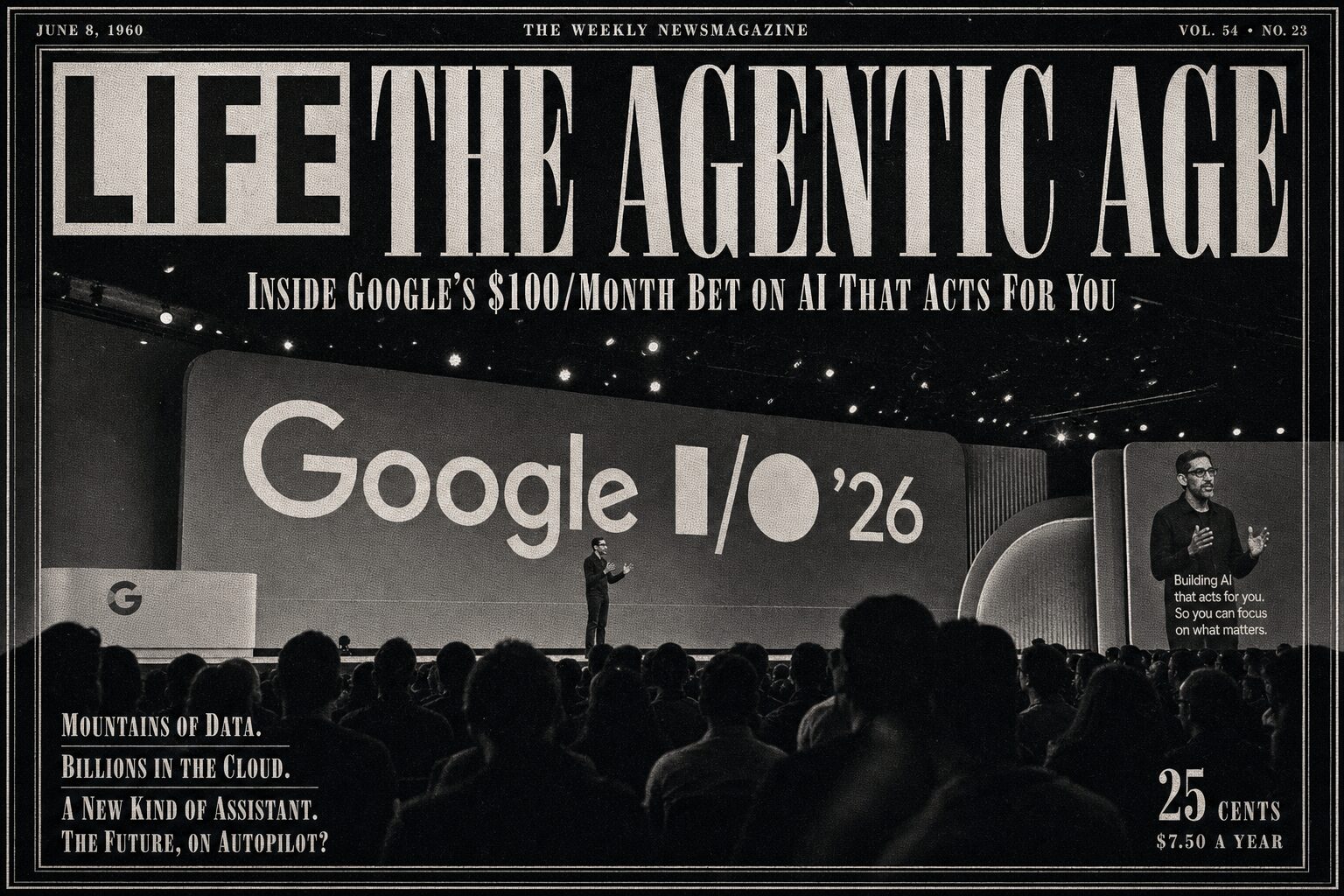

Mountain View, May 19, 2026 — Google opened its annual developer conference yesterday with what CEO Sundar Pichai called the start of the internet’s “next stage”: a wholesale pivot from a company that answers questions to one that takes actions on your behalf. Across a two-hour keynote, Google packed in seven reveals — a new Gemini Omni model family, the Gemini Spark personal agent, an AI-rebuilt Search box, Universal Cart for one-click multi-retailer checkout, Samsung-built smart glasses, the Daily Brief assistant, and a $100/month AI Ultra tier — and almost every one of them carries direct implications for small businesses.
For the first time in 25 years, Google is openly redesigning the way people find, compare, and buy things online. If you sell to consumers, run a service business, or rely on organic search for leads, the changes coming this summer will reshape how you show up — or whether you show up at all.
1. The Search Box Becomes an Agent
The most consequential reveal was also the quietest: Google is rebuilding the search box itself. The new box expands as you type, accepts text, photos, files, video, and even a dropped-in Chrome tab as input, and routes the query to AI Mode by default — now powered by the brand-new Gemini 3.5 Flash model. Most importantly, the box now contains agents that can complete tasks inline: checking ticket availability, booking appointments, comparing product specs, even completing a purchase without leaving the results page.
What this means for small businesses: traditional ten-blue-link SEO is being squeezed harder than ever. Google said its AI overviews already serve more than 2 billion users monthly, and the new agent-driven results will absorb even more of the click-through traffic that used to land on your website. The winners will be brands whose product feeds, hours, pricing, and reviews are clean, structured, and machine-readable. The losers will be sites that depend on a curious searcher clicking through to read a paragraph and convert.
2. Gemini Spark — Your Personal Agent
Gemini Spark is Google’s answer to OpenAI’s Operator and Anthropic’s Computer Use: a 24/7 personal agent that lives across Gmail, Docs, Calendar, Tasks, and (over the summer) third-party apps via the Model Context Protocol. Spark can draft replies, reschedule meetings, file expenses, hunt for flights, and — with a confirmation step — actually spend money or send emails on your behalf.
Spark launches next week to AI Ultra subscribers in the United States. The pricing matters: Ultra costs $100/month, sits above the existing AI Plus and AI Pro plans, and is clearly aimed at professionals and small business owners who already pay for productivity tools. For a solo operator, $1,200/year for an always-on executive assistant that books, follows up, and triages on your behalf is the kind of ROI calculation that gets cheaper every quarter.
3. Gemini Omni — Video In, Video Out
Gemini Omni is a new model family that accepts image, audio, video, and text as input and returns video grounded in real-world knowledge as output. Google demonstrated Omni Flash generating a 30-second product explainer from a single photograph and three lines of copy, with consistent character voice and identity preserved across edits. The system is rolling out today inside the Gemini app, Search, and the Gemini API.
Sitting alongside it: Gemini 3.5 Flash, which Google says runs four times faster than competing frontier models on output tokens per second while beating Gemini 3.1 Pro on coding, agentic, and multimodal benchmarks. For small businesses building automations, that combination of speed and reasoning at Flash-tier pricing is the biggest unlock in the keynote.

4. Universal Cart — One Cart for the Whole Web
If the Search box reveal squeezes SEO, Universal Cart squeezes Shopify, Amazon, and every direct-to-consumer brand at once. Google is rolling out a single cart that aggregates products from multiple retailers, tracks price drops, checks stock, surfaces fees and rewards, and lets an agent complete the purchase through what Google is calling the Universal Commerce Protocol. The cart will be wired into Search, Gemini, Gmail, and YouTube, with rollout starting this summer in the US.
Google’s own scale numbers tell the story: shopping queries fire across its services more than 1 billion times a day, and its Shopping Graph now indexes over 60 billion product listings. A unified cart that an AI agent fills on the customer’s behalf changes who controls the checkout — and quietly demotes the brand’s own product page from “destination” to “feed source.”
5. Samsung-Powered Smart Glasses Ship This Fall
Three years after Google Glass became a punchline, the company is trying again — this time with Samsung building the hardware, Qualcomm supplying silicon, and Warby Parker and Gentle Monster handling frames. Two models ship this fall: a voice-only audio pair and a more expensive variant with an internal display. The pitch is contextual computing: look at a restaurant facade and hear the Yelp summary; look at a foreign-language sign and hear the translation; look at the sky and identify the constellation. Both models work on Android and iOS.
For brick-and-mortar businesses, this is the most underrated reveal of the keynote. The moment glasses-based search hits even 5% adoption, your Google Business Profile, your reviews, and your storefront photos become a real-time conversion surface for people standing 10 feet from your door.
6. Daily Brief and Ask YouTube
Two smaller features round out the consumer story. Daily Brief sifts through Gmail, Calendar, and Tasks each morning to produce a personalized agenda with suggested next steps; it’s rolling out today across AI Plus, Pro, and Ultra in the US. Ask YouTube lets users pose multi-step questions and returns a structured, interactive answer drawn from across the YouTube catalog rather than a flat list of videos.
The implication is the same one running through every announcement: Google is moving from “list of links” to “answer with action.” Content creators and businesses that produce videos, blog posts, and how-to material need to think about whether their work is structured to be cited by these agents, not just clicked.
7. AI Ultra — A New $100 Pricing Tier
The pricing reveal Google buried in the second half of the keynote may be the most important number of the day. AI Ultra costs $100/month and bundles expanded Spark access, the latest Omni capabilities, and higher usage limits. It signals where Google believes premium AI subscriptions are heading — and it gives every SaaS vendor pricing into AI features a new anchor to compete against.
The Official Keynote
You can watch Sundar Pichai’s full opening keynote below — or skip to the 18-minute mark for the Spark reveal and the 47-minute mark for the Universal Cart demo.
What Small Businesses Should Do This Week
The temptation with a keynote like this is to wait six months and see what sticks. That would be a mistake. Three concrete actions are worth taking before Universal Cart and Spark hit general availability this summer:
- Audit your structured data. Product feeds, schema markup, business hours, and review counts are about to matter more than blog content for surfacing inside agent results. Run a Merchant Center diagnostic and a Google Business Profile review pass this week.
- Tighten your missed-call and after-hours coverage. When a Spark agent books an appointment on a customer’s behalf, you have minutes — not hours — to confirm. An AI voice agent or missed-call text-back automation inside your CRM closes the gap. Automated Sales Machine handles both natively.
- Pre-position your reviews. Smart glasses surface review summaries to people physically near your business. The brand with 312 reviews at 4.8 stars wins the glance; the one with 31 reviews at 4.2 doesn’t get the visit. Turn on automated review requests after every transaction.
The Bigger Picture
Google I/O 2026 felt less like a developer conference and more like a public commitment: the company is betting the next decade on agents that act, not chatbots that wait. Android barely got a mention. Cloud was a footnote. Almost every reveal — Spark, Omni, the new Search, Universal Cart, smart glasses, Daily Brief — pointed at the same thesis: software should do the work, not just describe it.
Whether users will trust an AI to spend their money is the open question. Whether small businesses can afford not to be present where those agents look is not.
FAQ
When does Gemini Spark launch?
Next week to AI Ultra subscribers in the United States, expanding to other tiers and third-party MCP integrations through the summer.
How much is AI Ultra?
$100/month. It sits above AI Plus and AI Pro and includes Spark, Omni, and higher Gemini 3.5 limits.
When do the Samsung smart glasses ship?
Fall 2026, in two models — voice-only and with internal display — through Warby Parker and Gentle Monster frames. Both work on Android and iOS.
Is Gemini 3.5 Flash available today?
Yes — it began rolling out May 19 in the Gemini app, AI Mode in Search, Antigravity 2.0, and the Gemini API. Gemini 3.5 Pro enters testing in June.
What is Universal Cart?
A single Google-managed cart that aggregates products from multiple retailers, tracks prices and stock, and lets an AI agent complete purchases through the new Universal Commerce Protocol. Rolling out in the US this summer.