


Last updated September 13, 2026
Navigating the Salesforce CRM Sales Cloud ecosystem requires understanding how AI and automation drive revenue growth. This guide breaks down essential features and current industry benchmarks. We analyze how these tools compare to consolidated AI operating systems to help you choose the right path for your business scaling needs.
| Feature Category | Key Salesforce Capability | Alternative AI OS Advantage |
|---|---|---|
| Pricing Model | Per-user licensing + data limits | Flat-rate pricing + unlimited leads |
| Lead Generation | AI-generated email replies | Autonomous agents (Chloe/Hunter) |
| Data Management | Unified Account & Opportunity views | Native CRM + Funnel + Inbox sync |
| Booking | Integrated meeting scheduling | 24/7 Voice & Chat AI appointment setters |
| Communication | Multi-channel browser extensions | Unified single-dashboard inbox |
Key Takeaways
- Moving away from per-user pricing prevents a "growth tax" on scaling sales teams.
- Autonomous AI agents now handle top-of-funnel prospecting 24/7, not just email templates.
- Consolidating customer data into one source of truth can increase revenue by 30%.
- Integrated reputation management directly influences local SEO and lead quality.
- Modern sales stacks prioritize drag-and-drop workflow builders over custom coding.
1. Stop paying per user and switch to a flat-rate model with unlimited contacts.
Traditional enterprise software often penalizes your growth by charging a "growth tax." As you add sales reps or expand your lead database, platforms like Salesforce increase your monthly bill. They scale costs per seat and per record. For a scaling agency or small business, this creates a budget ceiling. Hiring more help actually lowers your profit margins. We take a different approach with ASM by offering a predictable flat fee of $150 per month. This covers your entire team. It does not matter how many users you onboard or how many thousands of leads you import.
"Salesforce Sales Cloud users report a 30% increase in revenue, but maintaining that growth requires an infrastructure that doesn’t penalize your scaling with per-user fees."
2. Deploy AI agents to handle the grind of prospecting and outbound lead generation.
Deploying AI agents allows businesses to automate repetitive outreach tasks like personalized email replies and lead qualification without increasing human headcount. Salesforce CRM Sales Cloud helps reps by generating AI email drafts. Modern AI operating systems go further. We use autonomous agents that converse with leads until they are ready to buy. These agents operate around the clock. No inquiry goes cold. By automating the top-of-funnel grind, your human closers can focus exclusively on final negotiations and high-level strategy rather than chasing unresponsive leads.

Sales teams often get bogged down by manual data entry and repetitive outreach. The shift toward autonomous sales is changing the math. In this environment, AI-generated replies can significantly decrease handle times while maintaining a consistent brand voice. We have pushed this further. We deploy specialized AI agents like Hunter to pursue prospects and advance deals 24/7. These agents do not just send emails. They engage in meaningful dialogue to qualify interest. You can see how this works in practice by looking at the results from the Chloe AI sales agent, which has proven to drive significant revenue without human fatigue.
3. Consolidate your customer data into a single source of truth to eliminate account blind spots.
Consolidating data into a single source of truth eliminates the confusion of siloed information by linking every customer interaction to one central profile. Data silos are the enemy of a clean B2B sales approach. If your marketing data lives in one app and your sales history in another, your team is flying blind. Salesforce uses Account and Opportunity Management to unify data for a single customer profile across leads and contacts. This ensures that every interaction, from an initial click to a final signature, is visible in one place.
Per Salesforce sales cloud, users of this unified model report a 30% increase in revenue because they can spot trends and risks that were previously hidden. We follow this same philosophy by providing a central hub where all activity is automatically captured. Your CRM, email, and funnel data are natively connected. You no longer have to guess why a deal stalled. You get a complete interaction history that provides specific guidance for sellers to move deals forward based on unified insights rather than fragmented spreadsheets.
4. Transition from B2B prospecting to autonomous sales scheduling.
The old way of B2B sales involved a tedious back-and-forth to find a meeting time. You likely used third-party tools like Calendly that do not always sync perfectly with your CRM. Modern standards have moved toward an autonomous sales system that handles the entire booking flow. You can now use AI Voice Assistants to qualify leads and book appointments 24/7 without any human intervention. We have built a native booking studio directly into our CRM. This replaces the need for separate scheduling software.
5. Synchronize your entire communication stream into one unified inbox.
Modern buyers expect to reach you on the platform of their choice. They use Facebook Messenger, Instagram DM, SMS, or WhatsApp. Managing these disparate channels usually leads to missed messages and lost revenue. Some platforms use "CRM Everywhere" browser extensions to bridge the gap, but the most efficient way to work is through a unified inbox. We bring every conversation stream into a single dashboard. This includes Google Business Profile chat, so you can capture local search leads instantly.
This is particularly vital for specialized businesses. For example, if you are looking for the best CRM platform for fitness studios, having all member inquiries in one view is a necessity for retention. By consolidating your communication, you remove the friction of jumping between tabs. You ensure that every prospect gets a timely, professional response regardless of how they reached out to you. This approach prevents leads from falling through the cracks during platform transitions.
6. Replace complex coding with visual drag-and-drop workflow builders.
For years, sophisticated sales automation required hiring high-priced consultants to navigate complex tools like Salesforce Flow. That barrier to entry is disappearing. You can now create node-based marketing automations for email, SMS, and ringless voicemail without writing a single line of code. We use Kanban-style boards to manage opportunities. This allows you to trigger entire workflows just by dragging a card from one stage to the next.
7. Automate lead prioritization using AI-driven scoring and actionable to-do lists.
Not all leads are created equal. Wasting time on low-intent prospects is the fastest way to miss your quarterly targets. By using AI-driven scoring, you can identify the best leads based on customer profiles that have historically driven the most revenue. Salesforce sales cloud enables teams to maintain a consolidated view of the pipeline with built-in charts that track changes over time. This allows you to use proactive coaching insights to identify at-risk opportunities before they drop out of the funnel.
8. Host your courses and membership sites directly inside your sales platform.
Hosting courses inside your CRM simplifies the customer journey by giving students instant access to content the moment their payment is processed. Managing a separate digital product suite often creates technical debt and high monthly overhead. Modern systems allow you to eliminate separate billing for platforms like Kajabi by using built-in course hosting. By moving your educational content into your CRM, you can connect sales funnels directly to member access.
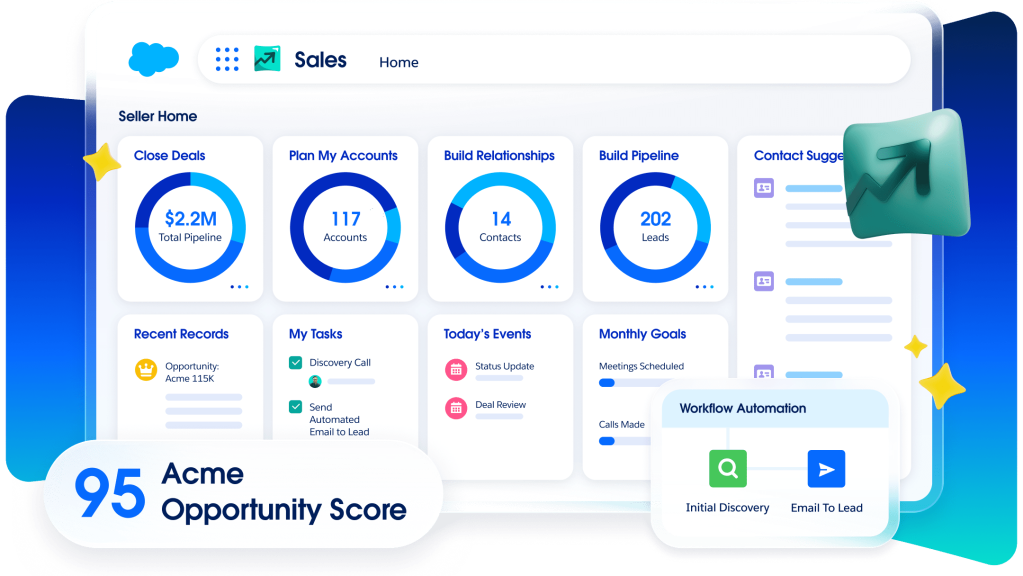
Image source: salesforce.com
This ensures that as soon as a transaction is confirmed, the student receives their credentials without manual intervention. You can manage unlimited contacts and students without increasing your monthly software subscription. This is a critical advantage for agencies or creators who want to scale their training programs without a growth tax. When your CRM and your course platform are the same entity, you gain deeper insights into how your students interact with your content.
9. Leverage Einstein Activity Capture to log every sales interaction automatically.
Manual data entry is often the primary reason sales data becomes unreliable. To combat this, you can sync Outlook or Gmail to automatically relate emails and calendar events to the correct CRM records. Every touchpoint is captured in real time without requiring a rep to type a single note. You can also use Recommended Connections to identify which colleagues have existing relationships with prospects, opening doors through internal introductions.
10. Automate your reputation management to boost local SEO rankings.
Your online reputation is a powerful driver of new business. Collecting testimonials is often an afterthought for busy teams. You can send automated Google and Facebook review requests immediately after a deal closes, capturing positive sentiment when it is highest. Beyond just gathering reviews, modern platforms allow you to utilize AI-powered replies to handle customer feedback and improve brand sentiment instantly. This high level of engagement signals to search engines that your business is active and trustworthy.
11. Build accurate real-time forecasts to ensure predictable business growth.
Predicting future revenue requires more than just guesswork. It requires a data-driven view of your entire pipeline. You can tailor metrics and KPIs to align specifically with your unique business revenue goals, ensuring that your reports reflect the reality of your niche. According to Salesforce, using Forecast Management tools helps drive accountability across the team with a shared understanding of top deals. You can visualize performance trends through out-of-the-box reporting dashboards.

This level of transparency allows you to adjust your strategy mid-month if you see a dip in activity. Whether you are tracking monthly recurring revenue or one-time contracts, having a real-time pulse on your growth helps you make informed decisions about hiring, marketing spend, and inventory. Predictable growth is the result of seeing your data clearly before the month ends, rather than reacting to a spreadsheet after the fact.
12. Streamline complex quoting and contract approvals to accelerate deal velocity.
Closing a deal often stalls at the paperwork stage. You can automate the Revenue Lifecycle Management process to ensure pricing accuracy across every quote. By unifying opportunity and account data, businesses can generate contracts significantly faster than manual systems, as noted by Salesforce sales solutions. This acceleration is vital for maintaining momentum during the final stages of the sales cycle. Streamlining the approval workflow means that discounts and custom terms are routed to the right managers instantly.
Auditing Your Duct-Taped Tech Stack for 2026
As we move forward, many businesses find themselves trapped in a fragmented ecosystem of disconnected tools. To regain control, start by identifying redundant subscriptions by listing every tool used for email, SMS, funnels, and CRM. Many companies realize they are paying for three different services that all perform the same basic automation functions. Once listed, compare the total cost of individual per-user licenses against a flat-fee AI operating system.
Beyond the financial cost, evaluate the time lost switching between tabs and reconciling data from disconnected platforms. When your lead data is in one app and your email is in another, information inevitably gets lost. Prioritize platforms that offer a unified inbox to streamline B2B sales approaches across social and email. This consolidation allows your team to respond to a LinkedIn message and an email from the same screen. It ensures a cohesive brand voice.
Measuring ROI: Salesforce vs. Automated Sales Machine

When evaluating the return on investment for your sales infrastructure, the numbers tell two different stories. Salesforce Sales Cloud users report a 30% increase in revenue, which is a significant benchmark for enterprise-level organizations. However, these gains are often tempered by the high cost of implementation and the scaling costs that hit SMBs as their team grows. In contrast, the Automated Sales Machine delivers efficiency through a transparent flat-fee model of $150 a month.
True ROI also comes from the hours saved through autonomous systems. Deploying a custom AI bot can automate lead qualification. This moves your strategy from manual hunting to autonomous closing. By reducing the overhead of high-priced consultants required for complex CRM deployments, you can focus your capital on net profit and market expansion. High-performance clinics that offer this type of technology often focus on infrastructure that supports the speed necessary for real-time customer interactions.
Frequently asked questions
Salesforce vs Automated Sales Machine: Which is better for SMBs?
Salesforce is a robust Enterprise solution but often involves per-user pricing that becomes expensive for growing small businesses. The Automated Sales Machine is designed specifically for SMBs, creators, and agencies, offering a flat rate for unlimited users and contacts. It provides native course hosting and unified social messaging which are often separate add-ons or require third-party tools in Salesforce.
Why switch from Salesforce to an all-in-one AI OS?
Switching eliminates a duct-taped tech stack where different apps for email, funnels, and CRM don’t communicate perfectly. An all-in-one system like the Automated Sales Machine integrates AI agents directly into the workflow to handle lead qualification 24/7. Businesses save on total software costs by consolidating CRM, marketing automation, and website hosting into one flat fee.
Can Salesforce Sales Cloud integrate with my current marketing tools?
Yes, Salesforce offers thousands of integrations through the AppExchange, but these often require additional monthly fees or complex setup by a developer. While you can connect tools like Mailchimp or HubSpot, maintaining these connections can be time-consuming. An all-in-one OS avoids this by having all features built into the same database from the start.
How does AI improve sales revenue in a CRM?
AI increases revenue by identifying which leads are most likely to close based on historical patterns, allowing reps to focus their energy on high-value targets. It also automates routine outreach, ensuring that every lead gets an immediate response. According to industry data, using these intelligent features can lead to a 30% increase in total revenue by reducing missed opportunities.
If you are ready to stop paying a growth tax on your sales software and want to leverage the power of an autonomous sales system, it is time to upgrade your infrastructure. You can get started today and begin consolidating your stack into a single, high-performance AI operating system.