
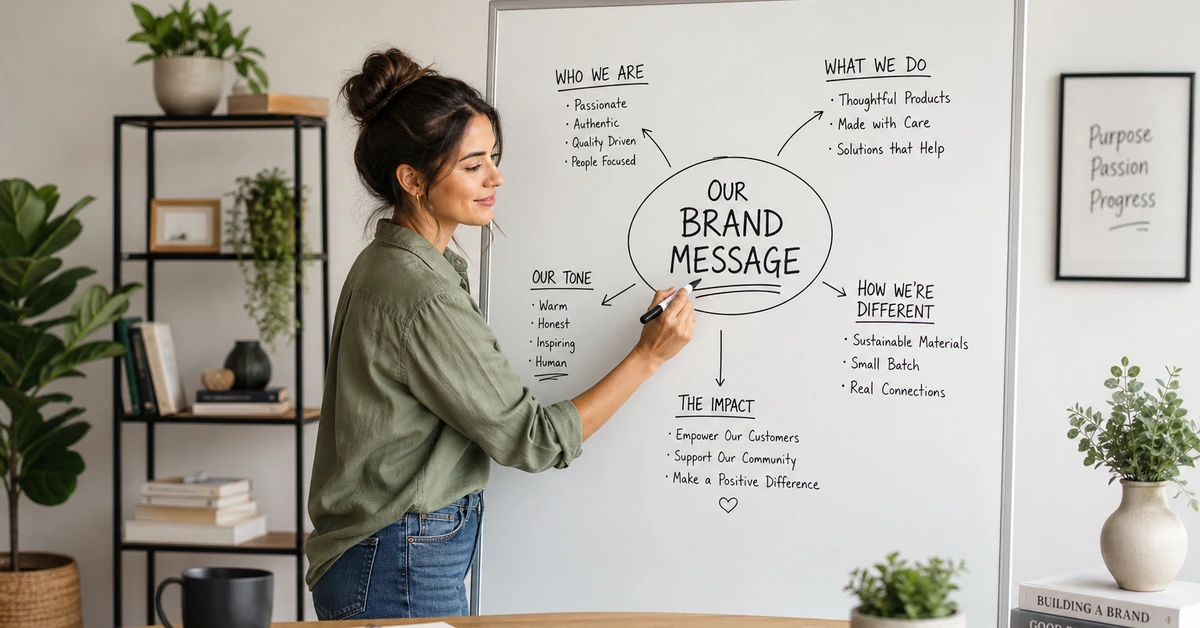

A unique selling proposition is the one thing your business does better than anyone else — articulated so clearly that your ideal customer immediately understands why you’re the only logical choice. Most small businesses either skip it entirely or write something so generic it could belong to any competitor. This guide gives you the framework to build a USP that converts.
Ready to stop blending in and start closing more deals? See how Automated Sales Machine automates your entire sales pipeline — book a free demo.
What Is a Unique Selling Proposition (and Why Most Businesses Get It Wrong)
A unique selling proposition — also called a USP — is the specific benefit that makes your product or service stand out from every competitor in your market. It answers the single most important question your prospects ask before buying: “Why should I choose you over everyone else?”
The concept was first formalized by advertising executive Rosser Reeves in the 1940s. His definition remains the clearest: a USP statement must (1) make a specific claim, (2) be one your competitors cannot or do not make, and (3) be powerful enough to move customers to buy.
Yet according to research from Bain & Company, the majority of businesses compete on price simply because they’ve never done the work to define a differentiated position. Price competition is the last resort of businesses without a clear USP — and it’s a race to the bottom.
USP vs. Value Proposition: A Critical Distinction
Many business owners confuse a unique selling proposition with a value proposition. They’re related but distinct:
- Value proposition: What you deliver to customers — the total package of benefits, outcomes, and experience your product or service provides.
- Your USP: The single most distinctive element of that value — the one thing competitors can’t credibly claim.
Your value proposition might be “we help small businesses manage their entire sales pipeline.” Your USP is the specific differentiator: “the only all-in-one CRM that replaces your entire tech stack for less than the cost of a single tool subscription.” One describes what you do; the other explains why you specifically are the right choice.
Why Weak USPs Are Killing Small Business Revenue
Most small business USPs fail for a predictable reason: they’re written for the business owner, not the customer. Phrases like “exceptional quality,” “outstanding service,” and “trusted by thousands” communicate nothing a prospect hasn’t heard from every competitor they’ve evaluated.
According to Gartner, 77% of B2B buyers describe their most recent purchase as complex or difficult — primarily because vendors failed to differentiate their offerings in ways that mattered. Buyers who can’t tell you apart from the competition default to the lowest price. A sharp USP eliminates that friction before your sales team ever enters the conversation.

The 4 Pillars of a Powerful Unique Selling Proposition
A USP that converts isn’t written by instinct — it’s engineered from four structural elements. Miss any one of them and the whole proposition collapses.
Pillar 1 — Customer-Centricity: Your USP Is Not About You
The most common mistake in writing a USP statement is leading with what the company values (“craftsmanship,” “passion,” “innovation”) rather than what the customer gains. Every word of your USP should answer the customer’s internal question: “What’s in this for me?”
Start by identifying your customer’s primary pain — the problem that keeps them up at night. Then position your USP as the direct resolution to that specific pain. A dental practice that says “comfortable dentistry for anxious patients” is speaking to the pain. “Gentle care with cutting-edge technology” is speaking to the dentist.
Pillar 2 — Specificity: Vague Claims Convert No One
Specificity is the engine of credibility. “Fast delivery” means nothing. “Delivered to your door in 48 hours or your next order is free” means everything — and it creates a brand promise the customer can hold you to. Specific claims are inherently more believable than general ones because they signal operational confidence.
When auditing your current USP, apply the “so what?” test. If a customer can respond to your USP statement with “so what?” or “every business says that,” it isn’t specific enough. Keep drilling down until you find the claim that stops them cold.
Pillar 3 — Differentiation: What You Do That No One Else Does
True differentiation isn’t about being different in ways that don’t matter to customers — it’s about being distinctly better in ways that do. This requires honest competitive intelligence. Map every competitor’s positioning, identify their claims, and find the gap in the market they aren’t serving.
According to a landmark study published in Harvard Business Review, companies that articulate a genuinely differentiated position grow at 2–3x the rate of industry averages — not because differentiation is rare, but because most businesses never invest in finding theirs.
Pillar 4 — Proof: Back Every Claim With Evidence
A USP without proof is just marketing copy. The strongest USPs are backed by verifiable evidence: customer testimonials that quantify specific outcomes, case studies that name real clients and real numbers, awards and certifications, and guaranteed commitments (money-back guarantees, performance SLAs, free pilots).
Proof doesn’t always need to appear in the USP statement itself — it lives on your website, in your proposals, and throughout your sales sequence. But the promise you make in your USP must be substantiated somewhere your prospects can verify it.
How to Craft Your Unique Selling Proposition: A 5-Step Framework
Building a unique selling proposition from scratch requires structured research before you write a single word. Here’s the exact sequence that produces results.
Step 1 — Mine Your Customer Data
The words in your best USP already exists — in the language your customers use. Start by pulling the last 20 customer reviews, support tickets, and sales call transcripts. Look for the words and phrases that appear repeatedly. What problem do they describe in their own language? What outcome do they celebrate most? What made them choose you over the alternatives?
This verbatim language is your raw material. Customers who describe choosing you because “you were the only one who explained it in plain terms, not tech jargon” are handing you your USP. Never ignore that data.
Step 2 — Audit Your Competitors
Map every competitor’s positioning across five dimensions: pricing, target customer, primary benefit claim, proof elements, and guarantee. Build a simple matrix. You’re looking for two things: (1) claims all of them make (which means that territory is crowded and undifferentiated) and (2) genuine customer needs that none of them are addressing.
The gap you find in Step 2 is your differentiation opportunity. The USP that wins isn’t necessarily about being the best — it’s about being the clearest and most relevant to a specific customer in a specific situation.
Step 3 — Identify Your Unfair Advantage
Every business has something it does better than anyone else — even if it has never articulated it. The challenge isn’t finding your unfair advantage; it’s being honest enough to recognize it and confident enough to build a position around it. This is your “unfair advantage”: a capability, relationship, process, or asset that competitors can’t easily replicate. It might be your founder’s 20 years of industry experience. A proprietary methodology. A distribution partnership. Or a deep specialization in one vertical that generalist competitors can’t match.
Your USP statement should be rooted in this unfair advantage, because that’s the only position that’s genuinely defensible over time. Advantages built on price, location, or generic features get copied. Advantages built on unique capabilities compound.
Step 4 — Write and Pressure-Test Your USP Statement
A great USP statement follows a simple structure: [Target Customer] + [Primary Problem] + [Your Specific Solution] + [Key Differentiator]. You don’t need all four in every iteration, but the discipline of completing each element ensures you’ve done the thinking.
Once you’ve written a draft, pressure-test it with three questions:
- Can a direct competitor make this exact claim without changing a word? (If yes, it’s not differentiated enough.)
- Does it make a promise specific enough that a customer could hold you accountable to it? (If not, it’s too vague.)
- Does your target customer immediately understand the benefit — without needing a follow-up explanation? (If not, it’s too abstract.)
Step 5 — Embed It Across Every Touchpoint
A your USP that lives only on your About page converts no one. It must be consistently present at every customer touchpoint: your homepage headline, your sales email subject lines, your proposals, your social ads, your sales calls, and every automated nurture sequence in your CRM.
Consistency is the secret multiplier — and it’s the step most small businesses skip. They spend hours crafting a sharp USP, then bury it on page two of their website and never integrate it into their sales sequences. McKinsey’s research on consumer decision journeys shows that brands with consistent messaging across channels see up to 23% higher revenue than those with fragmented positioning. Your USP only converts when it shows up exactly where and when your customer is making the decision to buy.

5 Real-World USP Examples That Drive Results
The best way to understand what makes a USP work is to study examples that have actually moved markets.
FedEx — The Overnight Guarantee
FedEx’s original USP — “When it absolutely, positively has to be there overnight” — is a masterclass in specificity and commitment. It doesn’t say “fast delivery.” It names the exact timing, adds an emotional intensity (“absolutely, positively”), and makes an implicit guarantee. When reliability is the customer’s primary concern, precision beats polish every time.
Domino’s — 30-Minute Delivery
Domino’s didn’t build its brand on taste (“America’s Best Pizza” is a generic and contestable claim). It built it on a specific operational promise: 30 minutes or it’s free. This USP statement acknowledged that their customer’s primary pain wasn’t quality — it was waiting. Domino’s solved the right problem.
M&Ms — “Melts in Your Mouth, Not in Your Hand”
One of the most enduring USPs in consumer history solves a practical problem — melting chocolate — with a memorable, testable claim. The USP addresses a genuine inconvenience that every chocolate-lover recognizes. When a your USP solves a real friction point with a verifiable solution, it builds long-term brand loyalty without requiring aggressive sales.
Dollar Shave Club — “Our Blades Are F***ing Great”
Dollar Shave Club’s launch USP wasn’t about product quality (though the quality was solid). It was about price and convenience: “A great shave for a few dollars a month.” The differentiation was clarity of value, not product superiority. In a market dominated by Gillette’s premium positioning, Dollar Shave Club found the underserved customer who refused to pay $30 for razor blades.
Automated Sales Machine — The All-in-One Stack Replacement
Automated Sales Machine’s USP speaks directly to the tech-stack fatigue that plagues small and medium businesses: replace your entire CRM, email marketing, SMS automation, landing pages, and booking system with a single platform — for less than most businesses pay for one of those tools alone. The differentiation isn’t a feature. It’s an entirely different operational model that frees business owners from managing eight disconnected subscriptions.
USP Mistakes That Stall Growth
Even experienced marketers make these unique selling proposition errors. Recognize them early and fix them before they cost you revenue.
Mistake 1 — Being Too Broad
A USP that tries to appeal to everyone ends up compelling no one. “The best solution for businesses of all sizes” is not a USP — it’s avoidance of a positioning decision. Narrow your target. A USP statement for “solo dentists in markets under 100,000 people” will outperform one aimed at “healthcare practices” every single time.
Mistake 2 — Copying Competitors
When you study competitors to define your USP, the goal is to find differentiation — not inspiration for imitation. Copying a competitor’s positioning creates a me-too brand that will always lose on price. If your USP sounds like a paraphrase of your top competitor’s homepage, start over.
Mistake 3 — Setting It and Forgetting It
A USP is not a tagline you write once and never revisit. Markets shift, competitors evolve, and customer needs change. The businesses that win long-term treat their USP as a living strategy that gets tested, refined, and sometimes completely rewritten as the market data demands it. Build a quarterly review of your this positioning into your strategic calendar.
Mistake 4 — Never Testing It
The only way to know if your USP is working is to test it with real prospects. A/B test your headline. Test two versions of your sales email opening. Run competing ad creatives. The USP that wins in real conversion data beats any positioning workshop output. Let the market decide.
Scale Your Unique Selling Proposition With Automation
Building a powerful unique selling proposition is half the equation. The other half is ensuring it reaches your ideal customer consistently — across every channel, at every stage of their decision journey, without requiring your team to manually execute every touchpoint. Consistency is what separates businesses that grow from businesses that plateau.
This is where sales and marketing automation becomes a force multiplier for your USP statement. When your CRM automatically delivers your USP-driven messaging at the exact moment a prospect shows purchase intent — through email, SMS, and retargeting — the gap between your positioning and your competitor’s closes permanently. A prospect who sees your USP in a cold outreach email, an automated follow-up sequence, a targeted Facebook ad, and a personalized landing page has experienced your differentiation five times before a single sales conversation happens.
Automated Sales Machine consolidates your CRM, email, SMS, funnels, and booking system into a single platform — so your USP is embedded in every automated sequence, not scattered across eight disconnected tools. Small and medium businesses using ASM consistently report replacing $400–$800/month in tool subscriptions with a single system that works harder than all of them combined.
Ready to Build a USP That Actually Closes Deals?
A great unique selling proposition isn’t a luxury for brands with massive marketing budgets — it’s the foundational competitive move that every growth-focused business must make. The businesses that win long-term aren’t always the most well-funded; they’re the most clearly differentiated — because without it, every sales conversation starts from zero, price becomes the only differentiator, and customer acquisition gets harder and more expensive by the quarter.
Your USP is the answer to the question every prospect is silently asking. The frameworks in this guide give you the tools to find it, articulate it, and deploy it at scale. Now it’s time to execute.
Book a free Automated Sales Machine demo and see how small businesses are embedding their USP into every automated touchpoint — from first click to closed deal — without adding a single hour to their sales team’s calendar.