

Tycoon AI: 10 Remarkable AI Agents Running Your Business

Tycoon AI — Run one-person companies entirely with AI agents
460 upvotes · #1 Product of the Day · Launched May 21, 2026 — View on Product Hunt
The premise sounds almost too simple: give your AI CEO a goal like “10x traffic this month” and watch her orchestrate a team of 10+ specialized AI agents to make it happen. No prompting. No API keys. No engineering degree required. That’s Tycoon AI’s elevator pitch, and it hit hard enough to land the product Product of the Day on Product Hunt with 460 upvotes on May 21, 2026. But behind the venture-scale ambition lies a more nuanced question: for solopreneurs and small teams, does delegating to AI actually work, or does it just move the problem upstream?
Topics: Marketing, Artificial Intelligence, Tech
What Tycoon AI Actually Does
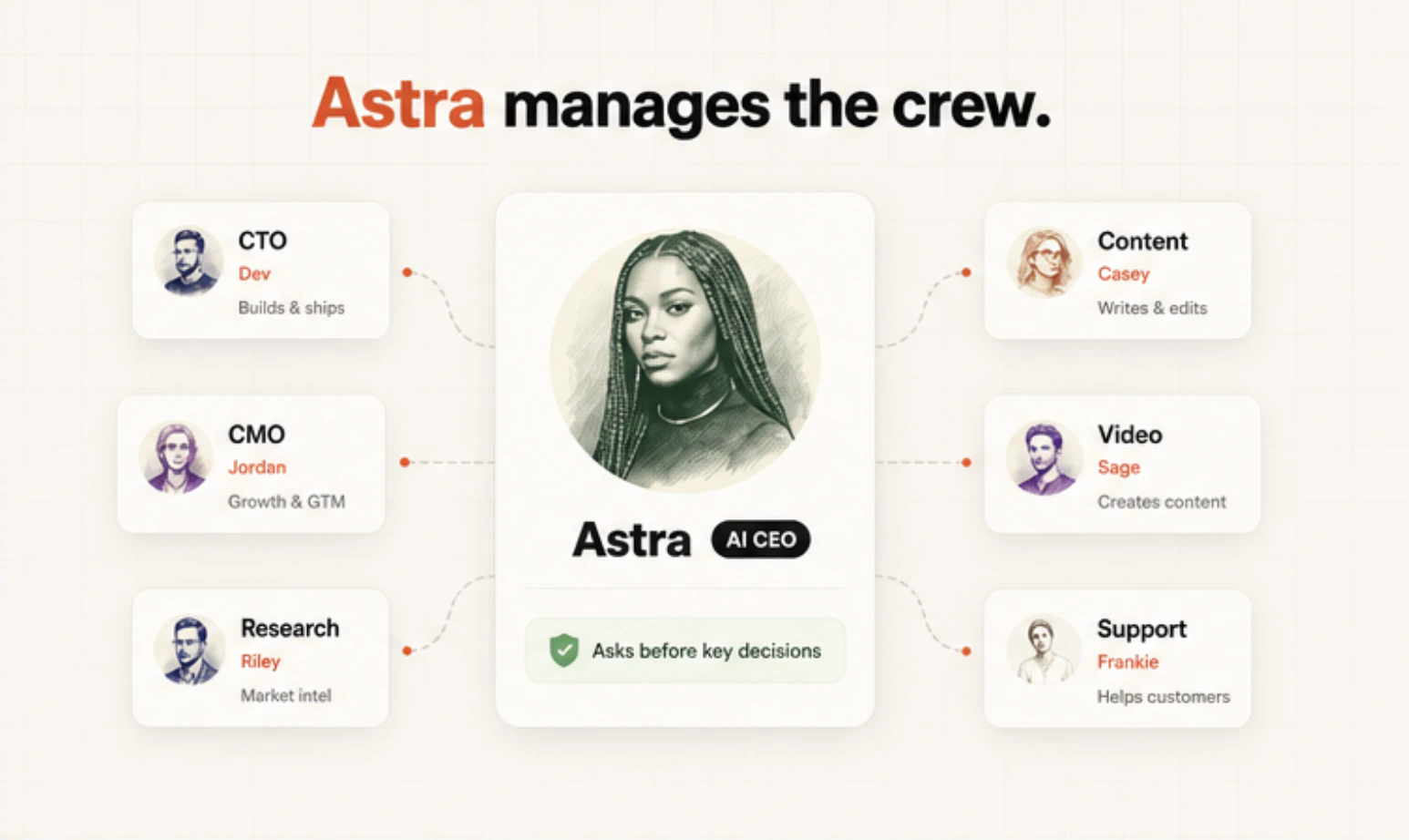
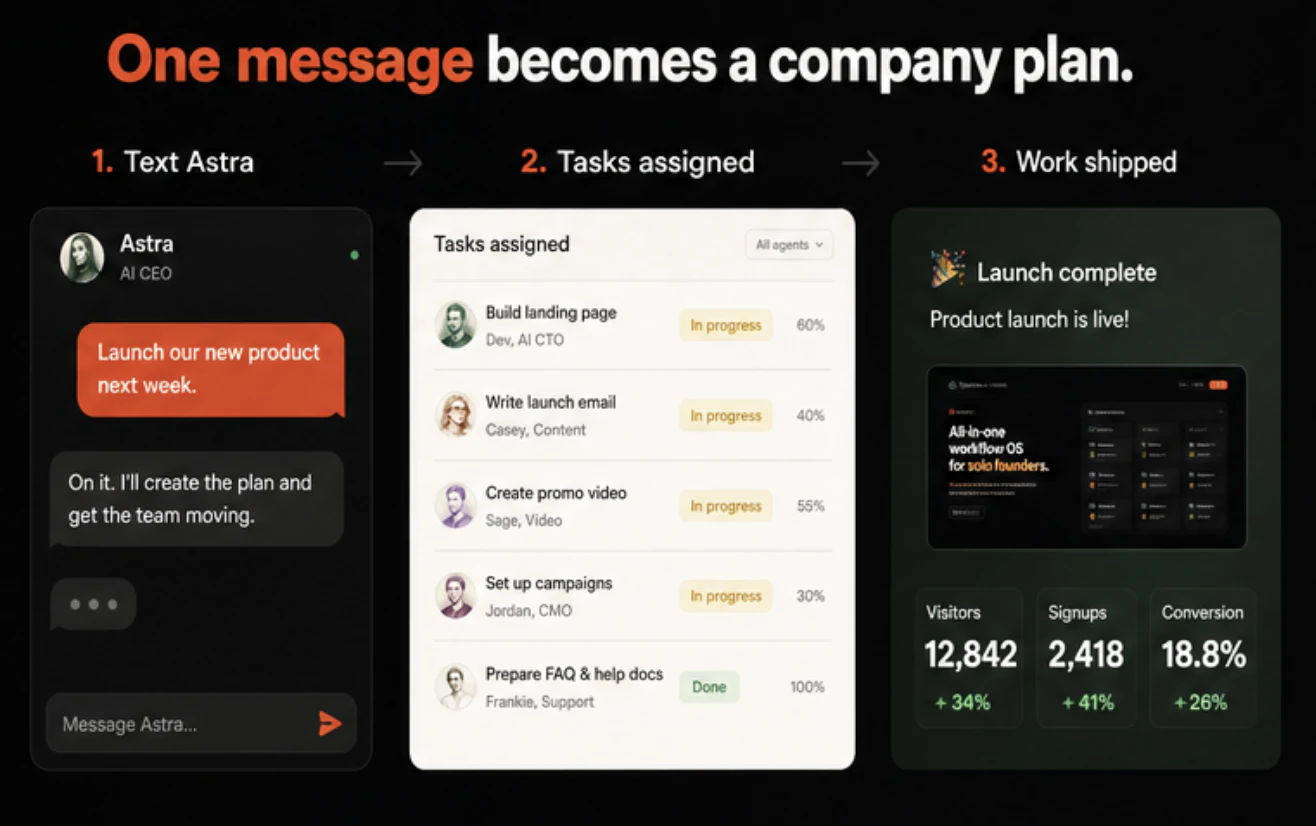
Tycoon positions itself not as a tool, but as a “success platform.” The core mechanic is delegation. You give Astra a KPI or a project. Astra creates a plan, assigns tasks to specialized agents—a CMO for social media, a CTO for coding, a CFO for finances—and tracks progress. When approval is needed, she escalates. Everything runs out-of-the-box. No setup. No integration wiring. You can communicate via iMessage, Slack, Discord, or Tycoon’s dashboard.
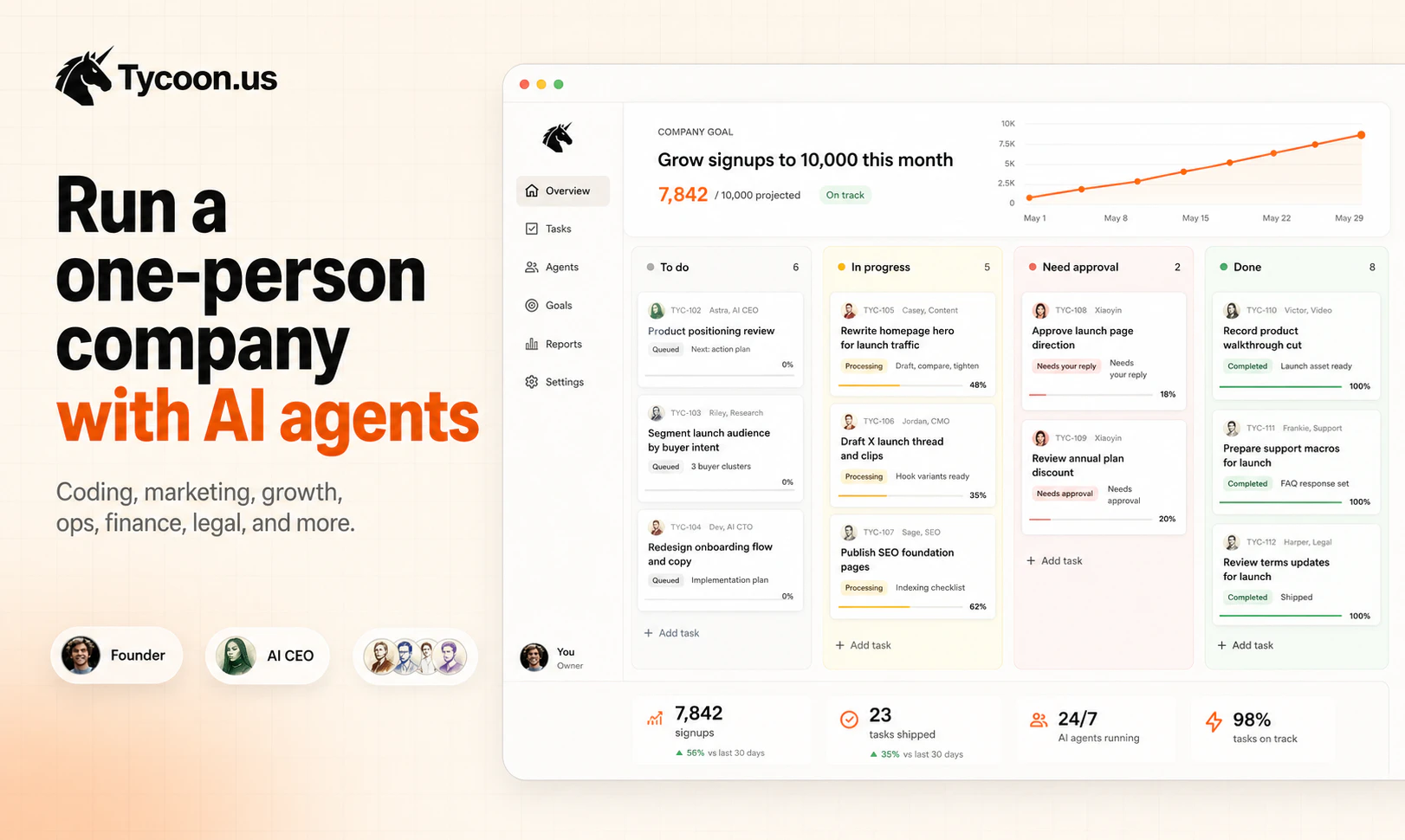
The platform integrates with Stripe, GA4, GitHub, and PostHog—letting agents pull real data about your business and make informed decisions rather than operating in a vacuum. That distinction matters. Without business context, AI agents hallucinate. With it, they can at least reason from evidence.
Key Features for Small Business Owners
Let’s drill into what actually differentiates Tycoon from competitors like CrewAI (Python-based, developer-focused) or Salesforce Agentforce (enterprise-locked). Tycoon’s bet is that solopreneurs don’t want to build AI agent teams—they want to buy one.
Pre-built agent library. You’re not architecting agents from scratch. The platform includes specialized agents out-of-the-box: CMO (X/Twitter management), CTO (coding and development), CFO (financial tracking), and others. Each comes with task workflows tuned for small business needs.
Knowledge persistence. The system maintains context across projects. Your agents remember your business model, past decisions, your audience, and your metrics. This reduces the “starting from zero” problem that haunts single-prompt AI workflows.
Hierarchical escalation. Not every decision goes to you. Astra evaluates which decisions need human approval and which can be automated. This is where the “psychology” angle Tycoon emphasizes becomes clear—delegation isn’t just technical; it’s organizational design.
Pricing and Access
Tycoon starts free with no credit card required. Specific pricing tiers are not publicly listed on their website. You’ll need to sign up or contact the team to see premium pricing. That said, the free tier’s generosity suggests they’re banking on virality and network effects rather than gatekeeping the core experience.
How It Compares to Alternatives
The AI agent orchestration market is heating up. CrewAI remains the developer darling—it’s open-source, Python-native, and lets engineers build bespoke multi-agent systems. Tycoon is the opposite: it’s opinionated, no-code, and targets founders who’d rather focus on business than AI engineering.
Salesforce Agentforce serves enterprises wanting to embed AI within their existing Salesforce instance. Tycoon is for solopreneurs working outside that ecosystem. SuperAGI sits somewhere in the middle—a developer platform that’s more accessible than pure code frameworks but more technical than Tycoon.
The real tension: Tycoon claims agents can operate autonomously, but the industry consensus still holds that AI agents need human-in-the-loop governance. Tycoon’s website emphasizes escalation and approval workflows, which implicitly acknowledges that fully autonomous operation isn’t quite here yet. That’s honest. It’s also a limitation for founders expecting “set it and forget it.”
Who Should Use Tycoon AI
The right fit: Solo founders and early-stage teams operating bootstrapped or seed-stage companies. You have clear KPIs, a GitHub repo, GA4 or Stripe data, and you’re willing to treat Astra as a capable but fallible collaborator. You’re not a developer—you don’t want to wrangle APIs or write agent prompts.
The wrong fit: Enterprise teams needing deep Salesforce integration, compliance-heavy operations, or fully autonomous agents without human oversight.
Pros and Cons
Pros:
- Genuinely low friction to start—no API keys, no coding, free tier available.
- Out-of-the-box agents with real business integrations (GitHub, Stripe, GA4) beat generic LLM chat.
- Escalation workflows prevent the “AI ran amok” scenario while still automating routine decisions.
- Founder transparency about limitations builds credibility.
Cons:
- The “AI CEO replaced a human CEO” marketing claim oversells autonomy. The reality is collaborative delegation, not replacement.
- Pricing opacity makes it hard to budget as you scale.
- Reliance on AI agents means inherited AI limitations: hallucinations, outdated knowledge, and failure modes no dashboard can fully catch.
- If your business has exotic workflows, agents may struggle without domain-specific fine-tuning.
Verdict
Tycoon AI is a genuinely useful product for its target market: solopreneurs and scrappy early-stage teams who need leverage without engineering overhead. It’s not magic, and it’s not a replacement for human judgment on major business decisions. What it is: a working execution layer for delegating routine, well-defined work to AI agents without building the system yourself.
The market for autonomous business management is still early—expect to see 5-7x growth through 2030 as agents get smarter. Tycoon is positioning itself as the no-code entry point to that future. Whether it becomes the standard or a stepping stone remains to be seen. Start with the free tier and judge by results, not the hype.
Check out Tycoon AI on Product Hunt or visit the official Tycoon AI website to learn more.