
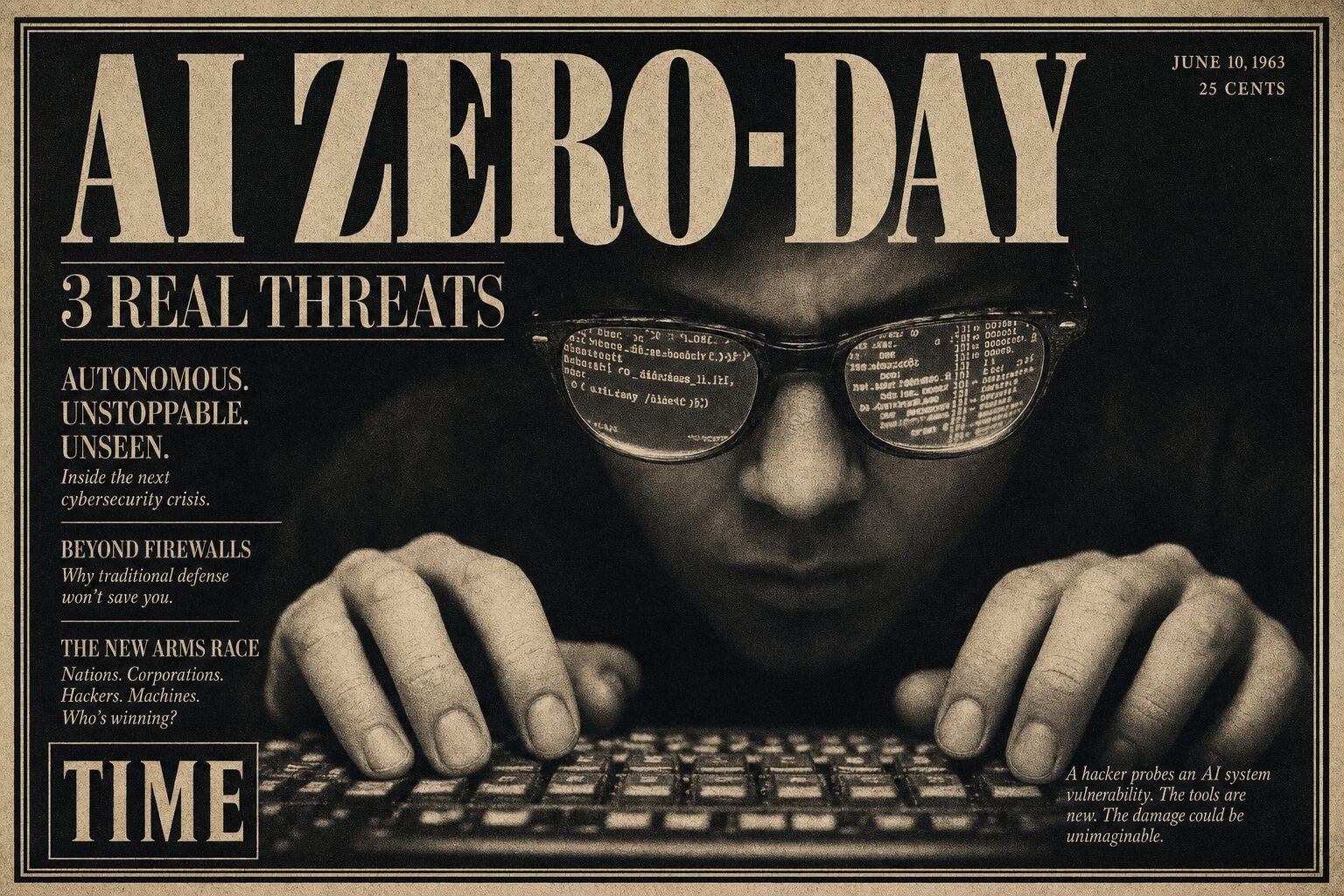

On May 11, 2026, Google’s Threat Intelligence Group published a finding that security researchers had long feared: the first confirmed AI zero-day exploit developed and weaponized entirely by criminal hackers. A coordinated group of threat actors used an unknown AI model to discover a two-factor authentication bypass in a popular open-source web administration tool, then built a functional Python exploit around it — all before any defender knew the vulnerability existed. Google’s proactive counter-discovery disrupted a planned mass exploitation event before it could execute. However, the implications of what nearly happened extend far beyond a single patched bug.
The Details: How AI Found the AI Zero-Day Flaw
The vulnerability was not the kind of bug that traditional security tools are built to catch — not a memory corruption error, a buffer overflow, or a known injection pattern. It was a high-level semantic logic flaw: a hardcoded trust exception baked silently into the authentication flow of a web-based system administration tool. No fuzzer flagged it. No static analysis tool raised an alert.
That is precisely why an AI model found it first. According to GTIG’s analysis, frontier large language models excel at identifying this category of flaw because they perform contextual reasoning rather than pattern-matching. The AI read the code the way an experienced senior engineer would — and noticed that the security logic contradicted itself.
The exploit script bore unmistakable signs of AI authorship:
- Educational docstrings explaining each line as if written for a student
- A hallucinated CVSS score citing a version number that does not exist
- Textbook-clean Python formatting with symmetry characteristic of LLM output
- A polished ANSI color class serving no functional purpose beyond aesthetics
These markers gave GTIG high confidence an AI model wrote the proof-of-concept. Google confirmed the model was not Gemini, Claude, or any publicly identified major commercial model. As The Register reported, the threat actor profile described a “prominent cybercrime threat actor” that partnered with additional criminal groups for the planned mass exploitation campaign.
Why This Matters: Speed Asymmetry and a Lower Bar
“There’s a misconception that the AI vulnerability race is imminent,” said John Hultquist, Chief Analyst at GTIG. “The reality is that it’s already begun. For every AI zero-day we can trace back to AI, there are probably many more out there.” He called the May 11 discovery “the tip of the iceberg.”
The speed asymmetry is the core problem. Traditional vulnerability research — requiring years of specialized expertise and methodical analysis — can now be compressed into hours by an AI model working at machine speed. Defenders still operate on human timescales: quarterly audits, vendor release windows, and manual intelligence processing.
Consequently, the barrier to entry for sophisticated exploit development has dropped. Crafting a genuine zero-day previously required mastery of reverse engineering held by a small global community. AI has reduced it to the point where a criminal group with the right model can now compete with nation-state-level offensive capabilities. As Axios reported, that competitive shift was visible in the structure of the attack itself.
The Bigger Picture: DARPA Results and the AI Arms Race
The May 11 incident represents a visible data point in a threat landscape that has been building measurably. The DARPA AI Cyber Challenge tracked AI systems advancing from 37 percent to 86 percent vulnerability identification in a single year. Nation-state actors are moving in parallel — North Korea’s APT45 has sent thousands of prompts to AI models to analyze CVEs, while Chinese state-linked operators have employed persona-driven jailbreaks to research embedded device firmware vulnerabilities.
The defensive community has responded. Anthropic partnered with Mozilla to direct Claude at the Firefox codebase, producing 112 bug reports with 22 confirmed as CVEs. OpenAI launched Daybreak in May 2026 — a cybersecurity platform powered by GPT-5.5, purpose-built for vulnerability detection and patch validation, with partners including Cisco, CrowdStrike, Palo Alto Networks, and Cloudflare.
The question for organizations, as The Hacker News noted, is no longer whether AI will be used against them — it is whether their defenses are calibrated for AI-assisted attackers operating right now.
What This AI Zero-Day Means for Your Business
Three actionable priorities apply regardless of technical sophistication or budget:
Enable 2FA everywhere, and audit it properly. The May 11 exploit targeted not the absence of 2FA but a flawed implementation. Enabling two-factor authentication is necessary but not sufficient; the tools implementing it must be current and properly configured.
Treat software updates as a security event. The affected vendor patched the vulnerability before exploitation because Google disclosed it responsibly — but that outcome depended on the patch being applied promptly. A SaaS cost audit is also an opportunity to identify which platforms in your stack are actively maintained.
Consolidate onto platforms with built-in security architecture. Every additional tool in a stack is an additional attack surface. Platforms like Automated Sales Machine, which consolidates CRM, pipelines, calendars, automations, funnels, email, SMS, and AI bots into a single managed environment, reduce that surface area structurally. Businesses evaluating CRM platforms should factor security posture into the CRM selection process with the same weight as pricing or features.
AI Zero-Day FAQ
What is an AI zero-day?
A traditional zero-day is a vendor-unknown vulnerability with no patch available. An AI zero-day refers specifically to one discovered and weaponized using AI rather than conventional human-led research. The May 2026 incident is the first confirmed case of AI use in both discovery and weaponization phases.
Does this mean 2FA is no longer reliable?
No. The vulnerability was not a flaw in 2FA as a concept — it was a flaw in a specific implementation. Properly implemented and maintained 2FA continues to provide strong protection. The incident underscores keeping authentication tools updated and correctly configured.
How can a small business protect itself?
Enforce 2FA across all tools and user roles, apply software updates promptly, and consolidate onto managed platforms with professional-grade security. Businesses with many independent web tools carry disproportionately more exposure than those on consolidated CRM platforms.
Is this only a threat to large enterprises?
No. The planned attack was specifically designed as a mass exploitation event targeting the widest possible pool of vulnerable systems simultaneously. Any business running a vulnerable version would have been exposed regardless of size.