
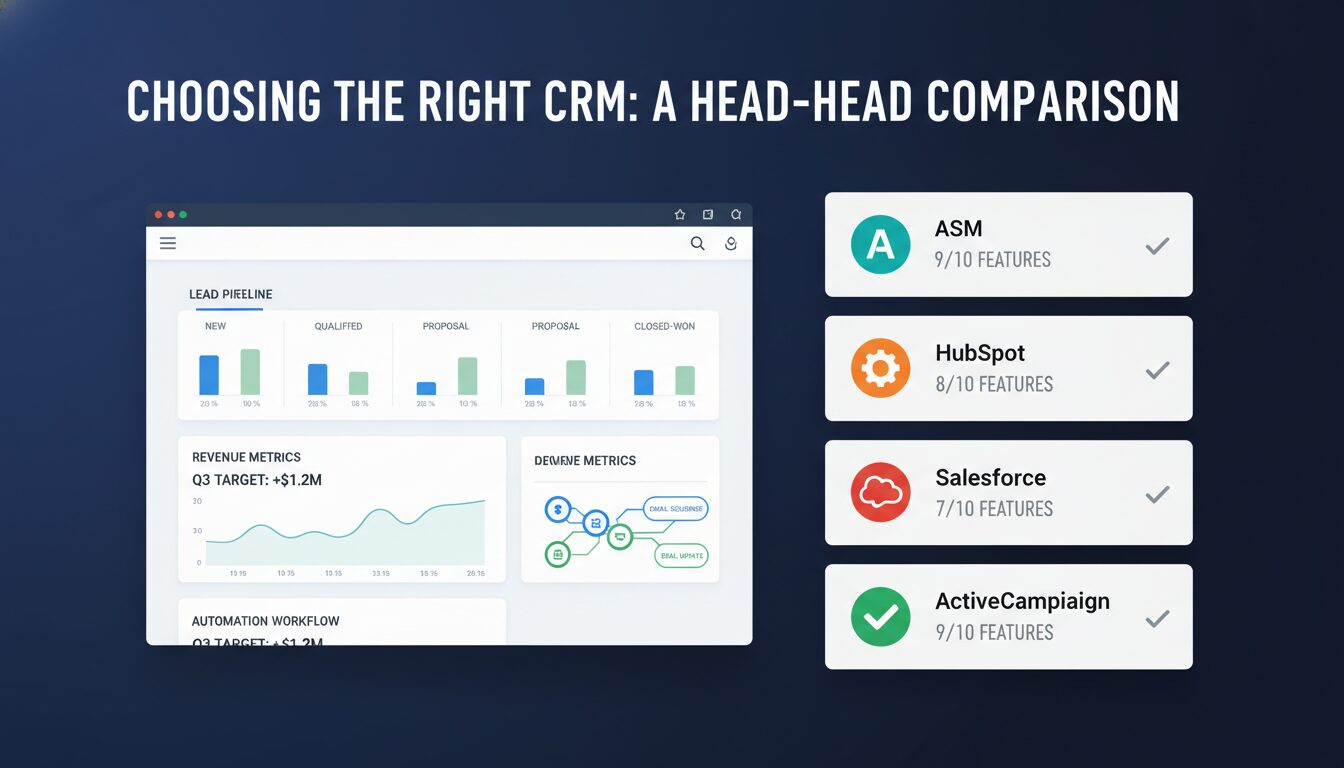

The right CRM software comparison cuts through marketing copy to show exactly what you get — and what you pay — before you commit. This guide evaluates Automated Sales Machine, HubSpot, Salesforce, ActiveCampaign, and Keap side-by-side across features, pricing structure, and fit for small and mid-size service businesses. If you’ve outgrown managing leads in spreadsheets but don’t want to pay enterprise prices for five disconnected tools, this comparison is your starting point.
Get a live demo of Automated Sales Machine →
Why CRM Selection Is the Highest-Stakes Software Decision for Small Businesses
The CRM market has grown into a landscape where the decision you make today shapes your entire operational infrastructure. Businesses implementing a CRM platform see an average return of $3.10 for every $1 invested, with AI-integrated platforms reducing manual tasks by 5–10 hours per employee per week, according to OpsLink’s 2026 CRM ROI analysis. The challenge for small business owners is not whether to adopt a CRM — it’s which of the dozens of competing platforms actually delivers that return without requiring a technical team or a six-figure budget.
According to a 2024 systematic review of CRM performance data published in the Journal of Integrated Engineering Sciences, CRM adoption among small and mid-size businesses drives a 25–40% improvement in customer retention rates — a metric that translates directly into revenue without additional acquisition spend. The platforms in this comparison all serve the same stated outcome. Their architecture, pricing, and practicality vary significantly.
The 5 Platforms in This CRM Software Comparison
This comparison covers the five platforms most frequently evaluated by small business owners and service-based teams:
- Automated Sales Machine (ASM) — An all-in-one AI CRM built to consolidate an entire tech stack into a single flat-rate subscription.
- HubSpot — A modular CRM platform with separate Marketing, Sales, and Service Hubs, each carrying independent pricing.
- Salesforce — An enterprise-grade CRM with modular licensing and significant implementation overhead.
- ActiveCampaign — An email marketing and automation platform with CRM capabilities unlocked at higher subscription tiers.
- Keap — A small business CRM focused on contact management, email automation, and invoicing.
Feature-by-Feature Comparison Table
The table below documents which features are included natively in each platform’s base or standard subscription. Features marked as tier-restricted require upgrading to a higher plan to access.
| Feature | ASM | HubSpot | Salesforce | ActiveCampaign | Keap |
|---|---|---|---|---|---|
| CRM & Contact Management | ✅ Base | ✅ Free tier | ✅ Starter | ⚠️ Plus+ only | ✅ Base |
| Email Marketing | ✅ Base | ⚠️ Marketing Hub | ⚠️ Marketing Cloud add-on | ✅ Base | ✅ Base |
| SMS Marketing | ✅ Base | ❌ Not native | ❌ Not native | ❌ Not native | ⚠️ Add-on |
| Sales Pipeline | ✅ Base | ⚠️ Sales Hub | ✅ Base | ⚠️ Plus+ only | ✅ Base |
| Workflow Automation | ✅ Base | ⚠️ Pro tier | ⚠️ Pro/Enterprise | ✅ Base | ✅ Base |
| Funnel Builder | ✅ Base | ❌ Not native | ❌ Not native | ❌ Not native | ❌ Not native |
| Website Builder | ✅ Base | ⚠️ CMS Hub | ❌ Not native | ❌ Not native | ❌ Not native |
| AI Appointment Booking Bots | ✅ Base | ❌ | ❌ | ❌ | ❌ |
| Reputation & Review Management | ✅ Base | ❌ | ❌ | ❌ | ❌ |
| Voice AI & Missed-Call Text-Back | ✅ Base | ❌ | ❌ | ❌ | ❌ |
| Unified Inbox (SMS, Email, Social) | ✅ Base | ⚠️ Service Hub | ⚠️ Service Cloud | ❌ | ❌ |
| Social Media Planner | ✅ Base | ⚠️ Marketing Hub | ❌ | ❌ | ❌ |
| White Label / Agency Snapshot Cloning | ✅ Available | ❌ | ❌ | ❌ | ❌ |
Key: ✅ = Included at base subscription | ⚠️ = Requires tier upgrade or add-on | ❌ = Not available natively
Automated Sales Machine provides every feature listed above within a single flat-rate subscription. HubSpot, Salesforce, ActiveCampaign, and Keap each require tier upgrades, separate hub subscriptions, or third-party integrations to reach the same combined feature coverage.

Pricing Breakdown: What You Actually Pay
Pricing structure is where this CRM software comparison diverges most significantly for small business operators.
Automated Sales Machine uses a flat-access pricing model. All platform features — CRM, sales funnels, workflow automation, AI appointment booking, reputation management, and the unified inbox — are available at the base subscription level. Usage-based billing applies only to variable communication services: outbound SMS, high-volume email sends beyond the included allowance, and AI feature consumption. There are no per-seat fees that escalate with team growth and no feature paywalls blocking access to core functionality.
HubSpot pricing is structured across four product hubs (Marketing, Sales, Service, CMS), each with Starter, Professional, and Enterprise tiers. Reaching the full feature set — marketing automation, sales sequences, and multi-channel support — requires subscribing to multiple hubs at Professional tier. HubSpot’s model also scales by contact count, meaning costs rise as your audience grows. A small business accessing Marketing, Sales, and Service hubs at Professional tier pays a materially higher monthly total than the entry price advertised.
Salesforce is per-seat and module-dependent. Accessing sales automation, marketing, and service tools requires separate module licenses. Implementation typically requires a Salesforce-certified administrator or consulting partner — a cost not reflected in the platform subscription price. Salesforce pricing is structured for enterprise organizations with dedicated technical resources; small businesses routinely find their total cost of ownership exceeds initial projections.
ActiveCampaign scales by contact count across four tiers (Lite, Plus, Professional, Enterprise). CRM capabilities and sales automation are restricted to the Plus tier and above. A small business with 2,500 contacts that requires CRM access pays significantly more than the Lite entry price.
Keap offers contact management, email automation, and invoicing on a contact-count-based pricing model. SMS capabilities require a paid add-on. Funnel building, website hosting, and AI automation are not available natively at any Keap tier.

Which Platform Wins for Service-Based Businesses
Service businesses — real estate offices, dental practices, med spas, fitness studios, and home service operators — have a distinct operational profile from B2B SaaS companies. Their highest-priority workflows include lead response speed (missed-call text-back), appointment booking automation, online review collection, and multi-channel communication across SMS, email, and social platforms.
On these criteria, Automated Sales Machine delivers capabilities that none of the other platforms in this comparison provide natively at any subscription level: AI appointment booking bots, voice AI, missed-call text-back automation, and a complete review workflow system are all included in the base plan. For a dental office or real estate team, these are not supplementary features — they determine whether a lead books or bounces within minutes of first contact.
HubSpot, Salesforce, and ActiveCampaign are architected primarily for B2B or e-commerce organizations with dedicated marketing and sales departments. Keap serves small businesses but does not offer the communication automation layer that defines modern service business operations. An all-in-one marketing platform purpose-built for service verticals addresses these workflows without requiring integrations, add-ons, or additional subscriptions.

Automated Sales Machine: The Platform Built to Replace Your Entire Stack
Automated Sales Machine is an all-in-one business platform that combines CRM, marketing automation, sales funnels, unified inbox, reputation management, and AI booking agents in a single application. It is built for online business owners, coaches, and creators who currently operate across multiple disconnected software tools. The platform replaces standalone tools such as separate CRM software, email marketing services, funnel builders, and review management apps with one integrated system.
The Automated Sales Machine platform includes drag-and-drop pipeline management, multi-channel marketing workflows, AI-powered lead qualification, automated review requests, website and funnel builders, and a consolidated inbox for SMS, email, Facebook, Instagram, WhatsApp, and webchat. Users manage contacts, track revenue, and run marketing campaigns from one dashboard without switching between applications.
The consolidation benefit extends beyond operational convenience. According to a January 2026 analysis from which-50.com, small businesses using integrated CRM platforms average a 303% ROI over three years — driven by reduced tool costs, eliminated integration maintenance work, and faster lead response enabled by unified contact data.
A typical small business managing a fragmented tech stack pays separate monthly subscriptions for a CRM, email marketing tool, funnel builder, scheduling software, reputation platform, and social media scheduler — often totaling $500–$1,000+ per month across disconnected tools. Automated Sales Machine consolidates all of these capabilities into one subscription. The platform’s usage-based billing model covers outbound SMS and high-volume email volume beyond the included allowance; the underlying feature set carries no additional per-tool fees.
Explore the full Automated Sales Machine feature set →
Frequently Asked Questions
What is the key difference between Automated Sales Machine and HubSpot?
HubSpot distributes its features across separate product hubs — Marketing Hub, Sales Hub, and Service Hub — each with independent pricing tiers. Accessing automation, pipeline management, and multi-channel support at full capability requires subscribing to multiple hubs at Professional level, with costs scaling by contact count. Automated Sales Machine delivers CRM, automation, SMS, funnels, website builder, AI tools, and reputation management within a single flat-rate subscription. Usage-based billing at ASM applies only to variable communication services: outbound SMS and high-volume email sends.
Does Automated Sales Machine replace Salesforce for small and mid-size businesses?
For small and mid-size service businesses, Automated Sales Machine covers the CRM and automation capabilities that Salesforce addresses — contact management, pipeline tracking, workflow automation, and multi-channel communication — without per-seat licensing, modular pricing, or the implementation overhead Salesforce requires. Salesforce remains a viable choice for enterprise organizations with dedicated Salesforce administrators and complex multi-department requirements.
Can I migrate from ActiveCampaign or Keap to Automated Sales Machine?
Automated Sales Machine supports contact import, campaign migration, and automation rebuilding from platforms including ActiveCampaign and Keap. Because the platform uses a flat-access pricing model, all migration target features — including full CRM, automation, and two-way SMS — are available immediately upon subscription activation. There is no tier upgrade required to access core functionality after migrating.
Which CRM is built for real estate, dental, med spa, or home service businesses?
Automated Sales Machine is designed for service businesses across these verticals. The platform includes missed-call text-back, AI appointment booking bots, review workflow automation, and a unified inbox covering SMS, email, Facebook, Instagram, Google, and webchat — the operational stack that service businesses require to convert inbound leads and retain clients. None of the other platforms in this comparison provide this combined feature set natively at any subscription tier.
How does a single ASM subscription compare to paying for multiple tools separately?
A typical fragmented tech stack for a small service business includes separate paid tools for CRM, email marketing, funnel building, appointment scheduling, reputation management, and social media scheduling. Automated Sales Machine consolidates these into one platform with flat-rate feature access. The result is a reduced monthly expenditure relative to multi-tool stacks and the elimination of integration maintenance, data sync errors, and the administrative overhead of managing five or more vendor relationships.
Start Running Your Business From One Platform
This CRM software comparison makes the trade-offs clear: modular platforms like HubSpot, Salesforce, and ActiveCampaign deliver broad capability at the cost of pricing complexity, tier restrictions, and fragmented architecture. Automated Sales Machine is built for small business owners and service-based teams who want all of it — CRM, automation, AI, communications, and funnels — in one place, at one predictable price.
Request a live demo to see exactly how Automated Sales Machine replaces your current tech stack, or start building your account today.