


Files SDK — A unified storage SDK for object and blob backends
225 upvotes · #4 Product of the Day — View on Product Hunt
Topics: Open Source, Developer Tools, GitHub, SDK
Multi-Cloud Storage Fragmentation: The Developer Problem Files SDK Aims to Solve
Building modern applications often means choosing between cloud providers—AWS S3, Google Cloud Storage, Azure Blob, Cloudflare R2, or others. Each has its strengths, but they come with a cost: fragmented APIs, vendor lock-in risks, and the burden of maintaining multiple integration paths in a single codebase. Files SDK launches with a focused answer. It promises one small, honest API across multiple cloud providers—along with web-standards I/O and an escape hatch to native clients when you need it. With 225 Product Hunt votes at launch on May 17, 2026, it’s already resonating with developers tired of storage abstraction complexity.
What Is Files SDK?
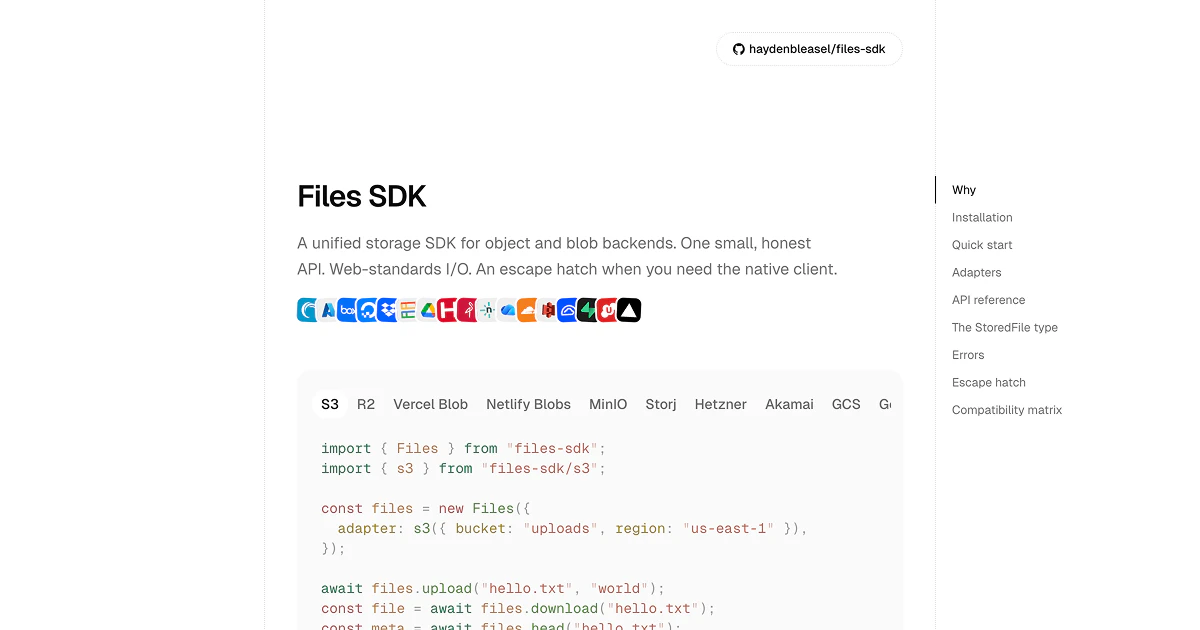
Files SDK is an open-source library designed to provide a single, consistent API across different cloud storage backends. Rather than writing conditional code for S3 versus GCS versus Azure Blob, developers import the library once and switch providers by changing a configuration string—or maintain multiple backends simultaneously.
The SDK emphasizes two technical principles: web-standards I/O and honesty about its scope. It doesn’t try to abstract every possible feature each cloud provider offers; instead, it covers common storage operations reliably and provides direct access to native clients when edge cases require it.
Key Features
- Unified API: Single interface for S3, GCS, Azure Blob, Cloudflare R2, and other object storage backends
- Web-standards I/O: Built on familiar patterns rather than proprietary abstractions
- Native client escape hatch: Access underlying provider SDKs when the unified API is insufficient
- Open-source: Available on GitHub for transparency, community contribution, and self-hosting
- Small footprint: Designed to be lightweight, not a full-featured framework
- Multi-cloud support: Switch between or combine providers without rewriting application code
Use Cases for Developer Teams and Small Businesses
Multi-cloud strategies: Teams running workloads across AWS and GCP can use the SDK to avoid duplicating storage logic. If cost or performance shifts, migrating to a different provider becomes a configuration change, not a refactor.
Reducing vendor lock-in risk: Small businesses relying on a single cloud provider can adopt the library early, building portability into their storage layer from the start. This mitigates migration costs if a provider’s pricing or terms become unfavorable.
Testing and CI/CD: Development environments often use local MinIO or local filesystem storage, while production uses cloud. The SDK’s support for multiple backends makes it easier to maintain parity between environments without conditional imports throughout the codebase.
Edge and hybrid deployments: Applications serving both on-premises and cloud users can configure it to read/write to local or cloud storage based on deployment context.
Pricing
The library is open-source and free to use. No licensing fees, no tiered plans. The primary cost is integration effort and operational maintenance. Commercial support or managed hosting options are not advertised at launch.
How It Compares
- SMCloudStore: Also a lightweight, multi-cloud object storage module for Node.js, supporting AWS, Azure, GCP, Backblaze B2, and MinIO with a modular NPM-package approach. It appears more language-agnostic with a stronger emphasis on web-standards I/O.
- Apache Libcloud: A well-established, low-level abstraction library supporting 50+ cloud providers since 2009. Broader in scope and heavier than this library—better suited to polyglot operations teams than focused development teams.
- Go Cloud: A cloud portability library from Google, with unified APIs for storage and databases across AWS S3, Azure Blob, Google Cloud Storage, and local filesystem. More opinionated; its emphasis on scope honesty and the native escape hatch suggests a different design philosophy.
- S3Proxy: A proxy adapter that exposes the S3 API while communicating with Azure Blob and other backends. S3Proxy proxies one provider’s interface; this library abstracts the API itself.

Pros and Cons
Pros:
- Open-source, reducing barriers to adoption
- Deliberate, bounded scope avoids abstraction leaks common in heavyweight frameworks
- Web-standards I/O reduces the learning curve for existing developers
- Native client access prevents the abstraction from becoming a bottleneck in advanced scenarios
- Solves a real pain point—storage fragmentation—without framework overhead
- Early traction signals genuine developer interest
Cons:
- Early-stage; ecosystem maturity and long-term maintenance are unproven
- Provider support breadth unclear versus Apache Libcloud’s 50+
- No commercial support option for risk-averse enterprises
- Documentation and adoption will depend on community growth
- Smaller projects may not justify adopting another abstraction layer
Verdict for Developers and Small Teams
Files SDK addresses a legitimate developer pain point with a refreshingly honest design philosophy. For teams already committed to multi-cloud strategies or building new systems that might span providers, it’s worth evaluating—especially given the open-source nature and lightweight API surface.
The real test will be adoption velocity and community contribution. For small business developers prototyping cloud infrastructure or sensitive to vendor lock-in, this is worth a look. For enterprises requiring mature tooling and commercial support, Apache Libcloud remains the prudent choice.
Check out Files SDK on Product Hunt or visit the official project website to learn more.