



General Compute — AI models that run on an inference cloud optimized for speed
307 upvotes · #3 Product of the Day — View on Product Hunt
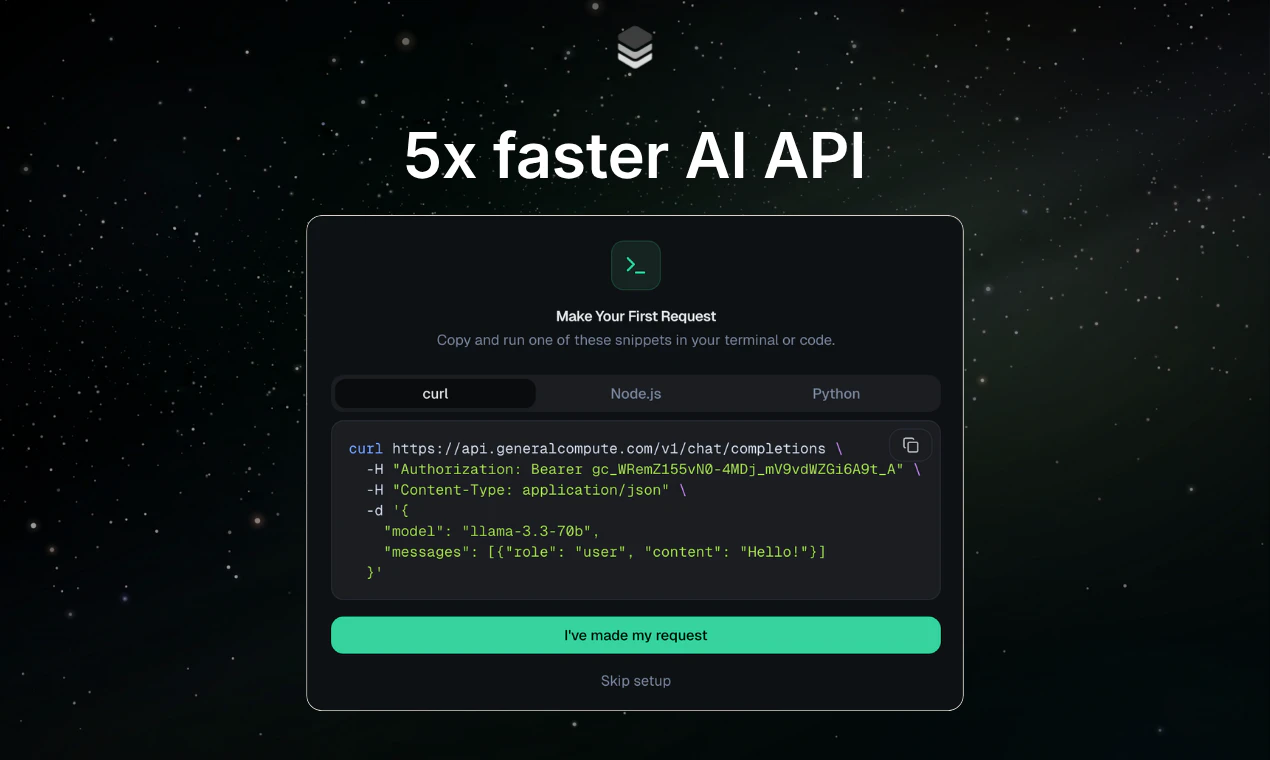
General Compute represents a fundamental shift in how organizations approach AI inference workloads. Rather than adapting real-time AI applications to GPU infrastructure designed primarily for training, General Compute offers purpose-built hardware optimized specifically for inference at scale. The general compute AI inference platform delivers approximately 5x faster response times and significantly higher per-user throughput for latency-sensitive applications such as coding assistants and voice agents. With an OpenAI-compatible API, developers can transition from traditional inference clouds by simply changing their base URL, preserving existing integrations and workflows.
Topics: API, Software Engineering
General Compute: The GPU-Inference Mismatch
Modern AI inference has outgrown the hardware that dominated the previous era. Nvidia’s GPU architecture was engineered to handle the parallel computational demands of training deep learning models, emphasizing throughput over latency. That design philosophy persists even as GPUs serve inference workloads—a mismatch that translates into unnecessary complexity and cost for real-time applications.
General Compute addresses this architectural disconnect by running inference on ASICs—application-specific integrated circuits built from the ground up for inference tasks. This hardware-software alignment eliminates the inefficiencies inherent to training-optimized silicon running inference jobs. The result is infrastructure better suited to the actual demands of production AI systems.
How ASICs Differ From GPUs
| Characteristic | GPU Infrastructure | ASIC Inference (General Compute) |
|---|---|---|
| Primary Design Purpose | Parallel processing for training | Optimized inference execution |
| Latency Profile | Higher latency, high throughput | Low latency, balanced throughput |
| Memory Bandwidth | Underutilized for inference | Optimized for inference access patterns |
| Power Efficiency | High power draw for inference | Lower power per inference operation |
| Flexibility | Handles varied workloads | Specialized, optimized for inference |
ASICs trade away the generality of GPUs in exchange for precision in a specific domain. By eliminating unnecessary computation pathways and tailoring memory access patterns for inference, ASIC-based platforms can deliver dramatic performance improvements on latency-sensitive tasks without the overhead that plagues GPU-based alternatives.
Key Features and Capabilities
- 5x Faster Response Times: Inference latency critical for real-time applications is substantially reduced compared to GPU-based inference clouds.
- Higher Per-User Throughput: The platform serves more concurrent users per dollar of infrastructure investment.
- OpenAI-Compatible API: A base URL swap enables the transition — no SDK changes, no code refactoring required.
- Purpose-Built Infrastructure: Running on hardware designed for inference eliminates architectural compromises.
- Real-Time AI Workload Support: Optimized for applications that cannot tolerate training-era latencies.
Use Cases: Where ASIC Inference Shines
Coding Assistants and Development Tools
Developers expect near-instantaneous autocomplete, code generation, and debugging suggestions. Traditional GPU inference introduces perceptible latency that breaks the flow of development work. General Compute’s ASIC infrastructure delivers the sub-100ms response times that coding tools require to feel responsive and integrated. This is especially relevant for teams deploying AI chatbots for business where response speed directly impacts user satisfaction.
Voice Agents and Conversational AI
Voice-based AI systems have strict latency budgets. Users notice delays greater than 200–300ms, which creates a degraded experience. General Compute’s speed advantage enables voice agents to feel natural and interactive, a requirement for customer service applications, accessibility tools, and conversational interfaces.
Real-Time APIs and Microservices
Organizations building APIs that integrate AI into broader applications need inference infrastructure that matches the latency profiles of their other services. the platform fits seamlessly into microservice architectures where predictable, low-latency inference is a hard requirement. Teams building marketing automation workflows with real-time personalization benefit from this reliability.

Competitive Landscape
Several platforms pursue similar inference optimization strategies. Groq uses its proprietary LPU architecture to deliver fast token generation. Together AI and Fireworks AI offer GPU-based optimizations with OpenAI-compatible APIs. Modal provides serverless compute with fast cold starts across cloud infrastructure.
the service differentiates through the combination of ASIC performance, OpenAI API compatibility, and a focus on latency-critical workloads. The 5x speed claim positions it competitively against GPU-based services, though organizations should evaluate against their specific latency and throughput requirements.
Strengths and Limitations
Strengths:
- Substantial speed advantages over GPU-based inference platforms for latency-sensitive workloads
- OpenAI API compatibility minimizes developer friction and enables rapid adoption
- ASIC infrastructure purpose-built for inference eliminates architectural compromises
- Per-user throughput efficiency reduces operational costs for high-scale deployments
- Usage-based pricing aligns costs with actual demand
Limitations:
- Specialized focus on inference means less flexibility than general-purpose GPU platforms for mixed workloads
- Market newness means fewer long-term operational case studies compared to established providers
- ASIC specialization implies less ability to adapt hardware across emerging model architectures without redesign
- Competitive pressure from both established players and other ASIC-focused startups may influence pricing
Verdict
this cloud represents a practical step forward in inference infrastructure. By running on ASICs optimized for the inference task rather than forcing that workload onto training-centric hardware, the platform addresses a real architectural mismatch. The OpenAI API compatibility removes vendor lock-in concerns and adoption friction.
For teams building latency-sensitive AI applications—particularly voice agents, coding assistants, and real-time APIs—the inference cloud merits serious consideration. Organizations operating Automated Sales Machine workflows or other mission-critical AI applications will find the speed advantage meaningful when real-time responsiveness determines user experience quality.
Check out the tool on Product Hunt or visit the official the service website to learn more.