
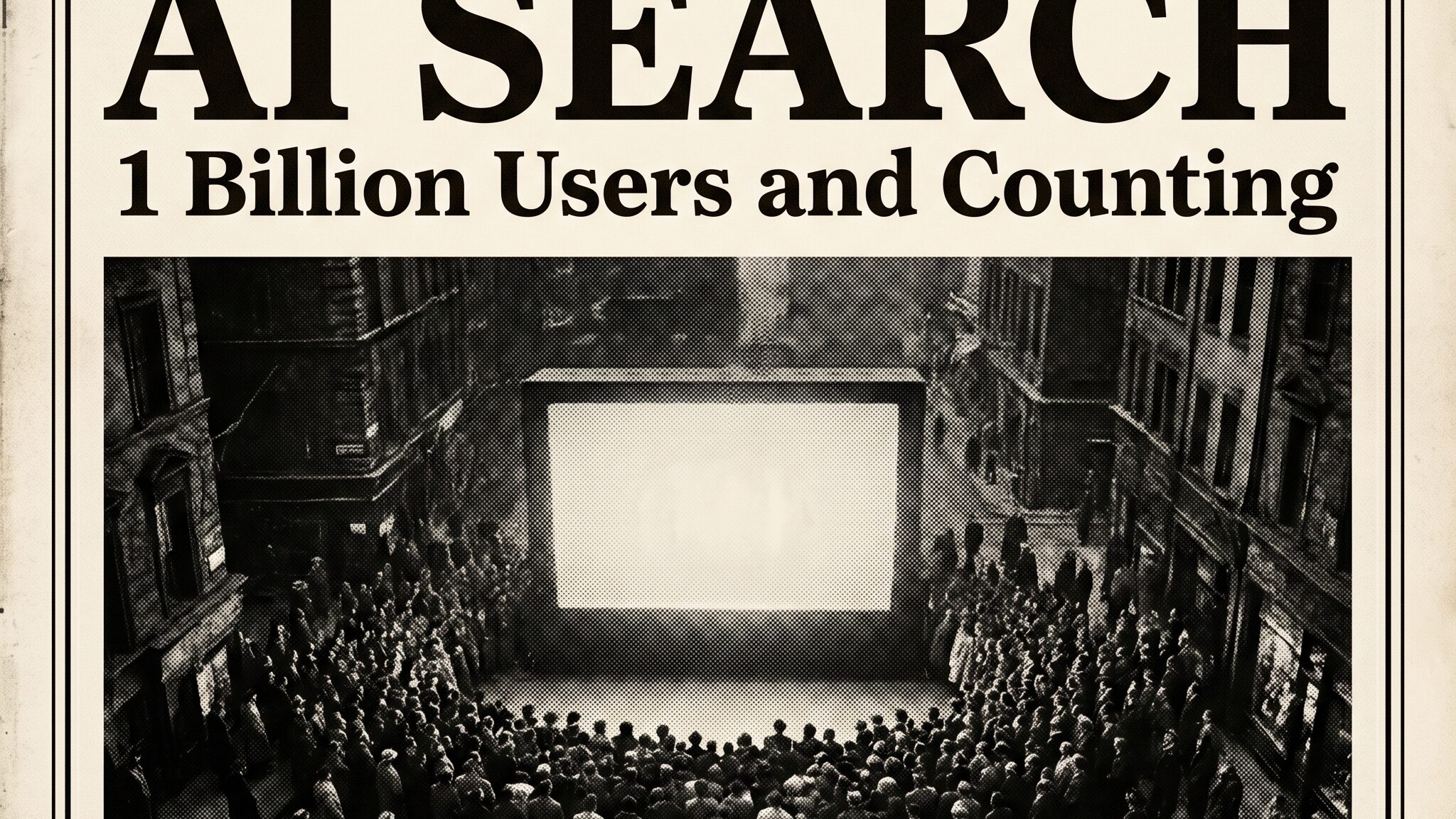

Google AI Mode has surpassed 1 billion monthly users, the company announced at Google I/O on May 20, 2026 — a milestone that marks the most significant overhaul of the search interface in more than 25 years. Powered by Gemini 3.5 Flash, Google AI Mode replaces the traditional list of blue links with a conversational, synthesized answer experience. For the tens of millions of small businesses that depend on organic Google search for customer discovery, the implications are immediate and structural.
The new interface is not a feature layered on top of classic search — it is a replacement interface. Users pose conversational queries and receive synthesized answers drawn from multiple sources, with agentic capabilities including a Universal Cart for in-search shopping and booking tools that can complete transactions without the user ever visiting a merchant website. Google has also announced it will begin sharing more granular data on how brands appear within AI-generated results — giving businesses their first formal visibility into what was previously a black box. Source: Google I/O 2026 coverage via Social Media Today.
What Google AI Mode Means for Small Businesses on Google Search
The core challenge for small businesses is straightforward: The platform surfaces fewer traditional links and more synthesized prose. If your business is not among the sources an AI system chooses to cite, you effectively become invisible — even if you rank on page one of classic search results. Early data from HubSpot reinforces the picture: ChatGPT generated its lowest level of business referral traffic in 12 months during April 2026, indicating that AI-mediated search is fragmenting across platforms simultaneously.
The shift has given rise to a new discipline called answer engine optimization, or AEO. Where traditional SEO focused on ranking signals — backlinks, page authority, keyword density — AEO focuses on structured credibility: organizing content so that AI systems can confidently extract and cite it in response to conversational queries. Businesses that have invested heavily in thin or keyword-stuffed content are particularly exposed. Those with deep, authoritative, clearly structured content on narrow topics are better positioned to be cited rather than bypassed.
The measurement infrastructure is also maturing rapidly. HubSpot has launched an AEO Sensor dashboard that tracks citations and referrals across AI answer engines. Microsoft Clarity has moved its Citations dashboard into general availability, giving publishers visibility into how AI systems retrieve their content before users ever visit their site. The data to understand AI-driven visibility now exists — the question is whether small businesses act on it before competitors do.
The traffic pattern shift also reshapes the economics of inbound marketing. If fewer users click through because the AI interface answers their question directly, the businesses that do receive visits are reaching a higher-intent audience. Capturing and converting that audience efficiently becomes more important than ever, placing a premium on marketing automation infrastructure that can respond to inbound signals quickly and consistently.
5 Critical Moves Small Businesses Should Make Now
- Audit your content for AI citability. Review your highest-traffic pages and ask whether an AI system could extract a confident, specific answer from each one. Pages that are vague, promotional, or poorly structured are unlikely to be cited by this search engine. Prioritize depth and specificity over volume.
- Structure content around conversational queries. This interface is optimized for how people speak, not how they type. Reframe headings and sections as direct answers to the questions your customers actually ask. FAQ sections, how-to guides, and definitional content perform well in AEO environments.
- Claim and optimize your Google Business Profile. For local small businesses, the Business Profile remains a primary data source for AI-generated local answers. Ensure your hours, services, photos, and reviews are current. Respond to reviews — AI systems weight engagement signals.
- Install AI citation tracking tools. Use HubSpot AEO Sensor or Microsoft Clarity Citations to establish a baseline for how often your content is cited across AI platforms. Without measurement, optimization is guesswork. Monitor referral traffic from Gemini, ChatGPT, and Perplexity separately from traditional search.
- Invest in conversion infrastructure for high-intent visitors. As the platform reduces total click volume but concentrates intent among those who do visit, your landing pages and funnels must convert efficiently. Pair that with a CRM that captures every inbound lead and triggers immediate follow-up — because the visitors you do receive are too valuable to lose to slow or manual processes.
The This milestone is a present-tense operational reality for any small business with a website. The companies that treat AEO as a parallel discipline to traditional SEO — and take Google AI Mode seriously as a distinct visibility channel, rather than a future concern, are the ones that will maintain visibility as the search landscape continues to evolve.
Frequently Asked Questions
Does this new interface replace traditional Google Search entirely?
Not immediately. The platform is now the default for over 1 billion monthly users — and small businesses should plan, but Google continues to offer access to traditional link-based results. The balance is shifting decisively toward AI-synthesized answers, and small businesses should plan for a future where this AI interface is the primary discovery channel.
How is answer engine optimization different from traditional SEO?
Traditional SEO focuses on ranking signals: backlinks, domain authority, keyword optimization. AEO focuses on content structure and credibility so that AI systems can extract and cite specific answers from your content in response to conversational queries. Both matter now, but AEO requires content built around depth and direct answers rather than keyword density alone.
Will small businesses lose traffic because of this platform?
Many will see a decline in total click volume as the AI interface answers more queries directly. However, visitors who do click through are typically higher-intent. The net revenue impact depends on how well a business converts that qualified traffic — making conversion infrastructure and lead management more important than raw traffic volume.