
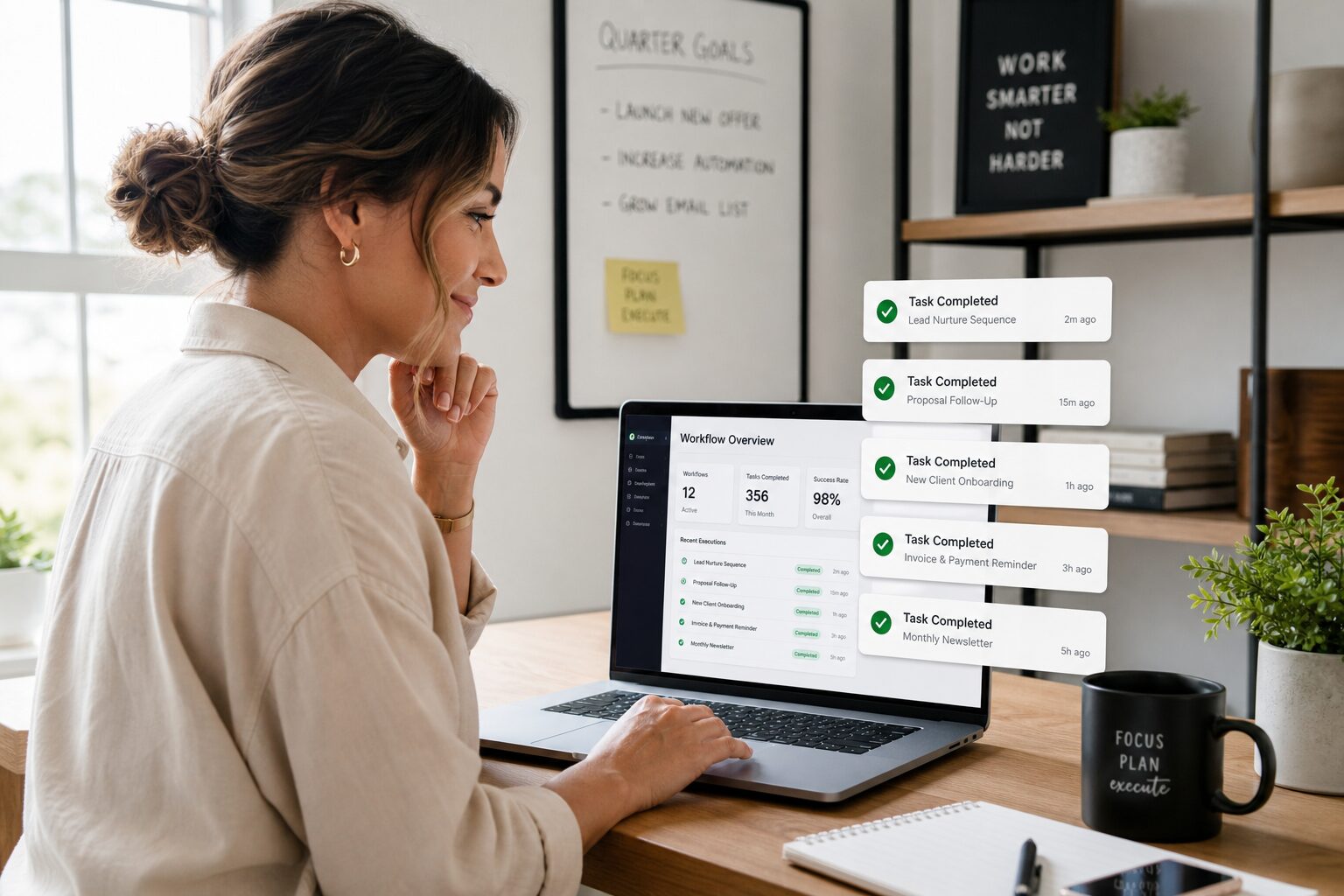

TL;DR: Workflow automation benefits every small business by systematically eliminating the repetitive manual tasks that drain time, inflate costs, and create preventable errors. According to the Enterprise Automation Index 2025, 36.6% of organizations report at least a 25% cost reduction after adopting automation — and 48.6% report efficiency gains of 25% or more. Ready to put these workflow automation benefits to work? Watch the Automated Sales Machine demo and see the full automation stack in action.
If you run a service business, you already know the feeling. Your team is good. They work hard. And yet a meaningful chunk of their day disappears into tasks that have nothing to do with delivering great work — manually following up on leads, copying data between systems, sending appointment reminders, chasing invoice approvals, updating spreadsheets that should have been automated years ago.
Workflow automation benefits businesses by solving exactly that problem: replacing manual, repetitive sequences with software-driven processes that trigger automatically, execute consistently, and run without anyone babysitting them. The time savings are real. The cost reductions are documented. The competitive advantage for businesses that automate early compounds every quarter.
This guide breaks down the workflow automation benefits that matter most for small and medium service businesses — with real data, vertical-specific examples, and a clear framework for evaluating the right platform. No theory. Just the mechanics and the math.
What Is Workflow Automation? (And Why It’s No Longer Optional)
Workflow automation uses software to execute business processes — or sequences of steps — based on predefined triggers and rules, with minimal or no human intervention. IBM describes workflow automation as “using technology to perform business processes with minimal or no human intervention” — reducing errors, eliminating time-consuming repetitive tasks, and enabling organizations to scale operations reliably.
In practical terms: a new lead fills out your contact form. Without automation, someone on your team sees the notification (eventually), logs the lead into the CRM (manually), sends a follow-up email (when they get around to it), and schedules the follow-up call (if they remember). Four steps. Four opportunities for delay, error, or total failure to follow through.
With workflow automation, the same sequence completes in seconds. Lead captured → CRM record created → welcome email sent → follow-up task assigned to the right agent. Every time. Including at 2 AM on a Saturday, when no one’s in the office.
Common workflows businesses automate include lead capture and routing, appointment scheduling and reminders, client onboarding sequences, invoice generation and payment follow-up, review request triggers, and internal approval chains. Each of these — running manually — creates overhead, inconsistency, and human error. Automated, they run in the background while your team focuses on the work that actually requires human judgment.
According to Kissflow’s 2026 automation research, 94% of companies are currently performing repetitive, time-consuming tasks that could be automated. The businesses that are already automating have a measurable operational advantage — and that gap is widening with every quarter that passes.

The Core Workflow Automation Benefits — What the Data Shows
Skip the theoretical ROI for a moment. Here’s what businesses that have already implemented workflow automation are actually reporting.
Fewer Errors, More Consistency
Human error is expensive. A missed follow-up loses a lead worth $2,000 in revenue. A data entry mistake in the CRM corrupts a client record that takes hours to clean up. A forgotten approval stalls a project that a client expected delivered on time. Manual processes are inherently fragile because they depend on individual attention — and individual attention is finite, fatigable, and distracted.
Workflow automation benefits operations most immediately by removing the human element from tasks where consistency matters more than creativity or judgment. The same sequence executes correctly on the 500th repetition as it did on the first. No fatigue. No distraction. No “I thought someone else was handling that email.”
Paycor notes that workflow automation “reduces errors, streamlines processes, and allows HR and operations teams to spend more time on strategic initiatives rather than manual data entry and repetitive administrative tasks.” That trade — precision-critical tasks to software, strategic work to humans — is the fundamental value proposition of automation. And for service businesses where client experience depends on consistent communication, it’s not optional.
Significant Time Reclaimed Every Week
Time is the resource small businesses can’t buy more of. Automation gives you the closest thing to it.
McKinsey estimates that 60% of employees could save 30% of their time with workflow automation, per Formstack’s analysis of automation statistics. That’s not 5% or 10% — it’s a full third of every workday. For a 40-hour work week, that’s 12 hours back per person, per week.
Scale that across a team of five: 60 hours per week reclaimed. 3,120 hours per year. Redirected from manual follow-up and data entry toward client delivery, sales conversations, and business development. The same Formstack analysis finds the average company saves $46,000 annually through workflow automation. That’s not aspirational ROI — it’s the documented average from businesses that have already made the investment.
Short version: the time your team currently spends on manual administrative work is not a fixed cost of doing business. It’s an inefficiency with a documented solution.
Operational Cost Reduction at Scale
The financial case for workflow automation benefits is hard to argue against. The Enterprise Automation Index 2025 — based on a survey of 285 automation practitioners across industries and published via PR Newswire — found that 73.2% of businesses increased automation investments in the past year. Among those companies:
- 36.6% report at least a 25% reduction in operational costs
- 48.6% report efficiency gains of 25% or more
These are not edge cases from technology companies with unlimited engineering resources. These are median outcomes for businesses across industries that committed to automation at any meaningful scale. The returns materializing at the 25th percentile are already substantial.
Scale Without Linear Headcount Growth
This is the benefit most SMB owners underestimate before they experience it firsthand: your capacity to serve clients stops being directly proportional to the size of your team.
Manual processes scale linearly. Every new client adds roughly the same administrative overhead per person. Automated processes don’t. The infrastructure that handles your onboarding sequence, your appointment reminders, your follow-up cadences handles them for 50 clients just as efficiently as it handles them for 5. The marginal cost of the 50th client’s onboarding sequence is functionally zero.
That’s leverage. For service businesses operating with lean teams, it’s the path to meaningful margin expansion — growing revenue without growing labor costs at the same rate.
Better Customer Experience, Every Time
Automated workflows don’t just benefit your internal operations. They deliver a more consistent, more responsive experience to your clients — which directly affects retention, reviews, and referrals.
When every client receives their appointment confirmation within seconds of booking, every new inquiry gets a response in under a minute regardless of time of day, and every follow-up happens exactly when it should — clients notice. Not because you told them you’re organized. Because they experienced it directly.
The retention gains are often the ones businesses are most surprised by. Consistent communication is one of the most cited drivers of client loyalty in service businesses. Automation makes it systematic instead of relying on individual team members having a good week.
Workflow Automation Benefits by the Numbers
Numbers cut through the hype. Here’s what the research actually shows:
- 73.2% of businesses increased automation investments in the past year
- 48.6% report efficiency gains of 25% or more from automation
- 74% of employees using automation say it helps them work faster — per Salesforce data via Vena Solutions
- 90% of knowledge workers say automation has improved their jobs
- $46,000 — the average annual savings per company from workflow automation
- 60% of employees could save 30% of their time with automation (McKinsey estimate)
- 94% of companies currently perform repetitive tasks that could be automated
The pattern is consistent across every data source: workflow automation benefits are not marginal, and they’re not slowing down. They’re compounding. And the businesses that haven’t yet made the investment are falling further behind with every quarter that passes.
Workflow Automation Benefits by Business Type
The workflow automation benefits look different depending on your vertical. Here’s how automation plays out in the industries Automated Sales Machine serves most.
Real Estate Agencies
Leads arrive from Zillow, Facebook ads, your website contact form, and referral emails — often simultaneously, always at unpredictable hours. Without automation, manual qualification and follow-up means slower response times and leads going cold before anyone gets to them.
Workflow automation benefits real estate operations by ensuring every lead receives an immediate response regardless of when they arrive. A new inquiry triggers an instant SMS and email, routes to the right agent based on geography or specialty, and enters a nurture sequence automatically if there’s no response within a defined window. The lead that fills out your form at 11 PM on Sunday gets followed up with before your office opens Monday morning.
The Automated Sales Machine all-in-one marketing platform consolidates lead capture, CRM, SMS, email, and follow-up sequencing so your agents focus on showings and negotiations — not spreadsheets and missed call logs.
Med Spas and Wellness Centers
Appointment management, cancellation handling, pre-service prep instructions, post-service review requests, lapsed client re-engagement — none of these require human judgment. They require consistency and precise timing. Automation delivers both.
Appointment confirmation goes out automatically when a booking is made. A reminder fires 24 hours before the service. A review request triggers 2 hours after the appointment is marked complete. A client who hasn’t returned in 45 days gets a personalized win-back offer. The front desk doesn’t chase any of it — and nothing falls through the cracks between staff shifts or busy seasons.
Fitness Studios
Member retention is the lifeblood of a fitness studio. It’s also entirely manageable with automation. A first-time class attendee triggers a welcome sequence and a limited-time membership offer. A member who hasn’t checked in for 10 days gets a personalized re-engagement message. A membership approaching renewal receives a reminder and an upgrade incentive at exactly the right moment.
None of this requires a staff member’s attention. It runs in the background while your coaches lead classes, train clients, and build the relationships that actually drive retention.
Marketing Agencies
Agencies running campaigns across multiple clients need clean, consistent operational infrastructure. Client onboarding checklists, deliverable approval triggers, reporting schedules, billing reminders — all of it benefits from automation. Inconsistency here erodes client trust fast.
The benefit agencies most consistently report is better client retention. When communication is systematic and on schedule, clients feel cared for. They don’t churn because they feel ignored or because a follow-up slipped through. And when a new prospect calls after hours, the missed-call text-back feature sends an immediate automated response — keeping the lead engaged until the morning.

How Workflow Automation Benefits Compound Over Time
Here’s what the statistics don’t fully capture: these benefits don’t stay constant. They compound.
The first automation you build — say, a lead follow-up sequence — saves a few hours a week and captures leads that previously slipped through the cracks. The second automation — appointment reminders — reduces no-show rates by 30–40%. The third — review request triggers — improves your online reputation score, which increases inbound traffic from search. The fourth — re-engagement campaigns — recaptures lapsed clients who would otherwise remain gone.
Each automation gain feeds the next. More leads captured leads to more appointments booked. Better show rates lead to more completed services. More reviews generate more organic discovery. More returning clients reduce customer acquisition costs. The compounding effect is why 74% of employees using automation report that it helps them work faster, according to Salesforce — and why 90% of knowledge workers say automation has improved their day-to-day experience.
Businesses already three or four automations deep have a structural operational advantage that’s difficult to close quickly. They’re not just more efficient — they’re operating on a fundamentally different model.
Why Fragmented Tools Undermine Workflow Automation Benefits
Most workflow automation failures don’t happen because automation doesn’t work. They happen because the automation is built across disconnected tools that don’t share data reliably — and the cracks between systems swallow the gains.
One platform handles email. Another manages SMS. A third runs your CRM. A fourth books appointments. When a lead’s status doesn’t update automatically across all four, automated sequences fire out of sequence, trigger on stale data, or miss the window entirely. The workflow automation benefits you expected evaporate in the integration gaps between tools.
Microsoft’s analysis of business process automation makes the point clearly: “Business process automation eliminates manual, repetitive tasks so your team can focus on higher-value work, reduce human error, and scale operations without proportionally increasing headcount.” The operative outcome — eliminate, not just reduce — requires integration. Siloed tools deliver partial results at best.
The most reliable path to those gains is a single connected platform where every touchpoint — lead capture, CRM updates, email campaigns, SMS sequences, appointment booking, and reporting — runs through one data layer. No middleware. No integration maintenance. No ambiguity about which system has the latest contact record.
The full Automated Sales Machine feature set spans CRM, workflow automation, AI appointment bots, voice AI, missed-call text-back, reputation management, email and SMS marketing, unified inbox, and funnel builder — all in one platform built specifically for small and medium service businesses that need the benefits without the enterprise complexity.
Choosing the Right Workflow Automation Platform
Not every automation platform is built for service businesses. Enterprise tools like HubSpot and Salesforce deliver powerful automation — and a price tag and implementation timeline to match. Standalone tools like Zapier add connective tissue between apps you’re already using, but require separate subscriptions for every underlying tool they’re connecting, and each integration point is a potential failure.
Here’s what to evaluate if you’re a small or medium business assessing workflow automation benefits from a new platform:
All-in-One Architecture vs. Point Solutions
Each additional tool in your stack is another monthly subscription, another login to manage, and another integration that can break when either platform pushes an update. All-in-one platforms eliminate the middleware. One login. One data layer. One unified subscription that replaces five to ten fragmented tools.
No-Code Workflow Builders
You shouldn’t need a developer to build a follow-up sequence or a re-engagement campaign. Look for visual, drag-and-drop workflow builders that let your team create and modify automations without writing a single line of code. The faster you can build and iterate, the faster the workflow automation benefits materialize.
AI-Powered Capabilities
The next tier of automation involves AI: appointment booking bots that handle scheduling conversations in natural language, voice AI for inbound call handling during off-hours, and AI-generated responses to common inquiries. These extend automation into interactions that previously required a human — compounding the efficiency gains of traditional rule-based workflows.
Native CRM Integration
Workflow automation without CRM context delivers task automation, not business transformation. Real workflow automation benefits come when your sequences are triggered by contact behavior — deal stage reached, lead score threshold crossed, last interaction date exceeded — all stored and updated in your CRM in real time. Without CRM integration, you’re automating in the dark.
Multi-Channel Coverage
Your clients communicate across email, SMS, social DMs, and voice. Your automation platform needs to operate across all of them from a single interface. A platform that only automates email delivers a fraction of the workflow automation benefits available to businesses that automate every channel their clients use to reach them.
The Bottom Line on Workflow Automation Benefits
The data is consistent, the compounding is real, and the window for getting ahead is still open — but it’s closing.
73.2% of businesses increased their automation investment last year. 36.6% are already reporting 25%+ cost reductions. The businesses still running primarily manual processes are falling further behind every quarter — not because they’re making bad decisions, but because the operational gap between automated and non-automated businesses keeps widening as the automated ones get more efficient, not less.
Workflow automation benefits every type of service business. Real estate agencies capture more leads with faster response times. Med spas reduce no-shows and improve review scores. Fitness studios improve retention through timely re-engagement. Marketing agencies deliver more consistently and retain clients longer. All of it compounds. All of it happens in the background while your team focuses on the work only humans can do.
Automated Sales Machine puts every tool you need in one connected platform — no patchwork integrations, no disconnected data, no complexity overhead. The CRM, the workflows, the AI bots, the reputation management, the SMS and email marketing — all running from a single dashboard built for service businesses exactly like yours.
Watch the demo to see how Automated Sales Machine works for businesses in your vertical. Or start your free trial and have your first automated workflow running today.