

TL;DR: A competitive analysis example gives small business owners a concrete, repeatable framework for understanding what their top competitors are doing—and where those competitors are failing. By mapping competitor strengths, weaknesses, pricing, and positioning into a structured comparison, any business can identify gaps in the market and build a strategy to win them. Automated Sales Machine gives growing businesses the CRM and automation tools to act on competitive intelligence and convert those insights into booked appointments and closed deals.
Ready to turn competitive intelligence into revenue? See how Automated Sales Machine automates your competitive follow-up → Book a Free Demo.
Most small business owners know they have competitors. Fewer actually study them. That gap—between knowing the competition exists and systematically understanding what they’re doing—is where deals are lost and customers walk out the door to someone who seems to have a better answer.
A well-structured competitive analysis example doesn’t require a marketing agency or a six-figure budget. It requires a clear framework, the right data, and the discipline to act on what you find. This guide walks you through five real-world competitive analysis examples—broken down step by step—so you can build your own and start using competitive intelligence as a genuine growth lever.
The businesses that win consistently aren’t just better at sales. They’re better at knowing exactly what their competitors are and aren’t offering—and they’ve built systems to exploit that knowledge every single day.
What Is a Competitive Analysis? (And Why Examples Matter)
A competitive analysis is a structured evaluation of your competitors’ products, services, pricing, positioning, strengths, and weaknesses relative to your own business. The goal isn’t to copy what competitors do—it’s to find the gaps where you can win.
According to the U.S. Small Business Administration, conducting a thorough competitive analysis is one of the most essential steps in business planning. It helps you understand where your product or service fits in the market landscape and how to position it for maximum impact.
But here’s the thing about competitive analysis in practice: reading a definition isn’t the same as seeing the process in action. That’s why working through a real competitive analysis example—with actual structure, real categories, and logical outputs—matters far more than knowing the theoretical definition.
The Four Core Components of Any Competitive Analysis
Regardless of which competitive analysis example you use as a model, every strong analysis covers four foundational areas:
- Competitor Identification — Who are your true competitors (direct and indirect)?
- Offering Comparison — What exactly are they selling, at what price, and to whom?
- Strengths and Weaknesses — Where do they excel? Where do customers complain?
- Positioning and Messaging — How do they talk about themselves? What promises do they make?
These four pillars show up in every legitimate competitive analysis example—from SWOT matrices to Porter’s Five Forces frameworks to customer review mining. The format changes. The fundamentals don’t.

5 Competitive Analysis Examples That Actually Work
Here are five battle-tested competitive analysis example frameworks that small businesses actually use—not theoretical constructs, but working models you can adapt to your own market within a single afternoon.
Example 1 — The Feature Comparison Matrix
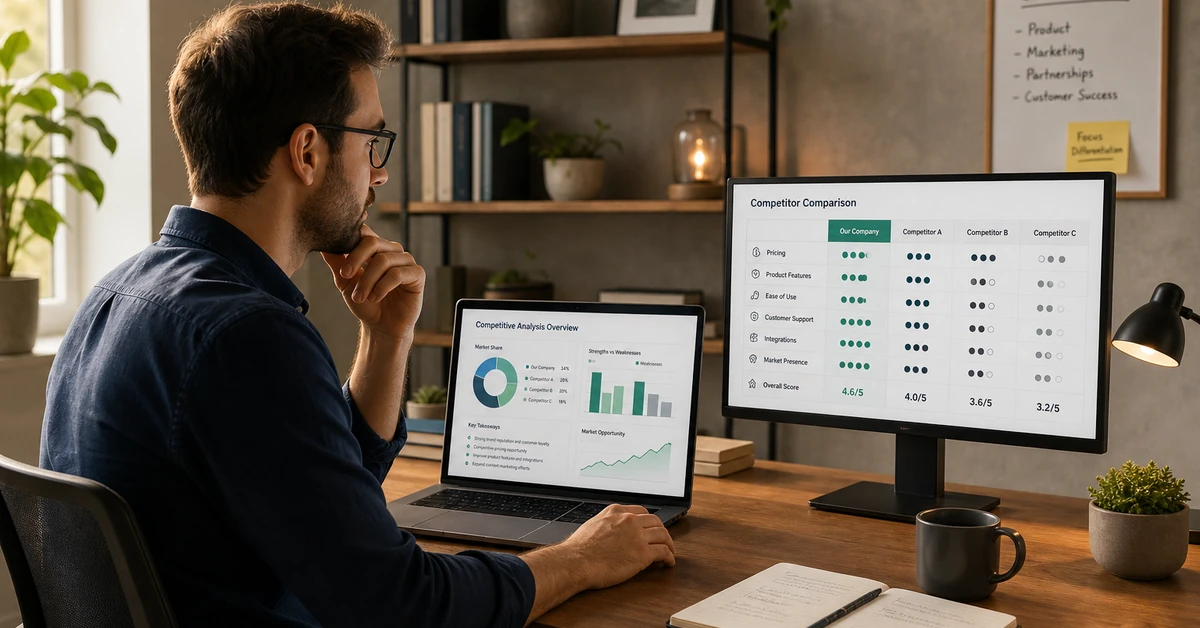
The feature comparison matrix is the most direct competitive analysis example: a spreadsheet where rows represent features or capabilities, and columns represent your competitors (plus your own business). Each cell gets a rating—present, absent, or partial.
This format works best for product or service businesses with clear, enumerable offerings. A dental office comparing appointment booking options, a CRM platform comparing automation features, a home services company comparing service guarantees—all benefit from this structure.
How to run it: List your 8–12 most important features or service elements in rows. Pull the top 4–5 competitors. Research each feature via their website, sales materials, and customer reviews. Fill the matrix honestly, including your own gaps.
What you do with it: Any feature where you score higher than all four competitors is a marketing claim. Any feature where you score lower than two or more is a vulnerability to address. Any feature that no one on the list offers is a potential differentiator.
Example 2 — Porter’s Five Forces in Action
Porter’s Five Forces is the academic gold standard of competitive analysis examples. Developed by Harvard Business School professor Michael Porter, it evaluates competitive pressure from five directions: industry rivalry, threat of new entrants, threat of substitutes, bargaining power of buyers, and bargaining power of suppliers.
For a small business, this framework is most useful at the industry or market level—not as a deep dive into individual competitors. It answers the strategic question: “How structurally attractive is this market, and where is my power?”
According to Harvard Business Review, Porter’s Five Forces remains one of the most widely used strategic frameworks for understanding competitive dynamics across industries. A small business applying this framework to their market quickly sees whether they’re playing in a commoditized race to the bottom or a structurally advantaged niche.
Example 3 — SWOT Analysis vs. Competitor Profile
The SWOT analysis is the most familiar competitive analysis example—strengths, weaknesses, opportunities, threats—but it becomes dramatically more powerful when run simultaneously against a specific competitor rather than in isolation.
The approach: run your own SWOT, then run your #1 competitor’s SWOT using publicly available data (their website, reviews, social channels, job postings, press releases). Layer them side by side. Where your strengths align with their weaknesses, you have a clear competitive advantage to exploit in positioning. Where their strengths align with your weaknesses, you have a tactical vulnerability to address or deflect.
This paired SWOT is one of the most actionable competitive analysis examples because it immediately produces messaging guidance. The language you use to describe your competitive differentiators should come directly from this analysis.
Example 4 — Price Positioning Map
A price positioning map is a visual competitive analysis example that plots competitors on a two-axis grid: price on one axis, and a key value dimension on the other (quality, speed, service, specialization, etc.).
This format exposes white space—areas of the market where no competitor is currently positioned. A home services company might discover that the local market has several high-price generalists and several low-price specialists, but nothing in the mid-price specialist quadrant. That gap is a market positioning opportunity.
To build one: research current pricing across your top 6–8 competitors (use their websites, request quotes, or check review platforms). Plot each competitor as a dot on your two-axis grid. Draw a circle around your own position. Look for clusters (oversupply) and empty zones (opportunity).
Example 5 — Customer Review Mining for Competitive Intelligence
The most underused competitive analysis example on this list: systematic mining of competitor customer reviews on Google, Yelp, Capterra, G2, or industry-specific platforms. Reviews are unfiltered competitive intelligence that competitors can’t spin or suppress.
Specifically look for three signal types in competitor reviews: (1) What customers love most — these are the competitor’s strongest perceived value props, which you need to either match or counter. (2) What customers complain about most — these are the competitor’s operational weaknesses, which represent your clearest conversion opportunities. (3) What customers wish existed — unmet needs are product and positioning opportunities waiting to be seized.
According to Gartner, customer voice data is among the most reliable indicators of competitor positioning gaps, consistently outperforming internal assumptions about competitive differentiation in market research. Mining reviews systematically gives any small business a real-time competitive intelligence feed that costs nothing but a few focused hours.

How to Build Your Competitive Analysis Framework
Having a competitive analysis example to reference is only the first step. The real leverage comes from building a systematic framework your business runs on an ongoing basis—not a one-time snapshot you create and then ignore for two years.
Step 1 — Identify Your Real Competitors
Most small businesses underestimate or misidentify their competition. There are three types of competitors every competitive analysis framework should include:
- Direct competitors — businesses selling the same product or service to the same audience (your obvious rivals)
- Indirect competitors — businesses solving the same customer problem with a different product or service
- Replacement competitors — the status quo your customer might choose instead (doing nothing, doing it themselves, using a generic solution)
For most small businesses, the most dangerous competitors aren’t the direct ones—they’re the indirect ones that offer a simpler, cheaper, or more convenient alternative. A competitive analysis example that only includes direct competitors misses half the picture.
Practical approach: Search Google for your top 3–5 keywords. Who ranks in the top results? Who runs ads? Ask your most recent won and lost customers who else they considered. Check review platforms for businesses in your category. That’s your initial competitive list.
Step 2 — Define the Metrics That Matter
Once you have your competitor list, define what you’re going to measure before you start collecting data. The metrics depend on your industry and strategic priorities, but a standard competitive analysis framework typically tracks:
- Pricing structure (flat, tiered, project-based, subscription)
- Core service or product features
- Target customer segment
- Online reputation (review volume, average rating, common themes)
- Marketing channels and messaging angles
- Geographic coverage or reach
- Speed of delivery or response time
According to McKinsey & Company, businesses that establish clear competitive measurement criteria before beginning their analysis are significantly more likely to translate competitive insights into actionable strategy—rather than accumulating data with no clear next step.
Step 3 — Build the Competitive Matrix
A competitive matrix is the output document of your competitive analysis example—the structured comparison that makes data actionable. It can be as simple as a Google Sheet or as sophisticated as purpose-built competitive intelligence software.
What matters isn’t the format. What matters is that the matrix is updated on a cadence (quarterly minimum), shared with relevant team members, and directly connected to decisions about positioning, pricing, and marketing messaging.
A competitive analysis example matrix that never gets updated is worse than useless—it creates false confidence based on stale data. Build the updating rhythm into your operations from day one.
Competitive Analysis Tools for Small Business
The right tools make running a competitive analysis example faster, more systematic, and more complete. Here’s a practical stack for small businesses at different investment levels:
Free tools that work:
- Google Search — Your competitors’ websites, ads, and content reveal their strategy
- Google Alerts — Set alerts for competitor brand names to track their PR and announcements
- Review platforms (Google, Yelp, Capterra, G2) — Unfiltered competitive intelligence from real customers
- LinkedIn — Job postings reveal what capabilities competitors are building
- SimilarWeb (free tier) — Rough competitor traffic and channel breakdown
Paid tools worth the investment:
- SEMrush or Ahrefs — Keyword gap analysis, content audit, and organic traffic comparisons
- Crayon or Klue — Dedicated competitive intelligence platforms for tracking competitor changes in real time
- SpyFu — Competitive PPC and keyword research for paid advertising intelligence
For most small businesses running their first structured competitive analysis example, the free tools are more than sufficient. The bottleneck isn’t access to data—it’s the discipline to act on what you find. Start with free tools, build the habit, then invest in automation as your competitive intelligence practice matures.
And here’s the critical piece most competitive analysis guides miss: data collection is only step one. Once you have insights from your competitive analysis, you need a system to act on them—booking demos, following up with leads who’ve compared you to competitors, and automating the follow-up sequences that convert those comparisons into decisions. That’s where a CRM and automation platform like Automated Sales Machine becomes essential—it’s the operational layer that turns competitive intelligence into booked appointments.
Turning Competitive Intelligence Into Revenue
The competitive analysis example you build is only valuable if it changes what you do and how you sell. Competitive intelligence that sits in a spreadsheet doesn’t win deals. Competitive intelligence that gets embedded into your sales messaging, your CRM, and your marketing does.
Map Competitor Gaps to Your Positioning
Every competitive analysis example produces a list of competitor weaknesses and market gaps. The job now is to map each gap to a specific positioning claim, sales message, or content angle.
For example: if your review mining reveals that your top competitor’s customers consistently complain about slow response times, your positioning should feature speed-of-response prominently—in your Google profile, your website copy, your sales scripts, and your follow-up emails. The competitive analysis example gave you the insight. The positioning work operationalizes it.
Feed Insights Into Your Sales and Marketing CRM
The highest-leverage application of any competitive analysis example is using it to build competitor-specific sales sequences and follow-up workflows. When a prospect mentions they’re also looking at a competitor, your sales team should have a specific script ready—and your CRM should automatically trigger a nurture sequence that speaks directly to that competitor’s known weaknesses.
This is the difference between reactive selling and strategic selling. Reactive selling competes on price and personality. Strategic selling competes on positioning—using the intelligence from your competitive analysis example to make your offer the obvious choice for customers who understand the landscape.
Automated Sales Machine’s CRM lets small businesses build these competitor-aware workflows without a full-time marketing team. Tag contacts by competitor, trigger custom email sequences, and automate the follow-up that most small businesses miss entirely. The result: more conversions from every lead who’s actively comparing you to a competitor.
Start Winning More Customers With Smarter Competitive Intelligence
Every competitive analysis example in this guide comes down to the same core principle: knowing your market landscape—who’s in it, what they’re offering, where they’re failing, and where you can win—is a fundamental operational advantage. Businesses that run competitive analysis systematically don’t just know their market better. They sell into it more effectively.
The businesses losing market share aren’t losing because they have an inferior product. They’re losing because they’re competing blind—reacting to competitors rather than anticipating them. A structured competitive analysis framework fixes that, one comparison at a time.
Automated Sales Machine was built for exactly this kind of small business: one with a clear product or service, a competitive market, and the ambition to convert more leads than the competition. The platform automates follow-up, manages your CRM pipeline, and gives your team the tools to respond faster, follow up longer, and close more deals.
See how Automated Sales Machine helps small businesses turn competitive intelligence into booked appointments—book your free demo today and see it in action.