
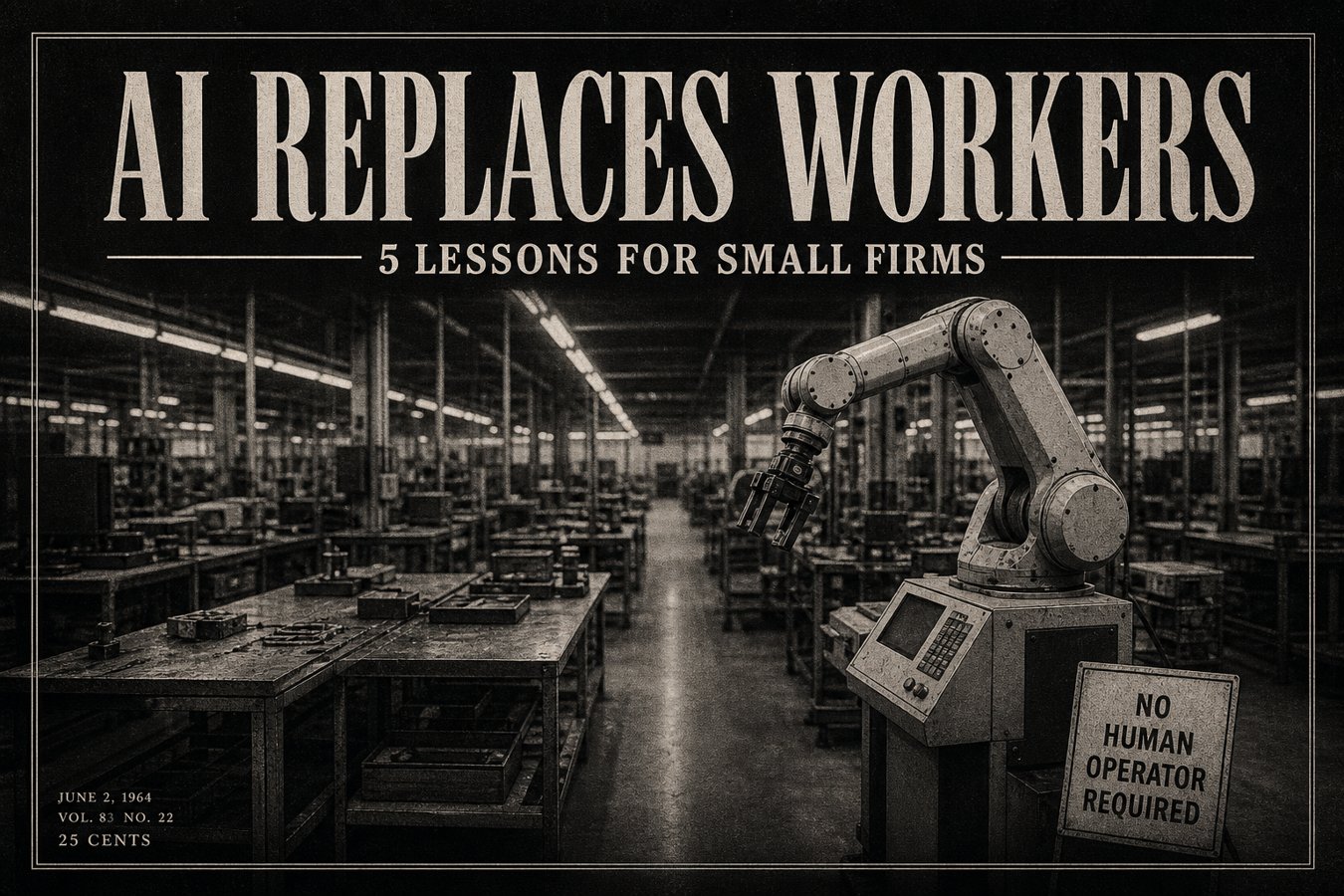

AI replacing workers is no longer a future-facing debate. A TIME report published May 14, 2026 documents that small businesses are actively swapping headcount for AI agents, and the numbers are starting to move in ways that small business owners cannot ignore. The story features Hospitable, a short-term rental management platform with 140 employees, that has increased AI spending by 50% since December 2025, an amount equivalent to three full-time salaries. Without those tools, the company estimates it would need to triple its 65-person support team.
Hospitable is not an outlier in ambition, but it is ahead of the curve in execution. AI agents at the company now generate 90% of the company’s code, answer 70% of customer support queries, help finance decide which transfers to make, and run marketing campaigns. The aggregate effect is that a 140-person operation now does the work of a much larger company, and the savings go to the bottom line rather than to new hires.
How Common Is This Really
The headlines suggest a stampede. The data suggests a slower, more selective shift. A U.S. Census Bureau report cited in the TIME piece found that less than a fifth of firms are using AI in any business function. A March 2026 study from Anthropic concluded that its AI models were being used for only a fraction of the work tasks they are already capable of handling.
The gap between the visible examples and the average firm matters. Hospitable is a software-first business with a technical team able to deploy AI agents at scale. Most small businesses, even those eager to adopt AI, lack the engineering depth to replicate that pattern. For now, AI replacing workers is happening fastest in companies that were already running on modern software stacks and already employed engineers who could glue the tools together.
The Small Business and Entrepreneurship Council’s 2026 Tech Use Survey found that 82% of small employers have invested in AI tools, but adoption depth varies widely. Most owners report saving hours per week, not eliminating roles. The typical pattern is augmentation, not replacement. The Hospitable case is the visible edge of a curve that will shift over the next two to three years.
Why Some Owners Are Moving Faster
The math behind the Hospitable decision is the same math every small business owner is running, whether they admit it or not. A single AI agent subscription costs a fraction of an entry-level salary, runs around the clock, and never asks for a raise. The question is whether the agent can actually do the work to a standard that holds up under customer scrutiny.
The owners moving fastest share three characteristics. They run software-first operations where most work already happens inside digital tools. They have one or two people on the team who can wire AI agents into existing systems. And they have a clear, repeatable workflow that AI can handle without constant human correction, such as a tier-one support queue, a structured invoicing process, or routine marketing copy.
Owners without those characteristics are seeing slower returns. A 2026 study from nonprofit Model Evaluation and Threat Research, also cited in the TIME piece, found that AI actually made software developers’ tasks take 20% longer in some cases. The takeaway is that AI does not automatically produce productivity. It produces productivity when paired with a well-designed workflow and a team that knows how to use it.
The Microsoft Prediction Adding Pressure
Microsoft AI chief Mustafa Suleyman recently predicted human-level performance on most professional tasks within 18 months. Most tasks involving sitting at a computer will be fully automated by AI within the next year or 18 months, he told Fortune. He named accounting, legal, marketing, and project management as vulnerable.
That prediction is on the aggressive end of expert opinion, and it has been challenged by researchers who point to the slow real-world adoption numbers. But it has changed the conversation inside small business circles. Owners who six months ago were curious about AI are now actively asking which roles in their company will be redefined and how fast.
Key Takeaways for Small Business Owners
- Augmentation comes first, replacement comes later. The Hospitable case is dramatic, but most owners will see a year of AI augmenting roles before any role is replaced outright. Plan for that sequence rather than skipping to the end.
- Identify the repeatable workflows first. AI is reliable where the inputs and outputs are structured and the rules are clear. Tier-one support, invoice chasing, scheduling, and routine content drafting are the safe starting points. Judgment-heavy work is harder to delegate.
- Measure outcomes before changing headcount. Hospitable did not lay off support staff. It avoided tripling the team. The financial impact came from headcount that was never hired, not from layoffs. That is a less disruptive path and a better story to tell employees.
- Invest in one person who can wire the tools. The owners moving fastest have someone on the team who can build prompts, set up integrations, and debug failures. That role is becoming as important as a bookkeeper or office manager.
- Treat the 18-month prediction as a planning horizon, not a deadline. Suleyman’s timeline may turn out to be too aggressive, but the direction of travel is clear. Owners who build AI fluency now will have time to redesign roles thoughtfully. Owners who wait may face a more rushed transition.
Background
The current wave of AI adoption began in late 2022 with the release of ChatGPT, accelerated through 2024 and 2025 with the rise of agentic AI tools, and reached a tipping point in late 2025 when major labs released agent frameworks that could complete multi-step tasks autonomously. By early 2026, small business AI spending had become a measurable category, with 93% of small businesses using AI planning to continue investing.
Hospitable, founded in 2016, manages short-term rental properties for hosts on Airbnb and Vrbo. The company has been a vocal example of AI-first operations and has shared its adoption journey publicly. Its growth profile, software-first business and technical team, is closer to a SaaS startup than a typical Main Street small business, which is why its results sit at the leading edge rather than the median.
The broader labor question, whether AI will eliminate net jobs or simply shift their composition, remains unsettled among economists. Historical patterns from previous waves of automation suggest a longer transition than the most aggressive forecasts predict. But for individual small businesses, the practical question is not the economy-wide effect. It is whether each owner can build a more productive operation with the same or smaller team.
What Owners Should Do Next
Three steps make sense this quarter. First, map the workflows in the business and rank them by hours consumed per week. Second, pick the most repetitive workflow at the top of the list and pilot an AI assistant against it for thirty days. Third, measure the hours saved and decide whether the next hire can be delayed or restructured around the assistant.
The Hospitable story is unsettling for some workers, but it also points to a path that most small businesses can take without a single layoff: stop adding headcount, redirect that budget to AI tools, and let the existing team do more meaningful work. That path leads to a more productive small business in 2026 and a more defensible business model in 2027 and beyond.