

Running automated marketing campaigns for small business is the single fastest way to stop leaving revenue on the table. The data confirms it: companies using marketing automation generate 80% more leads and see conversion rates climb by 77%. Yet the gap between knowing and executing remains wide. According to industry research, only 27% of companies rate their marketing automation maturity as advanced — meaning nearly three out of four businesses are bleeding pipeline revenue through manual, inconsistent outreach.
This guide is the playbook for closing that gap. If you run a service business, agency, or local operation and you are tired of chasing leads by hand, automated campaign workflows are the fastest path to predictable pipeline growth. Below, you will find the exact campaign types to deploy, the step-by-step framework to build them, and the metrics that prove they are working.
Why Manual Marketing Is Costing Your Small Business Real Revenue
Before building a single automation workflow, you need to understand what manual marketing actually costs. Not in abstract terms — in dollars, hours, and lost deals.
The Time Tax of One-by-One Outreach
A typical small business owner or marketing manager spends 15 to 20 hours per week on repetitive marketing tasks: writing individual follow-up emails, posting social updates, manually segmenting lists, and tracking who opened what. That is half a full-time salary burned on work a properly configured platform handles in milliseconds.
Consider the math. If your time is worth $75 per hour and you spend 18 hours weekly on manual campaign tasks, you are spending $70,200 per year on labor that a properly configured automation platform can reduce to near zero. That is not a theoretical number — it is the operational reality for thousands of SMBs running fragmented tech stacks with no automation layer.
The Inconsistency Problem
Manual marketing is inherently inconsistent. When you are busy servicing clients, follow-up emails slip. When a team member is on vacation, the social calendar goes dark. When leads come in from a trade show, they sit in a spreadsheet for three weeks before anyone contacts them.
This inconsistency kills revenue in two ways. First, speed-to-lead research from Harvard Business Review shows that responding to a lead within five minutes makes you 100 times more likely to connect. Second, inconsistent communication erodes brand trust. Your prospects are comparing you to competitors who send polished, timed, personalized sequences on autopilot. If you are sending sporadic one-off blasts, you have already lost the perception war.
The Compounding Cost of Lost Opportunities
Every lead that goes unfollowed is not just one lost sale — it is the lifetime value of that customer, plus every referral they would have generated. For a service business averaging $3,000 per client annually with a 3-year retention span, one missed lead equals $9,000 in lost revenue. Miss ten leads per month due to manual follow-up delays, and you are hemorrhaging $90,000 annually. Marketing automation exists precisely to eliminate this bleed.
5 Essential Automated Marketing Campaigns Every Small Business Needs
Not all automation is created equal. The following five campaign types represent the highest-ROI automations for small businesses across service industries, agencies, and local operations. Deploy these first — they form the backbone of every effective automated marketing strategy.
1. Welcome and Onboarding Sequences
The welcome sequence is your most powerful automated campaign. Industry benchmarks from HubSpot show that welcome emails deliver an average open rate of 68.6% — roughly four times higher than standard promotional emails. This is the moment of highest intent and engagement. Waste it with a generic “thanks for subscribing” message, and you have squandered your best shot at conversion.
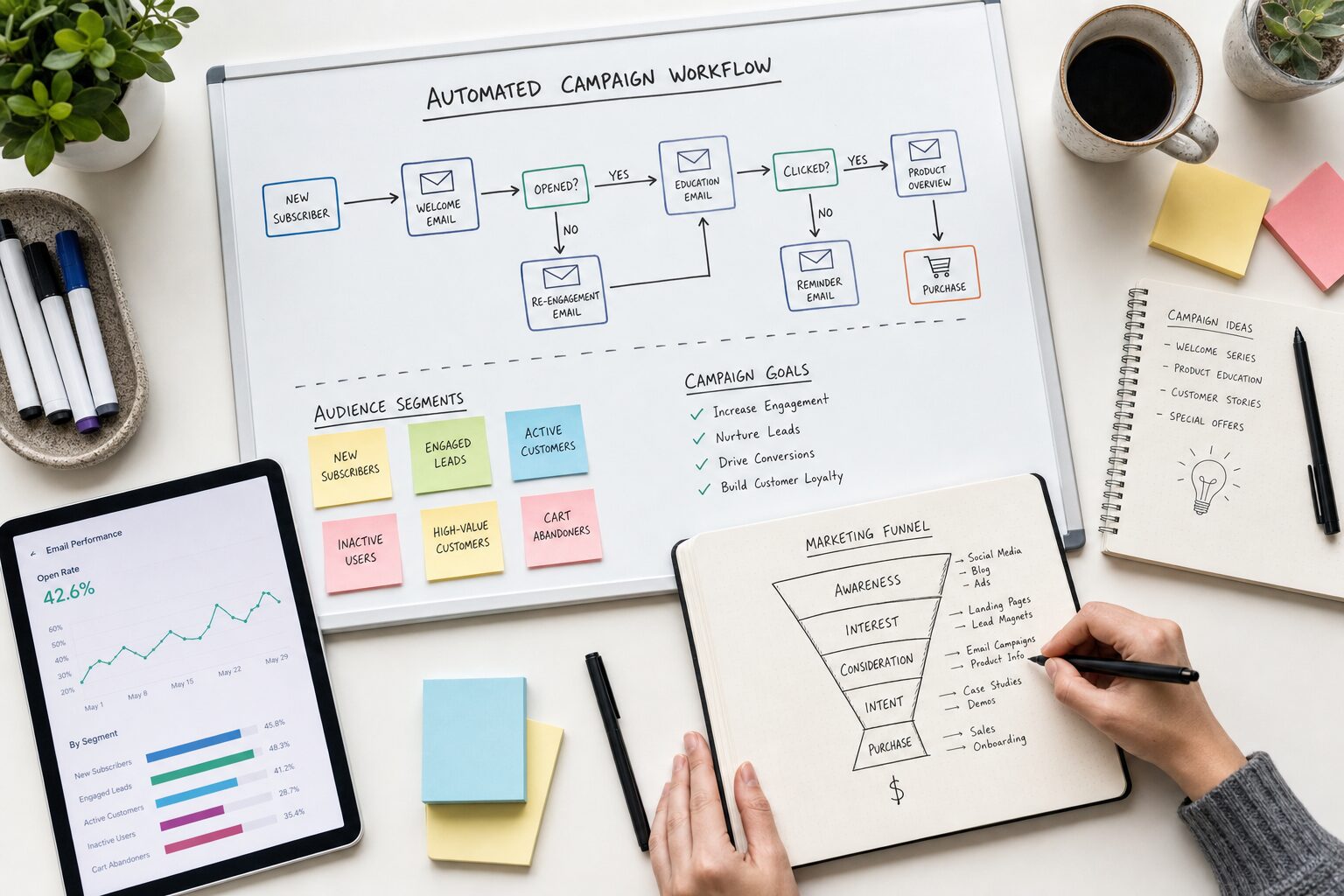
A high-performing welcome sequence for small business includes:
- Email 1 (Immediate): Deliver the promised lead magnet or confirmation, introduce your brand’s core value proposition, and set expectations for future communication frequency.
- Email 2 (Day 2): Share your highest-performing piece of content or a case study that demonstrates measurable results. Build credibility through proof, not promises.
- Email 3 (Day 4): Address the #1 objection your prospects raise during sales conversations. Remove friction before they even speak to your team.
- Email 4 (Day 7): Soft CTA — offer a free consultation, demo, or audit. Frame it as diagnostic, not salesy.
2. Lead Nurture Drip Campaigns
Not every lead is ready to buy today. In fact, research consistently shows that 50% of qualified leads are not yet ready to purchase at the time of initial contact. The businesses that win are the ones who stay visible and valuable during the consideration phase without requiring manual effort.
Automated lead nurture campaigns deliver value-driven content over weeks or months, segmented by interest, behavior, or source. A med spa might nurture Botox inquiries differently than body contouring leads. A home services company segments by project type — HVAC maintenance contacts receive different content than full-system replacement prospects.
The critical rule: every nurture email must deliver standalone value. If a prospect reads the email and learns nothing actionable, it is a wasted touch that erodes trust. Build your automated marketing campaigns for small business around education-first principles, and the conversions follow naturally.
3. Abandoned Cart and Abandoned Form Follow-Ups
E-commerce businesses know abandoned cart emails convert at up to 10.7%. But this principle applies far beyond retail. Any small business with an online booking form, quote request page, or consultation scheduler loses prospects at the point of commitment. Those partial conversions represent the highest-intent leads in your funnel — they started the process and stopped.
Configure automated follow-up sequences triggered by:
- Incomplete form submissions
- Pricing page visits without booking
- Started-but-not-completed appointment scheduling
- Downloaded a guide but did not request a consultation
A well-timed SMS or email within 30 minutes of abandonment can recover 15-25% of these lost opportunities — all without a single manual action from your team.
4. Review and Referral Request Campaigns
Your best marketing asset is the voice of your existing customers. Automated review request campaigns, triggered 24-48 hours after service delivery, dramatically increase the volume and velocity of Google reviews. For local service businesses, this is a direct revenue driver — businesses with 4.5+ star ratings and 50+ reviews dominate local search results and Google Maps.
The automation sequence is straightforward:
- Trigger: Service marked as complete in your CRM
- Step 1 (24 hours post-service): SMS or email asking for a quick rating (1-5 stars)
- Step 2 (If 4-5 stars): Redirect to Google review page with pre-filled link
- Step 3 (If 1-3 stars): Route to internal feedback form — address issues before they become public reviews
- Step 4 (7 days post-review): Referral request with incentive (discount, gift card, service credit)
5. Re-Engagement and Win-Back Campaigns
Every business has a segment of past customers who have gone cold and a list of leads who stopped engaging. Re-engagement campaigns target these dormant contacts with automated sequences designed to reignite interest. The cost of re-activating an existing contact is a fraction of acquiring a new lead, making win-back automations one of the highest-ROI plays in your stack.
Effective win-back triggers include:
- No email opens in 60+ days
- No purchases or bookings in 90+ days
- Lapsed membership or subscription
- Anniversary of first purchase or sign-up date
The key to re-engagement is specificity. Generic “we miss you” messages perform poorly. Instead, reference their last interaction, highlight what has changed since they left, and offer a concrete reason to return — a new service offering, a limited-time promotion, or a personalized recommendation based on their history.
Building Your Automation Stack: A Step-by-Step Framework
Understanding which automated marketing campaigns for small business to deploy is the first half. The second half is building the infrastructure to execute them reliably. This framework takes you from zero to a fully operational automation engine in four phases.
Step 1 — Map Your Customer Journey End-to-End
Before configuring a single workflow, document every touchpoint a prospect experiences from first awareness through purchase and beyond. Most small businesses discover 8-12 distinct touchpoints — and at least half are currently unautomated.
Create a simple grid:
- Stage: Awareness → Consideration → Decision → Onboarding → Retention → Advocacy
- Touchpoints: What actions or events define each stage?
- Current method: Manual or automated?
- Automation priority: High (revenue impact) / Medium / Low
This exercise typically reveals that the highest-impact touchpoints — lead response, post-purchase follow-up, and review requests — are the ones being handled manually. Those become your first three automation builds.
Step 2 — Consolidate Your Platform
The single biggest barrier to effective marketing automation is a fragmented tech stack. When your email tool does not talk to your CRM, your CRM does not sync with your booking system, and your SMS platform operates independently of everything else, automation becomes impossible at scale.
Small businesses running five to ten disconnected tools spend an average of $2,500 to $12,000 annually on subscriptions — and still lack the integration layer required for true automation. Consolidating into an all-in-one CRM and marketing automation platform eliminates data silos, reduces subscription costs, and makes every campaign type described in this guide deployable from a single dashboard.
When evaluating platforms, prioritize these capabilities:
- Built-in email, SMS, and social media automation
- Visual workflow builder with conditional branching
- CRM with pipeline management and contact scoring
- Landing page and funnel builder
- Review management and reputation monitoring
- Reporting dashboard with campaign-level ROI attribution

Step 3 — Build Your First Three Campaigns
Do not attempt to automate everything simultaneously. Launch with the three campaigns that deliver the fastest measurable impact:
- Welcome sequence — immediate ROI from higher engagement on new leads
- Lead follow-up automation — eliminates the speed-to-lead gap that kills conversions
- Review request campaign — builds social proof that compounds over time
For each campaign, define the trigger event, the message sequence (content + timing), the exit conditions, and the success metric. Build, test with a small segment, measure results for two weeks, then optimize and scale.
Step 4 — Set Triggers, Conditions, and Segmentation Rules
The power of automated marketing campaigns for small business lies in intelligent triggering — sending the right message to the right person at the right moment. Static, one-size-fits-all blasts are not automation; they are scheduled spam.
Configure behavioral triggers that respond to prospect actions in real time:
- Page visit triggers: Prospect views pricing page → trigger sales follow-up sequence
- Engagement triggers: Contact opens 3+ emails in a week → tag as “hot lead” and notify sales
- Inactivity triggers: No engagement in 45 days → enter re-engagement campaign
- Purchase triggers: First purchase completed → enter onboarding and cross-sell sequence
Layer segmentation rules on top of triggers. A fitness studio segments by membership type (drop-in, monthly, annual), class preference, and visit frequency. A dental practice segments by treatment history, insurance type, and time since last appointment. The more granular your segments, the more relevant your automated campaigns become — and relevance drives revenue.
Measuring ROI: The Metrics That Actually Matter
Deploying automated marketing campaigns without measuring their impact is flying blind. But tracking vanity metrics — total emails sent, social impressions, list size — gives you a false sense of progress. Focus on the metrics that connect directly to revenue.
Campaign-Level Conversion Rate
The single most important metric for any automated campaign is the conversion rate at each stage of the sequence. What percentage of welcome email recipients book a consultation by email four? What percentage of abandoned form follow-ups result in a completed submission? What percentage of review requests generate a published review?
Benchmark your campaigns against these automated email performance standards:
- Welcome sequences: 20-30% click-through rate on first email; 8-15% conversion to booked call by end of sequence
- Lead nurture drips: 2-5% monthly conversion rate from nurture to qualified opportunity
- Abandoned form follow-ups: 15-25% recovery rate within 48 hours
- Review requests: 10-20% response rate; 60-80% positive rating among responders
- Win-back campaigns: 5-12% re-engagement rate on dormant contacts
Customer Acquisition Cost vs. Lifetime Value
Automated marketing campaigns for small business should measurably reduce your customer acquisition cost (CAC) over time. Track CAC monthly and compare it against the pre-automation baseline. Businesses implementing comprehensive automation typically see a 25-30% reduction in CAC within the first six months, driven by higher conversion rates on existing traffic and lower labor costs for lead follow-up.
Simultaneously, track customer lifetime value (LTV). Effective onboarding and retention automations increase LTV by extending the average customer relationship duration and increasing cross-sell and upsell conversion. The target ratio is an LTV-to-CAC of 3:1 or higher. If your automated campaigns push this ratio above 4:1, you have built a growth engine that can absorb aggressive scaling.
Revenue Attribution by Campaign Type
Your platform should allow you to attribute closed deals back to the specific automation that influenced the conversion. This is not optional — without campaign-level revenue attribution, you cannot optimize. You will keep running underperforming campaigns and underinvesting in your highest-ROI sequences.
Set up UTM parameters on every link within your automated sequences. Tag every contact with the campaign that generated or influenced their conversion. Run monthly attribution reports that answer one question: which automated campaigns directly contributed to closed revenue, and how much?
Avoiding the 5 Automation Pitfalls That Kill Small Business Growth
Automation is a force multiplier — but it multiplies bad strategy just as effectively as good strategy. These five pitfalls derail more small business automation programs than any technical limitation.
1. Over-Automating the Human Touch
Not every interaction should be automated. High-stakes moments — a prospect ready to commit, a customer with a complex service issue, a VIP client anniversary — demand genuine human connection. The businesses that get automation right use it to handle the 80% of routine communications so their team can invest deeply in the 20% that require a personal touch.
Build “human handoff” triggers into your workflows. When a lead hits a specific engagement score or requests a direct conversation, the automation pauses and routes the contact to a team member with full context — every email they opened, every page they visited, every form they submitted.
2. Set-It-and-Forget-It Syndrome
The phrase “set it and forget it” is the most dangerous misconception in marketing automation. Automated campaigns require ongoing optimization. Open rates decline as subject lines grow stale. Market conditions shift. Competitor messaging evolves. A campaign built six months ago and never touched is a campaign that is actively underperforming.
Schedule a monthly automation audit. Review performance metrics for every active campaign. A/B test subject lines, send times, and CTAs. Update content that references dates, statistics, or offers that have expired. Prune workflows that are no longer aligned with your current business priorities.
3. Ignoring Segmentation
Sending the same automated sequence to your entire list is the fastest way to destroy engagement and trigger spam complaints. According to McKinsey research, 71% of consumers expect personalized interactions, and 76% get frustrated when personalization does not happen.
At minimum, segment by:
- Lead source: Referrals behave differently than paid search leads
- Service interest: Different offerings require different nurture content
- Engagement level: Highly engaged contacts need different treatment than cold prospects
- Customer status: Prospects, active customers, and past customers warrant distinct sequences
4. Neglecting Mobile Optimization
Over 60% of email opens occur on mobile devices. If your automated emails are not designed for mobile-first consumption — short paragraphs, large tap targets, single-column layouts, and fast-loading images — you are losing the majority of your audience before they read a single word. Test every automated campaign on a mobile device before activating it.
5. Skipping the Data Foundation
Only 16% of RevOps professionals trust their data accuracy, and bad data is the single biggest blocker to automation maturity. Automated marketing campaigns for small business depend on clean, accurate, and complete contact records. If your CRM is filled with duplicate entries, outdated emails, and missing fields, your automations will misfire — sending wrong messages to wrong people at wrong times.
Before launching any campaign, invest in a data cleanup sprint. Deduplicate contacts, validate email addresses, fill in missing segmentation fields, and establish data entry standards that prevent future degradation. This upfront investment pays dividends across every automated campaign you build.
Turn Automation Into Your Competitive Advantage
The data is unambiguous. Businesses that deploy automated marketing campaigns generate 80% more leads, see 77% higher conversion rates, and report an average ROI of $5.44 for every dollar invested. For small businesses competing against larger, better-funded competitors, automation is not a luxury — it is the equalizer that lets a five-person team operate with the marketing reach of a fifty-person department.
The five campaigns outlined in this guide — welcome sequences, lead nurture drips, abandoned form follow-ups, review request automations, and win-back campaigns — represent the minimum viable automation stack. Deploy them in order, measure relentlessly, and optimize monthly. Within 90 days, you will have a self-sustaining marketing engine that generates leads, nurtures prospects, converts customers, and builds social proof without requiring daily manual effort from your team.
The gap between businesses that automate and those that do not is widening fast. Sixty-three percent of companies that outperform their competitors already use marketing automation. The question is not whether to start — it is whether you can afford to wait any longer.
Ready to build your automated marketing campaigns? Book a free demo to see how an all-in-one platform can replace your fragmented tech stack and deploy every campaign in this guide from a single dashboard. Or get started today and launch your first automation in under 30 minutes.