


Client acquisition strategies are the deliberate, repeatable systems that small businesses use to identify, attract, and convert strangers into paying clients — replacing random word-of-mouth with a scalable, predictable revenue engine. The most effective approach combines a defined Ideal Client Profile (ICP), a multi-channel outreach system, and automated follow-up sequences that work 24/7. Ready to build a client acquisition system that fills your pipeline automatically? Book a free demo with Automated Sales Machine and see how small businesses are adding 20–40 new clients per month on autopilot.
What Are Client Acquisition Strategies?
Client acquisition strategies are the structured, repeatable processes a business uses to attract, engage, and convert prospects into paying clients. Unlike passive referral models that depend on luck, deliberate client acquisition strategies create a predictable flow of new business — one you can measure, optimize, and scale.
The critical distinction between businesses that struggle and businesses that thrive is the presence of documented client acquisition strategies. According to Forrester Research, companies with a formalized sales and marketing acquisition process are 33% more likely to close deals at their target conversion rate and generate significantly more qualified pipeline than those operating on informal referrals alone.
For small businesses — service firms, agencies, local operators, and B2B companies — client acquisition is the single highest-leverage activity. Every system you put in place compounds: a better ICP produces better leads, which shortens sales cycles, which increases close rates, which lowers your cost per client.
The result of effective client acquisition isn’t just revenue — it’s control. You stop waiting for the phone to ring and start engineering demand.
The 4-Phase Client Acquisition Framework
Winning client acquisition strategies share a common structural backbone regardless of industry or service type. This 4-phase framework gives you a mental model for diagnosing exactly where your current process is breaking down.
Phase 1: Define Your Ideal Client Profile (ICP)
Every effective client acquisition strategy starts with precision, not reach. Before you spend a dollar on advertising or an hour on outreach, you need a sharply defined Ideal Client Profile — the specific type of business or individual most likely to buy, stay, and refer.
Your ICP should answer: What industry vertical? What company size (employee count, revenue range)? What geography? What pain points are they actively trying to solve right now? What does their buying process look like?
The tighter your ICP, the higher your conversion rates. Broad targeting produces broad results. When your messaging speaks directly to a dental practice owner’s staffing costs or a real estate team’s lead follow-up problem, you stop sounding like every other vendor and start sounding like the answer to a specific problem.
Document your ICP in a one-page profile that your entire team can reference. Include firmographic data, behavioral signals, and the specific trigger events that prompt your best clients to seek your solution.
Phase 2: Build High-Converting Acquisition Channels
Once you know who you’re targeting, the question becomes: where do they spend their time, and how do you get in front of them before your competitors do?
The most effective small businesses use 2–3 primary acquisition channels executed with discipline rather than 7–8 channels executed haphazardly. Channel selection should be driven by your ICP’s behavior — if your ideal clients are B2B service buyers, LinkedIn outbound and SEO-driven content may outperform Instagram by a factor of 10.
Build each channel as a system with clear inputs, conversion points, and hand-off criteria to your sales process. A channel without a system is just activity. A channel with a system is a repeatable revenue stream — and that distinction is at the heart of what separates thriving client acquisition strategies from scattered marketing efforts.
Phase 3: Convert Prospects Into Paying Clients
Traffic and leads are worthless without conversion. The conversion phase is where most small businesses leave money on the table — prospects express interest and then fall into a black hole of disorganized follow-up or a generic sales pitch that fails to connect.
According to Salesforce’s State of Sales report, high-performing sales teams are 2.8 times more likely to prioritize leads based on behavioral data — meaning they reach out to the right prospect at the right moment with the right message, rather than working through a static list in arbitrary order.
Conversion systems include: a defined discovery process, a consultative demo or proposal framework, objection-handling playbooks, and automated follow-up sequences that keep warm leads engaged without requiring manual effort from your team.
Phase 4: Retain and Expand the Client Relationship
Client acquisition doesn’t end at the signed contract. The final phase — retention and expansion — directly affects your acquisition cost economics. A client who stays for 24 months and refers two additional clients has a dramatically higher lifetime value than one who churns after 90 days.
According to the Harvard Business Review, increasing customer retention rates by just 5% can increase profits by 25% to 95%. That means every dollar you invest in onboarding, success management, and proactive communication pays compounding dividends over time.
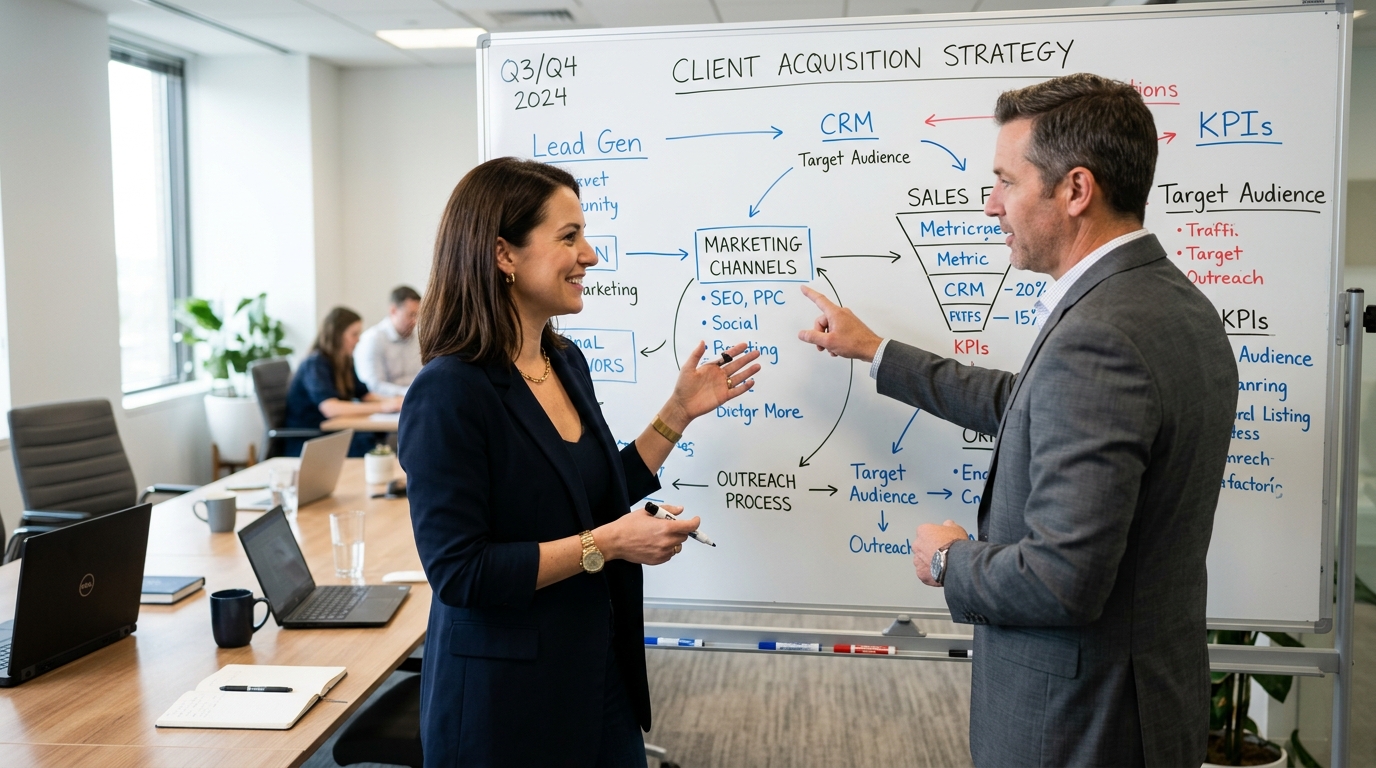
7 Proven Client Acquisition Strategies for Small Business
With the framework established, here are the seven most effective client acquisition strategies for small business owners — each proven across service industries and designed to integrate into a unified acquisition system — ranked by scalability, cost-efficiency, and proven ROI across service-based industries.
1. Content Marketing and SEO
Of all the client acquisition strategies in this playbook, organic search delivers the highest long-term ROI for most small businesses — operating on a 12–24 month time horizon but compounding indefinitely. When a prospect types “CRM software for real estate agents” or “email marketing automation for dentists” into Google, they are raising their hand at the exact moment of highest purchase intent.
Content-driven SEO works by creating authoritative, keyword-optimized articles, guides, and resource pages that rank for the searches your ideal clients are actively conducting. Each piece of content becomes a permanent traffic asset that compounds over time — unlike paid advertising, which stops the moment you stop paying.
The key is targeting long-tail keywords with clear commercial intent and backing each article with real data, expert positioning, and internal links to your core service pages. Businesses that publish 11 or more posts per month generate nearly 3 times more organic traffic than those publishing fewer than four, according to HubSpot Research.
2. Referral Programs and Word-of-Mouth
Referrals are the highest-converting client acquisition strategy in existence — prospects referred by existing clients convert at rates 3–5 times higher than cold traffic and churn at roughly half the rate. The problem is that most businesses leave referrals entirely to chance.
A structured referral program systematizes what happens naturally. Define your referral incentive (cash credit, service upgrade, gift card), build a simple process for clients to share your information, and create touchpoints in your client lifecycle that prompt referral conversations at peak satisfaction moments — immediately after a win, milestone delivery, or positive outcome.
Automate the tracking and fulfillment so referrals are acknowledged quickly and consistently. A client who refers and sees immediate, professional follow-through will refer again. One who receives silence will stop.
3. Outbound Sales and Cold Outreach
Outbound client acquisition gives you immediate control over pipeline volume in a way that inbound channels cannot. When you need 10 new clients in the next 60 days, outbound is your lever.
Effective outbound in 2026 is not blast email. It’s a hyper-personalized, multi-touch sequence that combines email, LinkedIn connection, and voicemail — delivered to a tightly filtered prospect list that matches your ICP exactly. The message leads with a specific insight about the prospect’s situation, not a generic pitch about your services.
Build your outbound sequence around 5–7 touches over 10–14 days. Track open rates, reply rates, and meeting conversion rates by sequence step to identify exactly where prospects are disengaging, then optimize that specific touchpoint.
4. Strategic Partnerships and Co-Marketing
A strategic partnership places you in front of an established audience that already trusts the partner. When a complementary business recommends your services — an accounting firm referring clients to your CRM software, a web designer referring clients to your marketing automation platform — you inherit their credibility.
Identify 5–10 businesses that serve your exact ICP but do not compete with you. Build a mutual referral agreement: you promote their services to your audience, they promote yours. Sweeten the arrangement with a revenue share, co-branded content, or exclusive offer for their clients.
Joint webinars, co-authored guides, and shared lead magnets allow both partners to build their lists simultaneously while delivering genuine value to the shared audience.
5. Social Media and Paid Advertising
Paid social advertising offers speed that organic channels cannot match — you can have a qualified lead in your CRM within 24 hours of launching a campaign. For small businesses, Meta Ads and LinkedIn Ads offer the best targeting precision against defined audience profiles.
The leverage point in paid client acquisition is the offer, not the ad creative. A compelling lead magnet (checklist, ROI calculator, free audit, mini-course) that solves a specific, high-urgency problem for your ICP will outperform a generic “book a demo” offer by 5–10x in lead volume. Capture the lead, nurture with email, and convert with a personalized consultation.
Set a clear cost-per-lead target before launching. If your average client is worth $5,000 and you close 1 in 5 qualified leads, you can afford to spend up to $200 per qualified lead and still acquire clients profitably.
6. Email Marketing and Lead Nurturing
Email remains one of the highest-ROI digital marketing channels — generating an average return of $36–42 for every $1 spent, according to multiple industry benchmarks. The key is building a list of permission-based subscribers and delivering genuine value before asking for the sale.
A lead nurturing email sequence does the selling work between a prospect’s first contact and their buying decision. According to HubSpot Research, businesses that use lead nurturing generate 50% more sales-ready leads at 33% lower cost than non-nurturing businesses — a decisive advantage for resource-constrained small business operators.
Structure your nurture sequence around the prospect’s buying journey: awareness content in emails 1–3, consideration content in emails 4–6, and decision-stage content in emails 7–10. Personalize each email based on behavioral signals — what pages they visited, what content they downloaded, what stage of your funnel they’re in.
7. CRM Automation and AI-Powered Acquisition
The most scalable client acquisition systems are the ones that run without requiring constant manual input from your team. CRM automation and AI-powered follow-up sequences allow you to engage dozens or hundreds of prospects simultaneously — at the right time, with the right message, without dropping a single ball.
McKinsey & Company research shows that companies using AI in sales and marketing see up to 50% higher lead conversion rates and dramatically reduced time spent on manual follow-up tasks. An automated pipeline ensures every new lead receives an immediate response, a structured nurture sequence, and timely follow-up reminders — all without human intervention at each step.
This is precisely where Automated Sales Machine delivers the highest leverage: a unified CRM and automation platform that replaces your fragmented tech stack with a single system that handles lead capture, pipeline management, automated follow-up, and appointment booking across every acquisition channel you use.

How to Measure Client Acquisition Performance
The businesses that consistently win at client acquisition are the ones that measure the right things. Without data, you’re flying blind — unable to identify which channels are generating ROI and which are burning budget with nothing to show for it.
The 4 Metrics That Actually Matter
- Client Acquisition Cost (CAC): The total cost — marketing spend, sales team time, software — to acquire one new client. Lower is better, but context matters: a $2,000 CAC is excellent if your client LTV is $20,000 and terrible if it’s $2,500.
- Lead-to-Client Conversion Rate: The percentage of qualified leads that convert to paying clients. Industry benchmarks vary widely, but most B2B service businesses operate in the 10–30% range for qualified leads. Track this by channel to identify which sources deliver your highest-converting leads.
- Time-to-Close: The average number of days from first contact to signed contract. Shorter is better — longer cycles create cash flow risk and increase the probability of prospects going with a faster-moving competitor.
- Client Lifetime Value (LTV): The total revenue a client generates over the full duration of the relationship. LTV is the denominator that makes all other acquisition metrics meaningful — a high LTV justifies a higher CAC investment.
Calculating Your Client Acquisition Cost (CAC)
The CAC formula is straightforward: divide your total sales and marketing spend in a given period by the number of new clients acquired in that same period.
CAC = Total Sales + Marketing Spend ÷ Number of New Clients Acquired
If you spent $10,000 on marketing and sales in Q1 and acquired 20 new clients, your CAC is $500. The strategic question then becomes: what is the average LTV of those clients? If LTV is $5,000, your LTV:CAC ratio is 10:1 — excellent. If LTV is $600, you have a margin problem that no marketing tactic can solve.
Track CAC by channel, not just in aggregate. Your content marketing CAC may be $150 while your paid advertising CAC is $800. That data tells you exactly where to allocate the next dollar of budget.
Client Acquisition vs. Client Retention: Where to Focus
This is one of the most common strategic debates among small business owners: should you prioritize bringing in new clients, or doubling down on keeping the ones you already have?
The honest answer is both — but in proportion to your current business stage. Early-stage businesses with thin client bases need aggressive acquisition to build momentum. Established businesses with high churn rates need retention work urgently, because acquiring new clients to replace churning ones is financially inefficient.
According to McKinsey & Company, personalization and proactive client engagement — the two core drivers of retention — generate 40% more revenue compared to businesses that treat all clients with uniform, reactive communication. The implication is clear: retention isn’t just about keeping revenue you have, it’s a growth lever in its own right.
The practical framework is this: if your monthly churn rate exceeds 5%, retention becomes a prerequisite for sustainable acquisition investment. Fix the leaky bucket before you pour more water in. Once churn is under control, acquisition spend produces compounding returns as your installed base grows and generates referrals.
How to Scale Your Client Acquisition With Automation
The ceiling on manual client acquisition is the number of hours in your team’s day. Automation removes that ceiling.
A well-built client acquisition automation stack captures leads from every channel (website forms, social media, referral submissions, advertising), routes each lead to the appropriate nurture sequence based on source and behavior, and automatically scores and prioritizes follow-up based on engagement signals.
When a prospect visits your pricing page three times in two days, your CRM should know — and it should automatically trigger a task for your sales team to reach out within the hour. When a lead goes cold for 14 days, your system should automatically send a re-engagement message. When a client anniversary hits, a relationship-building check-in should go out without anyone on your team lifting a finger.
This is not theoretical. Gartner research confirms that 80% of B2B sales interactions will occur in digital channels — meaning the businesses with the most responsive, intelligent digital follow-up systems will win the most clients, regardless of the quality of their sales team’s manual outreach.
The key components of a scalable client acquisition automation system include:
- Unified CRM: A single database that tracks every prospect and client interaction across all channels
- Automated lead capture: Web forms, chatbots, and landing pages that feed directly into your CRM without manual entry
- Multi-channel nurture sequences: Email, SMS, and voicemail drops that deliver timed, personalized messages based on lead behavior
- Appointment booking automation: Self-serve scheduling links that allow prospects to book calls without the back-and-forth email chain
- Pipeline reporting: Real-time dashboards that show exactly where each prospect is in your acquisition funnel at any given moment
Automated Sales Machine delivers all five components in a single platform — eliminating the 5–7 disconnected tools most small businesses are currently paying for and running through a system that books appointments and nurtures leads even while your team sleeps.
Start Building Your Client Acquisition System Today
The businesses winning the most clients in competitive markets are not necessarily the best at what they do — they’re the best at systematically finding, nurturing, and closing the right clients. Effective client acquisition strategies are the engine that drives predictable, scalable revenue growth. The ones who commit to building these systems — and automate the repetitive execution — compound their growth advantage with every passing quarter, and the right automation platform makes that engine run without requiring constant manual fuel.
If you’re ready to replace the referral roller coaster with a proven, automated client acquisition system, see exactly how Automated Sales Machine helps small businesses add 20–40 new clients per month without adding headcount. Book your free Automated Sales Machine demo today and get a custom growth plan built for your business in 30 minutes.