


WhatCable — Know what your USB-C cable can really do As a usb-c cable speed checker mac, it addresses a growing need among small business owners.
239 upvotes · #4 Product of the Day — View on Product Hunt
You plug your MacBook into what looks like a perfectly good USB-C cable and walk away. An hour later, the battery has barely moved. No error message. No warning. Just a slow trickle of power and no explanation. If that scenario sounds familiar, you are not alone — and the problem is almost never your charger. It is the cable. The WhatCable app is built around one insight: most Mac users have no reliable way to know what their USB-C cables are actually capable of. As a quick cable diagnostics tool users can run directly from the menu bar, it surfaces the data that was always buried in hardware handshakes and makes it readable to anyone.
Topics: Hardware, Menu Bar Apps, Apple
USB-C Cable Speed Checker Mac: What WhatCable Shows You
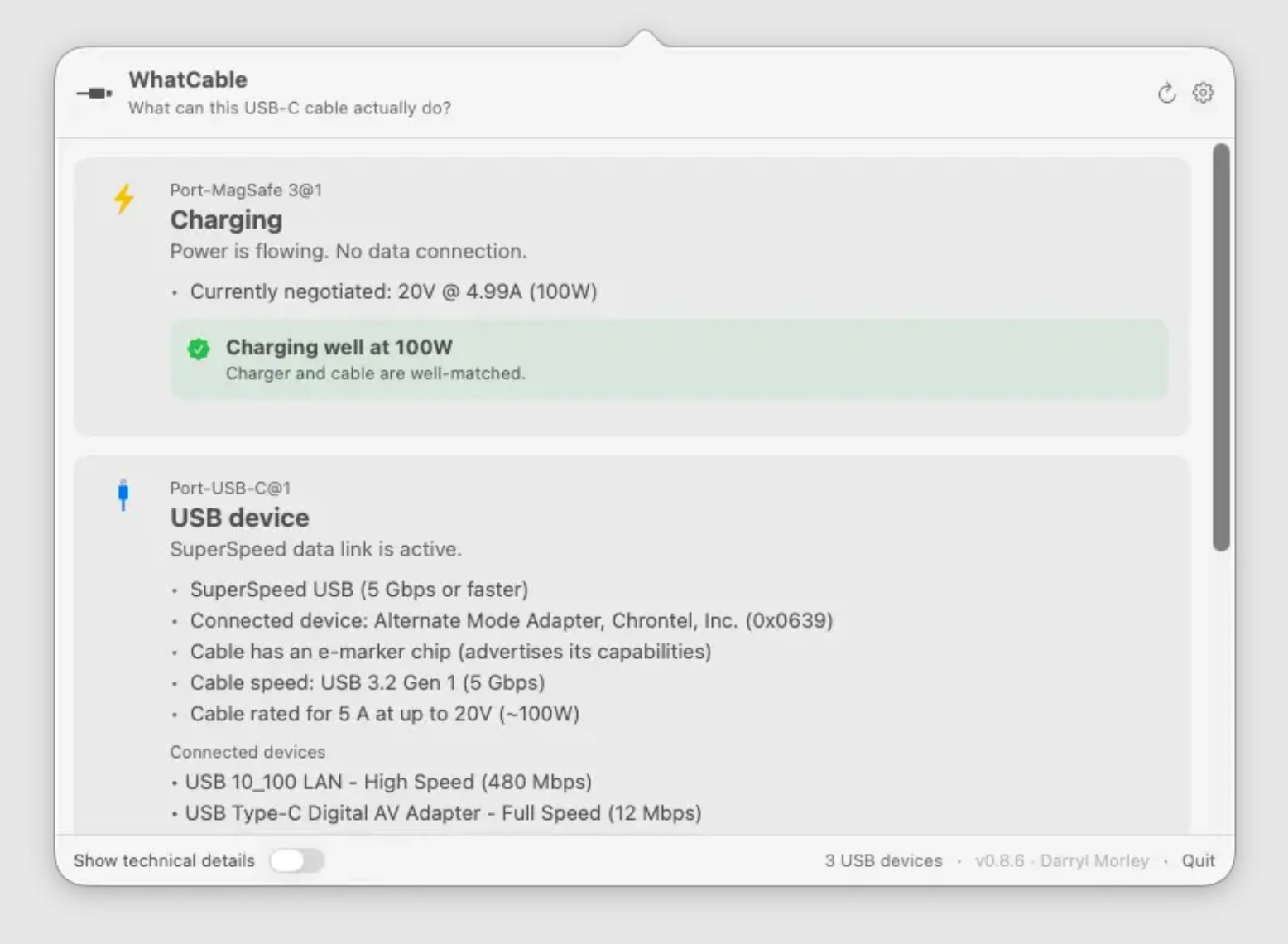
WhatCable reads the e-marker chip embedded in compliant USB-C cables and translates its output into plain English. An e-marker is a small integrated circuit that stores information about what a cable can handle — maximum wattage, data transfer speed, and whether it supports protocols like USB 3.2, Thunderbolt, or USB4.
Once you connect a cable and open WhatCable from the menu bar, you see three categories of information. First, charging power: the app reports the maximum wattage the cable supports, so you immediately know whether a cable is rated for 60W, 100W, or something lower. Second, data speed: it shows the transfer protocol and throughput ceiling, distinguishing between a basic USB 2.0 cable (480 Mbps) and a Thunderbolt 4 cable (40 Gbps). Third, e-marker presence and details: if the cable carries an e-marker, WhatCable reads it and reports what is stored there.
The tagline is an accurate summary. WhatCable gives results without requiring a terminal command, XML parsing, or any third-party driver.

Who Needs This
The most immediate audience is anyone who owns more than two or three USB-C cables. That includes remote workers who have accumulated cables from laptops, phones, external drives, and docking stations over several years. It also includes small business owners who outfit a shared workspace and need to know which cables are safe to use with a new MacBook Pro or a USB4 external SSD.
As a quick usb-c diagnostics tool in the menu bar, WhatCable fits naturally into a workflow where you just need a quick answer. You plug in the cable, glance at the menu bar, and move on. For a small business owner evaluating gear purchases or troubleshooting a slow workstation, that kind of instant clarity has real operational value.
Pricing
WhatCable is free on the Mac App Store. There is no subscription, no freemium tier, and no in-app purchase mentioned at launch. For a utility this focused, free is the right price. You can install it, check every cable in your drawer, and uninstall it if you want. There is no financial commitment attached to finding out whether your favorite cable is actually a USB 2.0 impostor.
How It Compares
WattsConnected is the closest competitor on macOS. It is free and shows wattage for USB-C and MagSafe connections. However, it does not report data transfer speeds or e-marker details. If your primary concern is slow charging, WattsConnected gives you a number. If you also want to know why your external drive is underperforming, it does not help.
USB Connection Information goes deeper on Power Delivery profiles and vendor identifiers. The output is aimed at users who already know what PD profiles mean. WhatCable is more accessible to a non-technical audience, which is a meaningful distinction for the small business market.
ChargerLAB POWER-Z KM003C is a dedicated hardware tester in the $50–80 range. It works without a Mac and is more thorough, but it also requires carrying an additional piece of equipment and spending money upfront. For most small business owners, a free usb-c cable speed checker mac app is a more practical starting point.
Pros and Cons
- Pro: Free with no subscription or upsell
- Pro: Lives in the menu bar — low friction, always accessible
- Pro: Reads e-marker data and reports it in plain English
- Pro: Shows both charging wattage and data transfer speed in one view
- Pro: No technical background required to interpret results
- Con: Mac-only — no Windows or Linux support
- Con: Requires a physical cable connection to read data; cannot pre-screen cables in bulk
- Con: Reports rated specifications from the e-marker, not actual throughput under load
- Con: Cables without e-markers return limited information
Verdict
WhatCable does one thing and explains it clearly. It is a tool users can deploy in under a minute at no cost, and it surfaces information that was previously inaccessible without hardware tools or command-line utilities. For remote workers and small business owners managing a mix of cables across multiple devices and docking setups, that is genuinely useful.
It is not a replacement for a hardware tester if you need protocol-level diagnostics. But as a first-line usb-c cable speed checker mac tool for diagnosing slow charging and unexpected data transfer limits, it fills a real gap in a category where the alternatives either cost money, require technical knowledge, or do less. If you have a drawer of USB-C cables and any uncertainty about what they actually do, WhatCable is worth the five minutes it takes to install and run.
Frequently Asked Questions
Does WhatCable work with all USB-C cables, including third-party and older cables?
WhatCable reads the e-marker chip present in compliant USB-C cables. Cables that carry an e-marker — typically those rated for 60W or higher, or those supporting high-speed data protocols — will return full details. Older or cheaper cables that lack an e-marker will still be recognized, but the app will report that no e-marker is present. That result is itself informative: a cable without an e-marker cannot be verified for high-wattage charging or fast data transfer.
Is WhatCable a reliable usb-c cable speed checker mac users can trust for purchasing decisions?
WhatCable reports what the e-marker chip says about a cable’s capabilities. This is the same data your Mac uses when negotiating charging and data protocols. However, the app reports rated specifications, not measured performance under load. For most everyday troubleshooting, the e-marker data is accurate and actionable. For high-stakes purchasing validation, pairing WhatCable’s output with a hardware tester gives a more complete picture.
How does WhatCable differ from simply checking the USB-C symbol or cable packaging?
Cable packaging and physical markings are notoriously unreliable. USB-C is a connector shape, not a performance standard. Logos and labels on packaging are not verified by any enforcement mechanism at the point of sale. WhatCable reads the actual e-marker data embedded in the cable hardware, which is the same information your Mac’s operating system uses when deciding how to charge and transfer data — making it a far more reliable signal than printed claims.
Check out WhatCable on Product Hunt or visit the official WhatCable website to learn more.